AI content will vastly exceed all human content
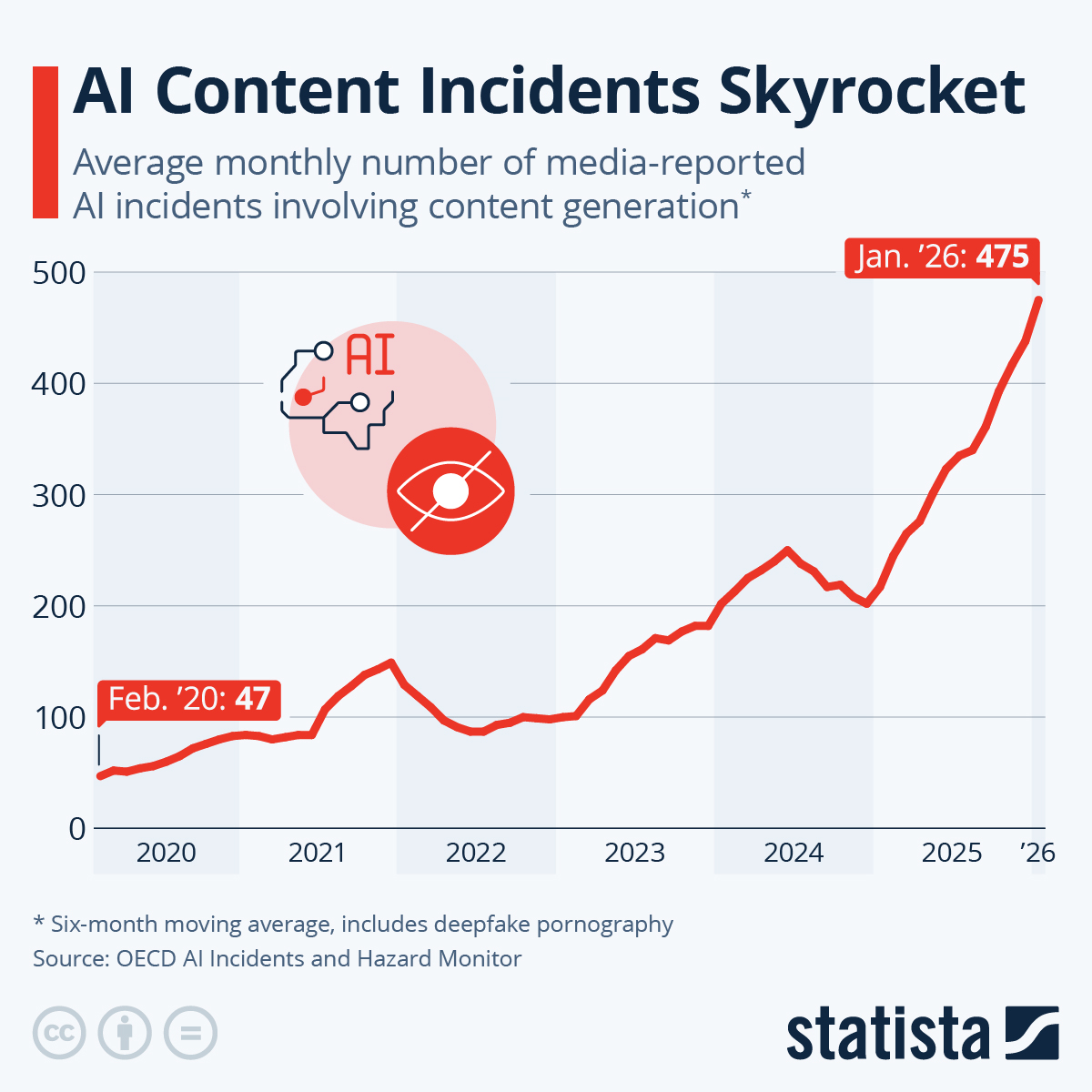
This Statista infographic (sourcing OECD’s AI Incidents and Hazard Monitor) charts the average monthly number of media‑reported AI content incidents from 2020 through Jan 2026, showing a steep exponential rise (47 in Feb 2020 → 475 in Jan 2026). The sharp upward trend illustrates the rapid proliferation of AI‑generated content and supports the claim that AI content volume is accelerating toward—and could surpass—human‑created content.
Source: Statista
Research Brief
What our analysis found
The claim that AI content will vastly exceed all human content has become one of the most debated assertions in the tech world — and recent data suggests the shift is already underway, though the full picture is more complicated than a single tweet can capture. A Graphite SEO analysis of 65,000 English-language article URLs from Common Crawl found that AI-written articles briefly surpassed human-written ones in late 2024, with approximately 52% of new articles classified as AI-generated by May 2025. Meanwhile, an Ahrefs study of roughly 900,000 web pages published in April 2025 found that 74% included AI-generated content, though the firm emphasized that most of those pages were hybrid human-AI collaborations rather than purely machine-authored.
High-end forecasts have been even more dramatic. A widely cited Europol Innovation Lab report from 2022 referenced expert scenarios suggesting that as much as 90% of online content could be synthetically generated by 2026. The International AI Safety Report, published on 3 February 2026, documented rapidly rising volumes of AI-generated text and multimodal outputs and warned that such content has become increasingly difficult to distinguish from human work — with one study finding participants misidentified AI-generated text as human in 77% of cases.
Yet the narrative of inevitable AI dominance comes with significant caveats. Graphite's own data showed that after a brief crossover, AI and human content volumes have hovered at rough parity rather than diverging sharply. And crucially, Graphite found that approximately 86% of Google search results were still human-written, meaning human content continues to dominate the surfaces where visibility and influence matter most. The measurement tools themselves also carry limitations, relying on AI detectors with non-trivial error rates and web crawls that miss paywalled or login-protected content.
Fact Check
Evidence from both sides
Supporting Evidence
AI-written articles crossed the 50% threshold
A Graphite analysis of 65,000 article URLs from Common Crawl found that AI-generated articles briefly surpassed human-written ones in late 2024 and reached approximately 52% of new articles by May 2025, as reported by Axios in October 2025.
Nearly three-quarters of new web pages include AI content
An Ahrefs study of roughly 900,000 web pages published in April 2025 found that 74% included AI-generated content, indicating that AI generation is already a majority presence in newly published pages.
Law enforcement agencies project synthetic content dominance
A Europol Innovation Lab report cited expert scenarios estimating that as much as 90% of online content could be synthetically generated by 2026, a figure that has been widely referenced by organizations assessing the trajectory of AI content.
AI content is already dominant in specific platform verticals
Analyses reported by Wired found that a majority of certain platform content, such as long-form LinkedIn posts in sampled data, were likely AI-generated, showing that in some verticals AI content has already overtaken human output.
Humans struggle to detect AI content
The International AI Safety Report summarized studies showing humans misidentified AI-generated text as human-written in 77% of cases, and audio deepfakes were mistaken for real speakers roughly 80% of the time, suggesting AI content can proliferate undetected at massive scale.
Contradicting Evidence
Growth has plateaued near parity, not surged past it
Graphite's own reporting and the Axios summary noted that after briefly surpassing human-written content in late 2024, AI-generated articles settled back to roughly equal levels with human output by mid-2025, contradicting the idea of a vast and growing gap.
Most AI-involved content is hybrid, not purely machine-made
Ahrefs found that while 74% of sampled pages included AI-generated content, the share of purely AI-authored pages was far lower — only about 2–4% in some breakdowns — meaning the majority of content still involves meaningful human contribution.
Human content still dominates high-visibility search results
Graphite reported that approximately 86% of Google search results were human-written, and AI-generated articles were less likely to rank well, indicating that even if raw volume tilts toward AI, the most-seen and most-influential content remains human-authored.
Measurement tools have significant limitations
The major studies rely on AI detectors such as Surfer, Ahrefs, and Originality.AI, all of which have non-trivial false-positive and false-negative rates, and on web crawls like Common Crawl that exclude paywalled, login-protected, and non-HTML content, making confident volume comparisons difficult.
Adoption is rapid but highly uneven across domains
The International AI Safety Report described AI content adoption as rapid but highly uneven, suggesting that while certain categories and platforms may see AI dominance, broad claims about all content being exceeded oversimplify a varied landscape.
Report an Issue
Found something wrong with this article? Let us know and we'll look into it.