The vast data centers that power artificial intelligence guzzle huge amounts of energy but they also have another alarming impact, according to new research. They are creating “heat islands,” warming the land around them by up to 16 degrees Fahrenheit, and making life hotter for more than 340 million people. https://t.co/BwiDK2wSeo
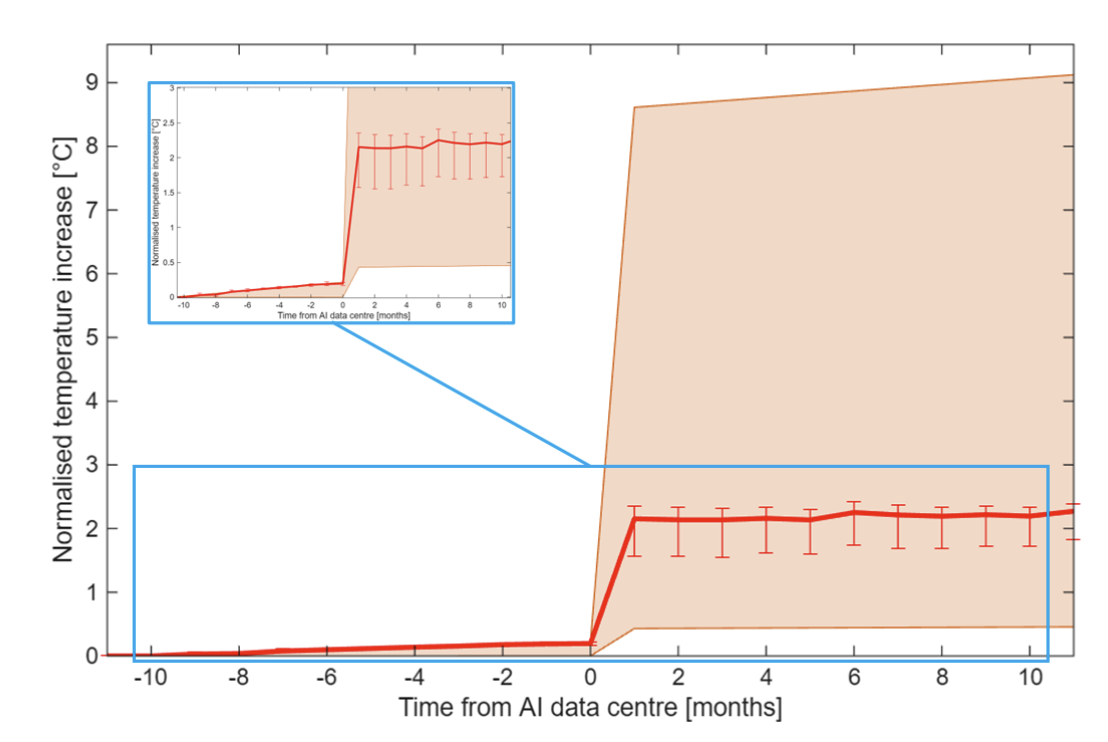
Figure from the paper showing normalized land‑surface temperature change vs. time centered on the month a data centre began operations: it shows a clear step rise to an average ~2°C increase after commissioning and extreme cases approaching ~9°C (≈16°F). This directly visualizes the paper’s “data heat island” result and supports the tweet’s claim about localized warming around AI data centres and the potential population exposure.
Source: arXiv (preprint: Marinoni et al., 2026) — figure reproduced on andymasley.com
Research Brief
What our analysis found
A sweeping new preprint posted to arXiv on March 21, 2026, by Andrea Marinoni and colleagues, claims that data centers — particularly those powering artificial intelligence — are creating localized "data heat islands" that warm the surrounding land by an average of approximately 2.0°C (about 3.6°F), with extreme spikes reaching up to 9.1°C (roughly 16°F) at some sites. The study analyzed MODIS satellite land-surface temperature data spanning 2004 to 2024 across thousands of global data center locations, comparing temperatures before and after facilities began operating. The authors further estimate that more than 340 million people live within the study's defined radius of influence and are therefore potentially exposed to elevated temperatures.
The findings spread rapidly through media outlets and social channels in late March 2026, with the headline numbers — especially the 16°F spike and the 340 million affected people — drawing significant attention. However, the paper is a preprint that has not yet undergone peer review, and several researchers and commentators quickly raised serious methodological concerns. Chief among them is whether the satellite measurements are detecting genuine waste-heat warming from data center operations or simply registering the well-known effect of replacing vegetation with buildings, asphalt, and other impervious surfaces — a distinction with major implications for how alarming the findings truly are.
The debate highlights a broader tension in climate and technology discourse: data centers unquestionably consume enormous amounts of energy, and their environmental footprint is a legitimate concern. But accurately quantifying their thermal impact on nearby communities requires carefully disentangling land-cover changes from operational heat emissions — a step critics say this preprint has not convincingly accomplished.
Fact Check
Evidence from both sides
Supporting Evidence
The preprint provides specific, data-backed estimates
The arXiv paper by Marinoni et al. reports a mean post-operation increase in satellite-derived land-surface temperature of approximately +2.0°C (3.6°F) on average, with extreme values reaching +9.1°C (~16°F) at certain sites, directly supporting the tweet's "up to 16 degrees Fahrenheit" claim (source: arxiv.org/abs/2603.20897).
The 340 million population exposure figure comes from the study itself
The preprint's abstract explicitly states that more than 340 million people live within the study's defined radius of influence around analyzed data center sites, which is the basis for the tweet's claim about the number of people affected (source: arxiv.org/abs/2603.20897).
Measurable temperature anomalies were detected several kilometers from sites
The study reports a detectable land-surface temperature anomaly extending up to approximately 10 km from data center locations, with a roughly 1°C signal still measurable at about 4.5 km in some analyses, suggesting the thermal footprint is not confined to the facility itself (source: gist.science summary of preprint).
Multiple media outlets and aggregators independently reproduced the key numbers
News digests including MorningOverview, Gist.science, and ResearchTrend all reported the same headline figures from the preprint in late March 2026, showing consistent transmission of the study's core claims across multiple platforms (sources: morningoverview.com, gist.science).
Contradicting Evidence
Satellite surface temperature is not the same as the air temperature people actually feel
MODIS measures land-surface radiative temperature — the temperature of rooftops, pavement, and ground — not the ambient 2-meter air temperature that humans experience. These two measurements can differ substantially depending on season, surface type, and atmospheric conditions, meaning the reported temperature increases may significantly overstate the warming that nearby residents would actually perceive (source: validated in remote-sensing literature, e.g., tc.copernicus.org).
The temperature signal likely reflects land-cover change, not waste heat from operations
A detailed critique by researcher Andy Masley (March 31,
argues that replacing vegetation with buildings, parking lots, and impervious surfaces would cause satellite LST to spike regardless of whether the facility emits any waste heat
His order-of-magnitude energy calculations suggest that actual waste heat from data center operations can plausibly account for only a tiny fraction of the observed LST increases (source: andymasley.com).
Counting everyone within 10 km as "affected" inflates the population figure
The study's 340 million figure counts all people living within the radius of influence around thousands of data centers globally, but critics note this does not mean all those people experience meaningful temperature changes in their daily lives — especially given the LST-versus-air-temperature gap and the rapid decay of any real thermal signal with distance (source: andymasley.com).
The paper has not been peer reviewed
The study is an arXiv preprint submitted on March 21, 2026, and had not undergone formal peer review at the time media coverage and the tweet circulated, meaning its methods and conclusions have not yet been independently validated by subject-matter experts through the standard scientific review process (source: arxiv.org/abs/2603.20897).
The study does not clearly distinguish AI data centers from conventional ones
Online discussion and expert commentary noted that the dataset likely includes a broad mix of data center types and ages, many of which are not AI-specific hyperscale facilities, complicating the tweet's framing that artificial intelligence is specifically responsible for the observed warming effect (source: community discussion, andymasley.com).
Report an Issue
Found something wrong with this article? Let us know and we'll look into it.