The foundations of global connectivity are advancing, reshaping people, industries, and societies. The latest Huawei Newsletter from MWC 2026 explores how carriers and industries can deliver smarter, more flexible services in the era of AI-centric networks, 5G-A, and U6 GHz.
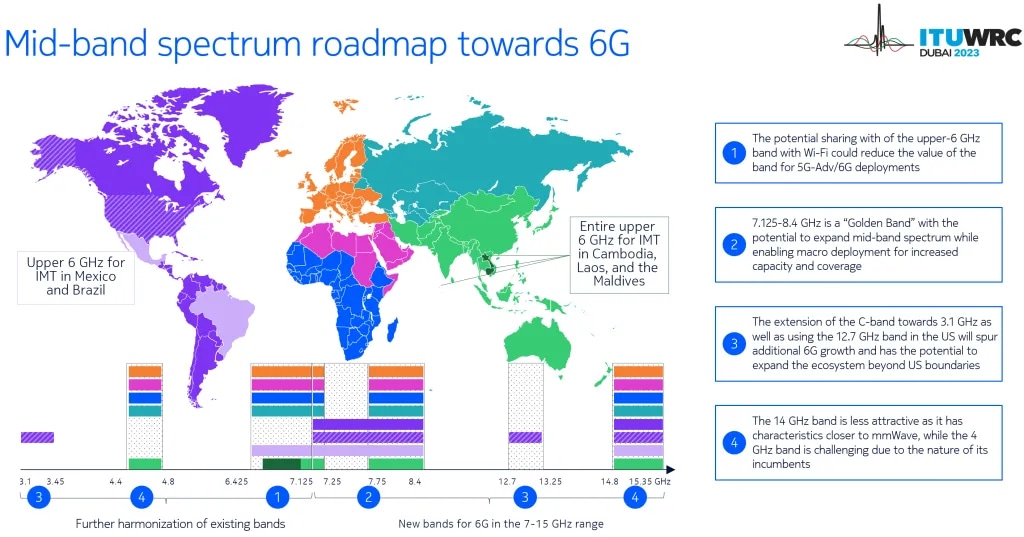
Nokia’s 'Mid-band spectrum roadmap towards 6G' infographic maps regional allocations (including the upper 6 GHz / U6 GHz band) and explains how mid-band spectrum enables 5G‑Advanced and the path toward 6G. This directly supports the Huawei/MWC2026 theme by visualizing the spectrum foundation carriers need to deliver higher-capacity, lower-latency AI‑centric services (5G‑A/U6GHz) and a smoother evolution to 6G.
Source: Nokia
Research Brief
What our analysis found
At MWC Barcelona 2026, Huawei unveiled a sweeping suite of next-generation network products designed to accelerate the transition toward AI-centric mobile broadband and upper-6 GHz (U6 GHz) spectrum utilization. The centerpiece hardware announcement, published on March 1, 2026, featured a 256-TRX U6 GHz Active Antenna Unit (AAU) built on an Extremely Large Antenna Array (ELAA) design integrating more than 1,500 antenna elements. Huawei cited single-user peak downlink rates in the 10 Gbps range and system-level cell traffic targets of up to 100 Tb/s, though trade press observers noted some of these figures reflect lab or demonstration conditions rather than proven live-network baselines.
The vendor also introduced what it calls an "Agentic MBB" framework on March 2, 2026, encompassing a three-layer AI-centric intelligence architecture, a RAN Agent, Adaptive Air interface, and new baseband and radio hardware including the UBBPi series and tri-band UWB MetaAAU. To bolster its 5G-Advanced (5G-A) narrative, Huawei pointed to ecosystem metrics in China: more than 135 5G-A compatible handsets, approximately 170 million units shipped, around 70 million 5G-A users globally, and contiguous 5G-A coverage across 270 Chinese cities, with terminal price points near CNY 2,500.
The announcements land in a broader industry context where rivals Ericsson and Nokia also spotlighted AI-RAN and 5G-A roadmaps at MWC 2026, signaling genuine momentum. However, analysts and regulators caution that U6 GHz spectrum allocation remains country-specific, with coordination and sharing studies still underway in many jurisdictions, meaning the global reach implied by Huawei's vision faces significant regulatory variability.
Fact Check
Evidence from both sides
Supporting Evidence
Official Huawei product launches at MWC 2026
Huawei published a U6 GHz product announcement on March 1, 2026 and an AI-centric Agentic MBB announcement on March 2, 2026, confirming the newsletter content referenced in the tweet (source: huawei.com MWC coverage).
Specific hardware and performance claims documented
The 256-TRX U6 GHz AAU with more than 1,500 antenna elements and single-user peak rates in the 10 Gbps range were detailed in Huawei's official MWC material and reproduced by Mobile World Live in a partner feature during March 2026 (source: mobileworldlive.com).
Independent trade press corroboration
Telecoms.com and Dataconomy both published write-ups on March 2, 2026 describing Huawei's U6 GHz product launch and repeating the key product and performance claims, providing third-party coverage of the announcements (source: telecoms.com, Dataconomy).
Broader industry alignment on AI-centric networks and 5G-A
Ericsson and Nokia issued their own MWC 2026 press releases highlighting AI-RAN and 5G-Advanced collaborations, supporting the tweet's assertion that AI-centric networks and 5G-A are reshaping the industry rather than being a Huawei-only narrative (source: ericsson.com MWC 2026 press release).
Substantial 5G-A ecosystem metrics in China
Huawei reported more than 135 5G-A compatible handsets, approximately 170 million units shipped, around 70 million 5G-A users globally, and contiguous coverage across 270 Chinese cities, lending quantitative weight to the claim of advancing global connectivity (source: mobileworldlive.com partner feature).
Contradicting Evidence
Lab targets versus real-world performance
Telecoms.com noted that Huawei may be "getting a bit ahead of itself" with its U6 GHz presentation, flagging that some of the cited peak rates and cell traffic figures are vendor targets from lab or demo environments rather than proven live-network performance, which tempers the scale of the claims (source: telecoms.com, March 2, 2026).
U6 GHz spectrum availability is not globally assured
Regulatory allocation of upper-6 GHz bands for licensed mobile use varies significantly by country; consultations such as UK Ofcom proceedings show that coordination and sharing studies are still underway, meaning U6 GHz deployment depends on local regulatory outcomes and is far from universally available (source: ofcom.org.uk stakeholder documents).
Ecosystem metrics are heavily China-centric
The impressive deployment figures cited by Huawei, including 270 cities with contiguous 5G-A coverage and 170 million handsets shipped, are drawn almost entirely from China, which may not be representative of global readiness or adoption trajectories in other markets where infrastructure, pricing, and regulatory conditions differ substantially.
Partner feature coverage versus independent analysis
The Mobile World Live summary that widely circulated Huawei's numbers was published as a partner feature, meaning it reproduced the vendor's claims rather than independently verifying them, which is an important distinction when assessing the reliability of the data points.
Report an Issue
Found something wrong with this article? Let us know and we'll look into it.