DDR5 RAM prices have dropped for the first time in several months. Corsair Vengeance 32GB (2x16GB) 6000MHz kits are now available for around 370 dollars on major retailers like Amazon and Newegg, down from previous levels by 40 to 100 dollars in some cases. This decline may be linked to Google's recent TurboQuant announcement, a KV cache compression technique that can reduce AI model memory usage by up to 6 times.
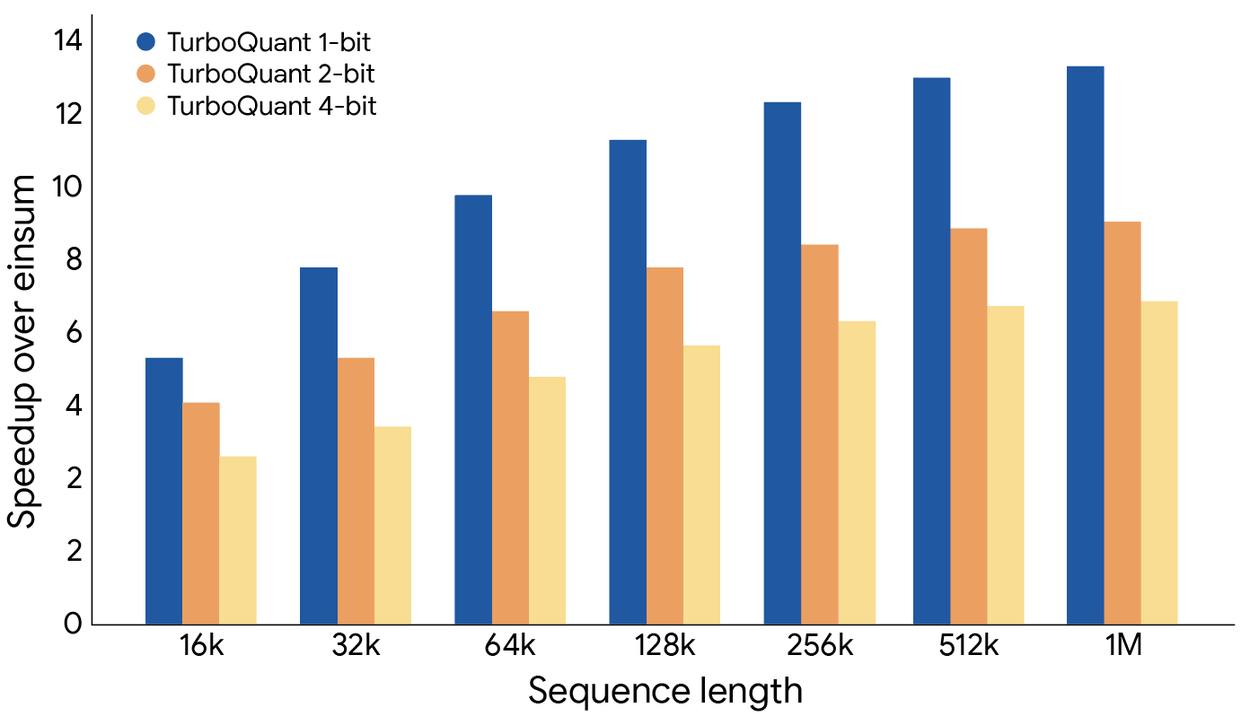
Bar chart from Google Research’s TurboQuant blog showing speedup in computing attention logits across sequence lengths for 1/2/4-bit TurboQuant (up to ~8x). It visualizes TurboQuant’s extreme KV-cache compression and speed gains, supporting the claim that TurboQuant can reduce key‑value cache memory (reported ≈6x) and therefore could plausibly lower near‑term DDR5 demand.
Source: Google Research (research.google/blog)
Research Brief
What our analysis found
DDR5 memory prices have seen their first meaningful retail decline in months, coinciding with a major AI efficiency breakthrough from Google Research. According to Tom's Hardware's price tracker, updated March 27, 2026, the Corsair Vengeance 32GB (2x16GB) DDR5-6000 kit is listed at a best U.S. price of $369 on Amazon, with matching $369.99 listings confirmed at Best Buy, Walmart, and Newegg. European retail data corroborates the trend: Germany's 3DCenter index recorded an approximately 7.2% month-over-month drop in DDR5 retail prices for March 2026, the first clear decline after months of steady increases.
The timing of this price dip closely follows Google Research's publication of TurboQuant on March 24, 2026, a KV cache compression technique that achieves roughly 3-bit quantization of key-value caches, reducing AI model memory requirements by at least 6× in tested workloads and delivering up to ~8× speedup on attention-logit computation on Nvidia H100 GPUs. The announcement sent shockwaves through financial markets, triggering a short-term selloff in major memory stocks including Micron, Samsung, SK Hynix, SanDisk, and Western Digital, as traders reassessed future memory demand projections for AI infrastructure.
However, the relationship between TurboQuant and retail DDR5 pricing is far from straightforward. Industry tracker TrendForce had projected strongly rising contract DRAM and DDR5 prices for Q1 2026, suggesting a notable divergence between wholesale contract markets and retail spot pricing. The consumer DDR5 market and the enterprise HBM/server DRAM market targeted by TurboQuant operate on different supply chains and pricing dynamics, making a direct causal link speculative at best despite the suggestive timing.
Fact Check
Evidence from both sides
Supporting Evidence
Corsair Vengeance DDR5-6000 32GB confirmed near $370 at major retailers
Tom's Hardware's price tracker (updated March 27,
lists the kit at $369 on Amazon, while Best Buy and Walmart product pages show $...
lists the kit at $369 on Amazon, while Best Buy and Walmart product pages show $369.99 listings, and Newegg search results confirm the same price point in late March 2026.
First meaningful DDR5 retail price decline in months verified
Germany's 3DCenter retail price index recorded an approximately 7.2% month-over-month drop in DDR5 prices for March 2026, with multiple tech outlets including Tom's Guide, TechRadar, and Fudzilla characterizing it as the first clear retail dip in several months.
TurboQuant's technical claims match the tweet's description
Google Research's blog post from March 24, 2026 confirms TurboQuant compresses KV caches to approximately 3 bits, reducing KV memory by "at least 6×" in tested workloads, consistent with the tweet's claim of up to 6× memory reduction.
Market sentiment reacted to TurboQuant as a demand threat to memory
Financial outlets including Investing.com, citing Reuters, reported a short-term selloff in memory stocks (Micron, Samsung, SK Hynix, SanDisk, Western Digital) on March 25–26, 2026, directly attributed to trader concerns about reduced future memory demand following the TurboQuant announcement.
Temporal adjacency supports a plausible connection
TurboQuant was published March 24, 2026, and the retail price dip was documented in data from the last week of March 2026, making the timeline consistent with the tweet's suggested link.
Contradicting Evidence
Contract DRAM prices were rising, not falling, in Q1 2026
TrendForce market bulletins from early March 2026 projected strongly rising contract DRAM and DDR5 prices for Q1 2026, indicating a significant divergence between wholesale market fundamentals and the retail price movements cited in the tweet.
TurboQuant targets AI server workloads, not consumer DDR5 demand
The technique compresses KV caches in large language model inference, which primarily affects enterprise HBM and server DRAM consumption rather than consumer desktop DDR5 modules like the Corsair Vengeance kit, making a direct causal link between the two markets questionable.
The $40–$100 price drop claim lacks precise sourcing
While current prices near $370 are confirmed, the tweet's assertion that kits are "down from previous levels by 40 to 100 dollars" is difficult to verify precisely; Tom's Hardware's tracker notes that 32GB DDR5 kits commonly ranged from $100–$200 in October 2025, suggesting earlier prices were actually lower, not higher, complicating the narrative of a straightforward decline.
Correlation does not establish causation on timing alone
The retail DDR5 price dip and TurboQuant announcement occurred within the same week, but no analyst report or industry source has publicly established a direct causal mechanism linking a research paper about AI inference optimization to immediate consumer DDR5 retail pricing changes.
Stock selloff reflects sentiment, not structural demand changes
The memory stock declines following TurboQuant were characterized as a short-term sentiment-driven reaction by traders, not a reflection of actual reduced orders or demand, meaning the market reaction may not translate into sustained retail price pressure.
Report an Issue
Found something wrong with this article? Let us know and we'll look into it.