NATO is testing live cockroaches as AI-powered spy drones. Incredible AI engineering, but also something I kinda wish I hadn't learned about: > Swarm Bio-tactics wired real cockroaches with electronic backpacks containing AI hardware, radios, cameras, and microphones. > Cockroaches are steered by sending electrical signals directly into the insect's nervous system > They can crawl through rubble, tunnels, and spaces where drones can't fly, and troops shouldn't go, transmitting data back the entire time. > Within one year, they went from concept to field-validated systems with paying NATO customers, including the German military. The qualities that make them useful for military recon (small, silent, nearly undetectable) are exactly what make them creepy. ...International laws weren't written with cyborg insects in mind.
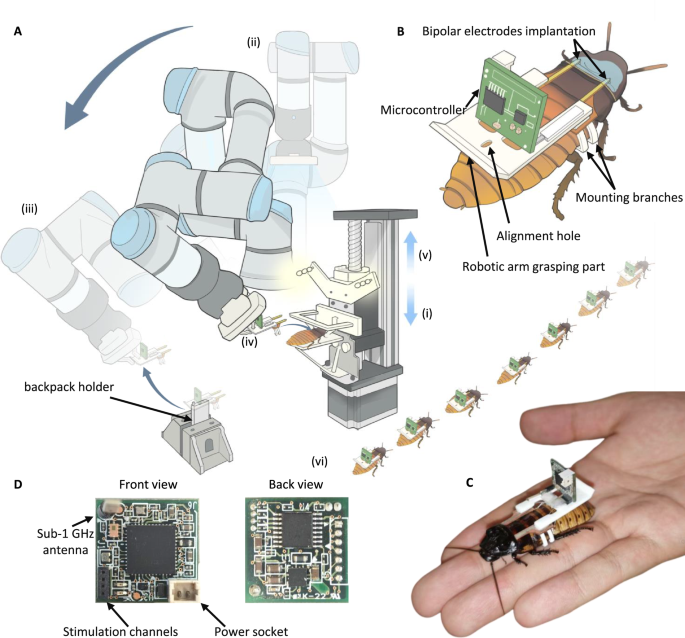
Figure 1 illustrates the insect–computer hybrid robot and the automated assembly setup: a vision‑guided robotic arm mounts a lightweight sensor “backpack” (microcontroller, antenna, power socket, bipolar electrodes and mounting branches) onto a cockroach and implants electrodes into the intersegmental membrane. This diagram directly shows the hardware, placement, and automated production pipeline that underpins the reports about backpacked, remotely‑stimulated cockroaches used for sensing/reconnaissance.
Source: Nature Communications (Nature)
Research Brief
What our analysis found
SWARM Biotactics, a German bio-robotics startup founded in 2024, claims to have developed cyborg cockroach swarms equipped with electronic backpacks containing AI hardware, cameras, microphones, and radios — and says it went from concept to field-validated systems with paying NATO customers, including the German Bundeswehr, in roughly one year. The company raised approximately €10–13 million in seed funding and says it now employs over 40 engineers and scientists. CBS News' 60 Minutes featured the technology on December 14, 2025, showing on-camera demonstrations of backpacked cockroaches being steered via electrical stimulation of their nervous systems.
The underlying science is well-established. A peer-reviewed study published in npj Robotics in 2024 demonstrated an insect-computer hybrid using Madagascar hissing cockroaches fitted with ESP32-CAM cameras and neural stimulation modules, achieving navigation success rates that rose from 6.7% to 73.3% after adding obstacle-avoidance capabilities. The U.S. DARPA HI-MEMS program funded similar insect-cyborg research as far back as the mid-2000s, establishing decades of precedent for the concept.
However, much of the recent reporting about operational NATO deployment traces directly back to SWARM's own LinkedIn posts and CEO statements. Independent confirmation from NATO or the Bundeswehr through official procurement announcements or press releases has not surfaced in the public record. Defense and tech outlets such as ArmyRecognition have amplified the company's claims, but journalists and analysts note that technical challenges around steering reliability, insect habituation, and biological variability remain significant hurdles documented in the academic literature.
Fact Check
Evidence from both sides
Supporting Evidence
Company claims backed by major media coverage
CBS News' 60 Minutes aired a segment on December 14, 2025, featuring SWARM Biotactics' CEO demonstrating backpacked cockroaches with sensors and neural stimulation steering in person.
SWARM's own public statements cite NATO customers
The company's LinkedIn post from February 25–26, 2026, explicitly states it deploys "programmable cyborg insect swarms — field-tested and operational with paying NATO customers" including the Bundeswehr, and claims a team of over 40 engineers and scientists.
Peer-reviewed science validates the core technology
A 2024 study in npj Robotics demonstrated a working cockroach-computer hybrid with an ESP32-CAM camera, wireless communication, and electrical stimulation for navigation, achieving a 73.3% success rate with obstacle avoidance in controlled lab tests.
Defense media and Reuters corroborate Bundeswehr interest
Reuters reported in July 2025 that the Bundeswehr Cyber Innovation Hub was engaged with SWARM Biotactics, and defense outlet ArmyRecognition subsequently reported the company's deployment claims in March 2026.
Longstanding government research precedent
The U.S. DARPA HI-MEMS program in the mid-2000s funded research implanting electronics into insects for sensing and steering, establishing that cyborg insect technology has been pursued at the state level for nearly two decades.
Contradicting Evidence
No independent NATO or Bundeswehr confirmation of purchases
While SWARM claims "paying NATO customers," no official NATO or Bundeswehr procurement announcement or press release confirming operational deployment has appeared in the public record. Reporting largely relies on SWARM's own LinkedIn posts and CEO statements.
Media coverage is largely company-sourced
Defense and tech outlets such as ArmyRecognition reproduced SWARM's claims without independent verification from government sources, meaning the "deployed" framing may overstate the actual status of the technology within military operations.
Significant technical limitations persist in academic literature
Peer-reviewed research documents recurring challenges with insect cyborg systems, including steering reliability, habituation (insects becoming unresponsive to electrical signals over time), and biological variability between individual insects, all of which raise questions about true operational readiness.
Lab success rates highlight the gap to field deployment
The best-documented academic results show a 73.3% navigation success rate under controlled laboratory conditions — a far cry from the near-perfect reliability military operations would demand in unpredictable rubble, tunnels, and combat environments.
The tweet's framing that "NATO is testing" may overstate institutional endorsement
A single startup claiming paying customers within a NATO member's defense apparatus is different from NATO as an alliance formally adopting or testing cyborg insect technology as an official program.
Report an Issue
Found something wrong with this article? Let us know and we'll look into it.