93% of US jobs can be done at least partly by AI, per Forbes
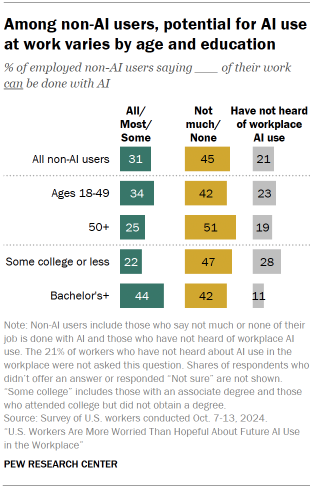
This infographic shows that among U.S. workers who aren’t currently using AI at work, 31% say at least some of their tasks can be done with AI—illustrating partial AI applicability across roles. It supports the tweet’s point by visualizing how many jobs include tasks that AI can perform at least in part.
Source: Pew Research Center
Research Brief
What our analysis found
A viral tweet claims that 93% of U.S. jobs can be done at least partly by AI, attributing the figure to Forbes. The statistic originates from Cognizant's New Work, New World 2026 report, released on January 15, 2026, which reassessed 18,000 tasks across roughly 1,000 occupations in the U.S. O*NET database. Cognizant estimates that up to $4.5 trillion in U.S. labor value is theoretically shiftable to AI-assisted or automated task completion. A Forbes contributor article published on February 25, 2026 did indeed summarize this finding, framing it as task-level exposure rather than full job replacement.
The report's methodology assigns each task a score on a five-point scale from "not automatable" to "fully automatable," weighted by task importance to produce an overall "exposure score." Critically, this score represents a theoretical maximum of what current AI could accomplish under optimal conditions — it does not account for actual adoption rates, workforce acceptance, or regulatory barriers. The acceleration is notable: average exposure scores are now roughly 30% higher than what Cognizant had projected for 2032, and the annual increase in exposure jumped from about 2% in 2023 to approximately 9% in the 2026 refresh.
However, other major analyses paint a considerably less dramatic picture. The IMF estimated in 2024 that about 60% of jobs in advanced economies are affected by AI. An OpenAI and University of Pennsylvania study found that roughly 80% of the U.S. workforce could have at least 10% of their tasks affected, while Goldman Sachs pegged broad exposure at about two-thirds of occupations. The gap between these figures and Cognizant's 93% largely comes down to how low the threshold is set for counting a job as "impacted" — even minimal theoretical exposure to AI on a single task qualifies a job under Cognizant's framework.
Fact Check
Evidence from both sides
Supporting Evidence
Forbes did publish the claim
A Forbes contributor article dated February 25, 2026 summarized Cognizant's finding that "93% of jobs in the USA can be done at least partially by AI" and cited the accompanying $4.5 trillion productivity figure, confirming the tweet's attribution to Forbes.
Cognizant's large-scale methodology underpins the number
The 93% figure comes from Cognizant's New Work, New World 2026 report, which reassessed 18,000 tasks across approximately 1,000 U.S. occupations using O*NET data. The breadth of the analysis lends the statistic a serious empirical foundation, even if the threshold for "impact" is low.
The exposure acceleration is well-documented
Cognizant's data shows a dramatic shift: the share of jobs in the lowest exposure category fell from 31% to just 7%, while the share in the highest exposure category rose from 0% to 30% between the 2023 and 2026 analyses, supporting the claim that AI's reach has expanded rapidly.
Multiple outlets corroborated the finding
Beyond Forbes and Cognizant's own press release, outlets such as Learning News echoed the 93% figure in February 2026, noting that most of the impact is partial or assistive rather than full replacement.
Contradicting Evidence
The 93% measures theoretical ceiling, not real-world impact
Cognizant's "exposure score" explicitly represents the theoretical maximum of what current AI could do under optimal implementation. It does not factor in actual adoption, workforce acceptance, or regulatory clearance, meaning the real-world figure could be substantially lower.
Other major analyses produce far lower estimates
The IMF estimated in 2024 that roughly 60% of jobs in advanced economies are affected by AI. Goldman Sachs placed broad exposure at about two-thirds of U.S. occupations. The OpenAI and University of Pennsylvania study found approximately 80% of the workforce could see at least 10% of tasks affected. All are materially below 93%.
High-risk displacement is a small fraction
The White House Council of Economic Advisers reported in March 2024 that only about 10% of American workers are in jobs "highly vulnerable" to AI-driven displacement, underscoring that broad theoretical exposure does not translate into widespread job loss.
Workers themselves dispute the premise
A Pew Research Center survey fielded in October 2024 found that 45% of U.S. workers who have not used AI at work say "not much or none" of their job can be done with AI, highlighting a significant gap between theoretical exposure models and perceived practical applicability.
No job can yet be fully done by AI
Indeed's CEO stated in March 2025 that as of February 2025, there is no job posting on the platform that AI can perform completely on its own, though roughly two-thirds of postings include skills AI could handle well — reinforcing that partial assistance is very different from replacement.
Report an Issue
Found something wrong with this article? Let us know and we'll look into it.