Big Tech firms are set to spend over $600 billion on data centers this year, driven by AI investment, per Reuters
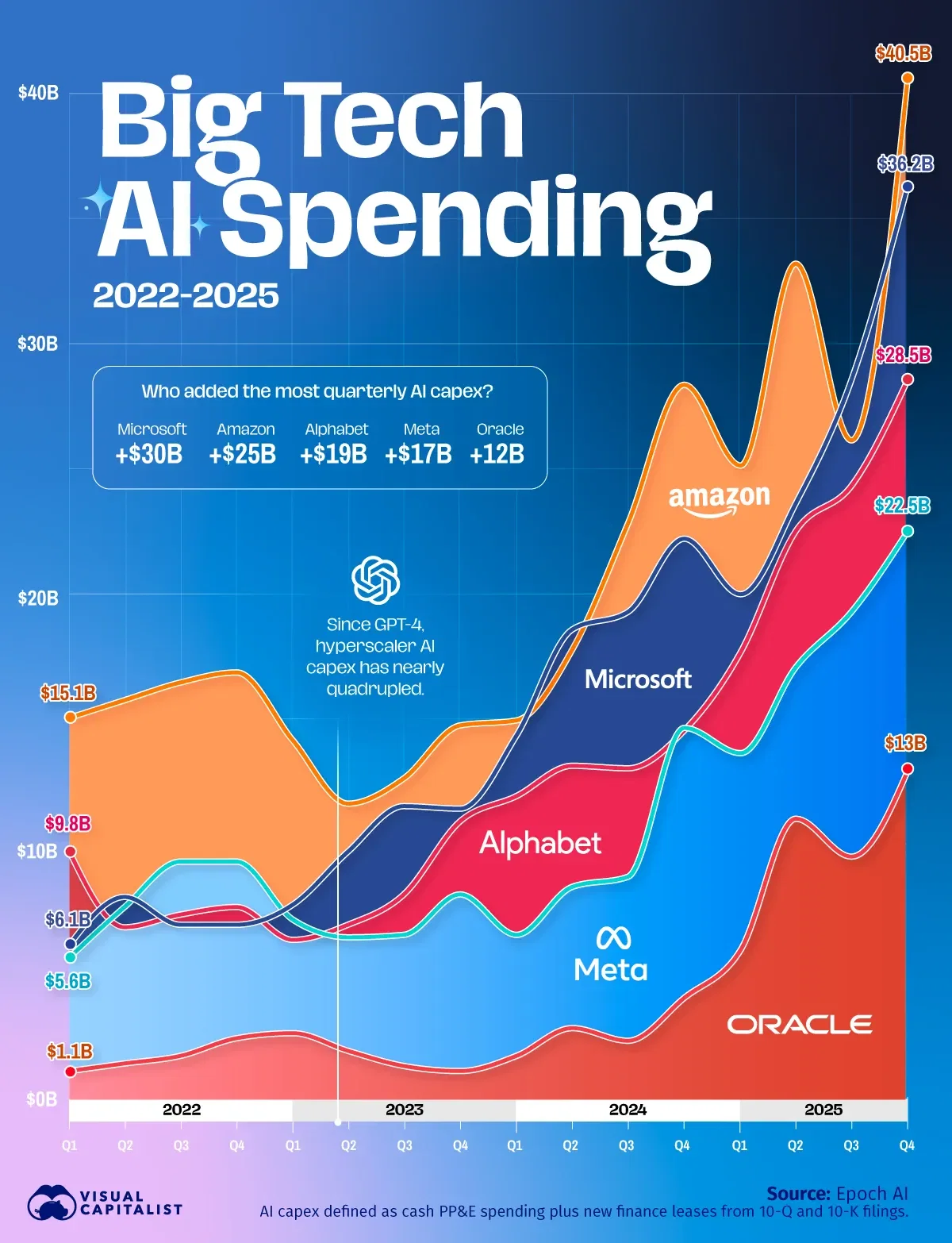
A Visual Capitalist infographic (Apr 20, 2026) that plots quarterly AI-related capital expenditures for Alphabet, Amazon, Meta, Microsoft and Oracle from 2022–2025. It clearly shows the steep surge in hyperscaler capex for AI/data-center buildouts, which provides visual context for Reuters' report that Big Tech spending could top $600+ billion in the current year.
Source: Visual Capitalist (hosted on Voronoi)
Research Brief
What our analysis found
Big Tech's appetite for AI infrastructure has reached unprecedented levels in 2026, with major players collectively committing to spend over $600 billion on data centers this year alone. According to Reuters and corroborating reports from The Futurum Group, the five largest US cloud and AI infrastructure providers — Microsoft, Alphabet, Amazon, Meta, and Oracle — have pledged between $660 billion and $690 billion in capital expenditure for 2026, nearly doubling 2025 levels. Business Insider reports the figure could climb as high as $725 billion when accounting for recent upward revisions from quarterly earnings calls.
Individual company commitments underscore the staggering scale of this investment race. Amazon leads with an estimated $200 billion in projected capex, followed by Alphabet at $175–$190 billion, Microsoft tracking toward $190 billion after recent forecast increases, Meta at $125–$145 billion, and Oracle targeting $50 billion. The vast majority of this spending is directed squarely at AI compute, data center construction, and networking infrastructure. Intellectia AI has described the initiative as the "largest peacetime investment project in human history."
However, the spending spree is not without significant headwinds. Investors have expressed unease about whether these massive outlays will deliver adequate returns, and infrastructure challenges — including multiyear delays for power grid connections, GPU shortages, and construction bottlenecks affecting roughly 40% of US data center projects — threaten to slow the buildout. Meanwhile, Gartner projects total global data center spending will grow 55.8% in 2026, surpassing $788 billion, with AI workloads expected to account for about 70% of data center expansion through 2030.
Fact Check
Evidence from both sides
Supporting Evidence
Reuters reporting confirms the figure
Reuters published reports in late April 2026 indicating that Big Tech AI spending is set to hit approximately $600 billion, driven by the ongoing AI boom, directly substantiating the tweet's attribution.
The Futurum Group corroborates with higher estimates
A February 2026 report found that the five largest US cloud and AI infrastructure providers committed to spending $660–$690 billion on infrastructure in 2026, with the majority earmarked for AI compute and data centers.
Business Insider reports even larger combined totals
An April 29, 2026 report stated that Amazon, Microsoft, Meta, and Google alone plan to spend up to $725 billion in capex for 2026, roughly $100 billion more than earlier projections.
Gartner forecasts massive data center spending growth
The research firm projects data center spending will grow 55.8% in 2026, surpassing $788 billion total, citing sustained momentum in AI infrastructure investment as the primary driver.
Individual company disclosures align with aggregate claims
Publicly announced capex targets from Amazon ($200B), Alphabet ($175–$190B), Microsoft ($190B), Meta ($125–$145B), and Oracle ($50B) collectively sum to figures well above $600 billion.
McKinsey projects $7 trillion in data center investment over five years
Programs.com, citing McKinsey, reported that nearly $7 trillion will be spent on building and upgrading data centers over the next five years, with over $5 trillion driven by AI-specific usage, reinforcing the long-term trajectory behind this year's spending.
Contradicting Evidence
Investor skepticism about return on investment
Despite the enormous capital commitments, several Big Tech stocks experienced dips following capex announcements, reflecting investor concern that heavy spending may not yield immediate profits or could prematurely pull forward future earnings.
Severe power and energy constraints
Data centers face significant challenges securing adequate energy, with many popular markets encountering multiyear delays for new grid connections and some regions imposing outright restrictions on new data center approvals, potentially limiting actual spending deployment.
Construction delays affecting up to 40% of US projects
Rising costs for electricity, equipment, and labor, combined with community opposition and legal hurdles, have left approximately 40% of US data center projects potentially delayed, meaning announced budgets may not translate to completed infrastructure within 2026.
Dangerous revenue concentration risk
A significant share of hyperscaler cloud revenue is tied to a small number of AI model makers, with Microsoft acknowledging that nearly 45% of its cloud revenue over two recent quarters came from OpenAI alone, raising concerns about the sustainability of demand.
Some projects already shelved or paused
Several hyperscalers have pulled back from data center commitments due to economic uncertainty, power limitations, and potential oversupply concerns, suggesting the $600 billion figure represents aspirational targets rather than guaranteed expenditures.
Apple's divergent strategy suggests alternative approaches exist
Apple spent just $4.3 billion in capex during the first half of FY2026, pursuing an edge-AI strategy rather than massive data center buildouts, indicating that not all of Big Tech views centralized AI infrastructure spending as the optimal path forward.
Report an Issue
Found something wrong with this article? Let us know and we'll look into it.