The AI marketing industry is exploding. By 2030, the AI marketing industry is expected to grow to a massive $82 billion in annual revenue. This implies a +25% CAGR from 2025 to 2030, making it one of the fastest growing industries in the world. By 2035, some estimates show that the AI marketing industry could generate over $300 billion in annual revenue. Furthermore, in a recent PwC survey, 88% of executives said they planned to increase AI-related budgets in the next 12 months due to agentic AI. One of the most prominent use cases of agentic AI has been marketing itself. AI is redefining the global marketing industry.
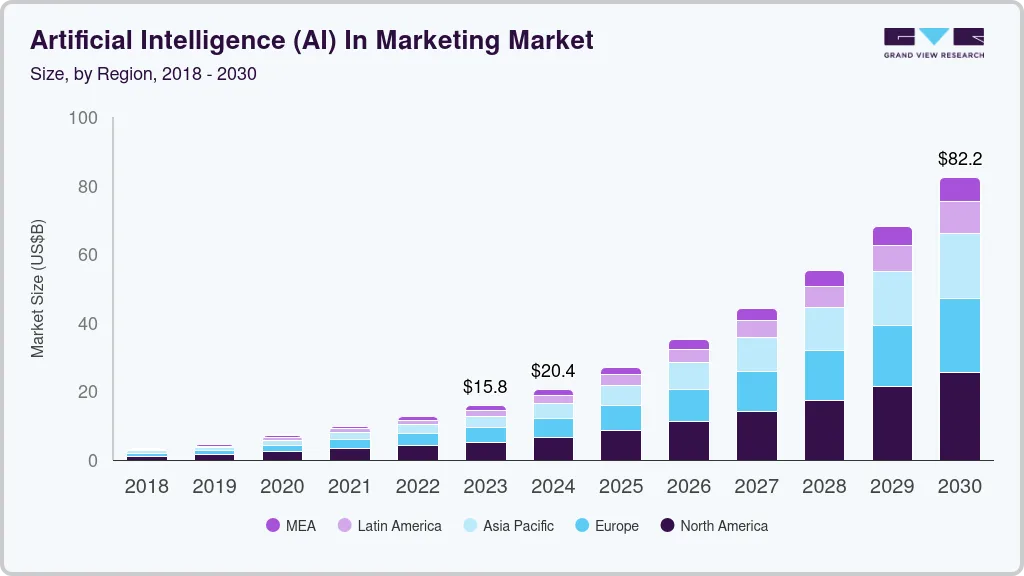
Stacked bar chart showing AI in Marketing market size by region (2018–2030) that visualizes growth from roughly $20.4B (2024) to $82.2B by 2030 (CAGR ≈25% from 2025–2030). It directly supports the claim that the AI marketing industry is rapidly expanding and reaching the ~$82B projection by 2030.
Source: Grand View Research
Research Brief
What our analysis found
The AI marketing industry is on a trajectory that few sectors can match. According to Grand View Research, the global AI in marketing market was valued at approximately $25.83 billion in 2025 and is projected to reach $82.23 billion by 2030, reflecting a compound annual growth rate of 25.0%. Looking further ahead, one estimate places the market at $296.32 billion by 2035, underscoring the enormous runway analysts see for AI-powered marketing tools, from autonomous campaign orchestration to real-time personalization at scale.
Investment sentiment among corporate leaders reinforces these projections. A May 2025 PwC survey found that 88% of US executives plan to increase their AI-related budgets over the next 12 months, with agentic AI cited as the primary catalyst. Over a quarter of those executives plan budget increases of 26% or more. The survey also revealed that 79% of firms have already integrated AI agents into their operations, with 66% reporting measurable productivity gains. More than half of respondents said they intend to expand AI agent use specifically in customer service, sales and marketing, and IT within six months.
However, the explosive headline numbers come with important caveats. Only 35% of companies have broadly implemented AI agents, and just 17% have fully integrated them across nearly all workflows. Barriers including cybersecurity concerns, cost, and interoperability challenges persist, and only 20% of respondents in the PwC survey said they trust AI for financial transactions. Meanwhile, differing market definitions across research firms produce a wide range of projections, with some broader categories like "AI for sales and marketing" forecast to hit as high as $240.58 billion by 2030, suggesting the commonly cited figures depend heavily on how the market is scoped.
Fact Check
Evidence from both sides
Supporting Evidence
$82 billion by 2030 projection confirmed
Grand View Research explicitly projects the global AI in marketing market to reach $82.23 billion by 2030, directly matching the tweet's claim.
25% CAGR verified
The same Grand View Research report confirms a CAGR of 25.0% from 2025 to 2030 for the AI in marketing market, consistent with the tweet's stated growth rate.
Near-$300 billion by 2035 estimate exists
Research estimates the AI in marketing market will reach $296.32 billion by 2035 at a 25.2% CAGR, closely aligning with the tweet's claim of "over $300 billion" though slightly under that threshold.
PwC survey on executive AI budgets confirmed
A May 2025 PwC survey found that 88% of US executives plan to increase AI-related budgets in the next 12 months due to agentic AI adoption, with over a quarter planning increases of 26% or more.
Agentic AI's marketing use case is well-documented
Multiple industry sources highlight agentic AI applications in marketing including autonomous campaign creation, real-time optimization, dynamic content generation, lead scoring, and multi-channel customer engagement.
Rapid current adoption supports "exploding" characterization
The PwC survey found 79% of firms have already integrated AI agents, with 66% reporting measurable productivity gains and more than half planning to expand use in sales and marketing within six months.
Contradicting Evidence
The 2035 figure falls slightly short of "over $300 billion"
The closest research estimate projects $296.32 billion by 2035, which is nearly $4 billion below the tweet's claim of "over $300 billion." While directionally accurate, the tweet rounds up in a way that slightly overstates the finding.
Market definitions vary significantly across research firms
Some reports define a broader "AI for sales and marketing" market projected at $240.58 billion by 2030, while others scope the "AI in marketing" market more narrowly at $78.8-$82.23 billion. The tweet does not clarify which market definition it references, which can be misleading.
Broad AI agent implementation remains limited
Despite high investment intent, only 35% of companies have broadly implemented AI agents and just 17% have fully integrated them into nearly all workflows, suggesting the industry's explosive growth narrative may outpace actual enterprise-wide adoption.
PwC survey was limited to US executives
The tweet references "executives" without geographic qualification, but the PwC survey specifically polled US executives, which may not reflect global executive sentiment.
Trust and organizational barriers persist
Only 20% of respondents trust AI for financial transactions, and firms cite cybersecurity, cost, and difficulty connecting AI agents across applications as significant hurdles to full adoption.
Report an Issue
Found something wrong with this article? Let us know and we'll look into it.