🚨 Do you understand what this man just pulled off.. > a guy from North Carolina used AI to generate hundreds of thousands of songs.. uploaded them to Spotify, Apple Music, Amazon.. then botted billions of streams on his own tracks and walked away with $8 million > 660,000 fake streams per day.. spread across thousands of AI songs so nobody noticed.. $1.2 million a year.. for music no human ever actually listened to real artists are out here grinding for 0.003 cents per stream.. promoting on TikTok.. begging for playlist placements.. and this guy just had AI make the music AND the audience first-ever criminal streaming fraud case.. he's paying back $8 million.. but the playbook is out there now.. and AI just got better since he started the music industry spent 10 years fighting piracy.. now they have to fight songs that don't exist being listened to by people who don't exist.
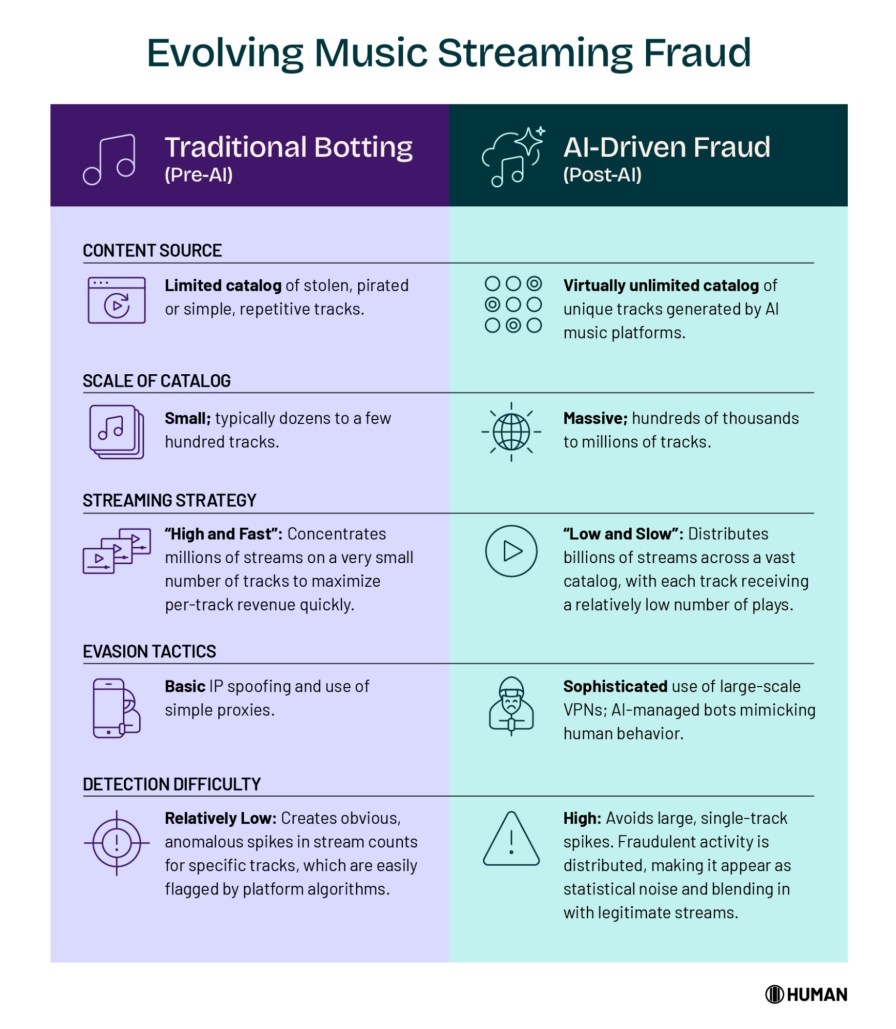
A clear infographic titled “Evolving Music Streaming Fraud” that contrasts Traditional Botting (pre-AI) with AI-Driven Fraud (post-AI) across content source, catalog scale, streaming strategy, evasion tactics, and detection difficulty. It directly illustrates how generative AI enables massive catalogs and “low-and-slow” botting that can hide billions of fake streams and dilute royalties — the exact mechanics described in the tweet.
Source: HUMAN (Human Security)
Research Brief
What our analysis found
Michael Smith, a musician from North Carolina, was indicted on September 4, 2024, by the U.S. Attorney's Office for the Southern District of New York in what prosecutors described as the first-ever criminal streaming fraud case. According to the indictment, Smith created hundreds of thousands of AI-generated songs and deployed thousands of bot accounts to stream them billions of times across platforms including Spotify, Apple Music, and Amazon Music. Prosecutors estimated he generated approximately 661,440 fraudulent streams per day, translating to roughly $1.2 million per year in royalties. The scheme allegedly ran from 2017 through 2024, with co-conspirators including the CEO of an AI music company and a music promoter who supplied the tracks and assisted in the operation.
On March 19, 2026, Smith pleaded guilty to one count of conspiracy to commit wire fraud, admitting his bot-driven streams yielded more than $8 million in royalties. He agreed to forfeit $8,091,843.64, with sentencing scheduled for July 29, 2026. Notably, the original indictment had alleged more than $10 million in fraudulently obtained royalties across three charges, but the plea deal narrowed both the admitted amount and the charges. The case has sent shockwaves through the music industry, raising urgent questions about how streaming platforms detect artificial engagement and protect the royalty pool that legitimate artists depend on.
The scheme's mechanics were deliberately designed to evade detection. AI-generated tracks were given randomized filenames and uploaded under invented artist and song names, while streams were spread thinly across thousands of tracks to avoid triggering platform fraud algorithms. The Mechanical Licensing Collective identified irregularities and withheld certain royalty payments before the federal indictment was filed, suggesting industry watchdogs had begun catching on. Still, the case underscores a growing vulnerability in the streaming economy, where the combination of cheap AI music generation and automated playback can siphon millions from a system built on the assumption that listeners are real.
Fact Check
Evidence from both sides
Supporting Evidence
DOJ indictment confirms core allegations
The September 4, 2024, indictment from the U.S. Attorney's Office for the Southern District of New York formally alleges Smith created hundreds of thousands of AI-generated songs, deployed thousands of bot accounts, generated billions of streams, and fraudulently obtained more than $10 million in royalties, directly supporting the tweet's central narrative.
661,440 daily streams and $1.2 million annual figure verified
The DOJ press release and underlying charging documents confirm prosecutors calculated Smith could generate approximately 661,440 automated streams per day, yielding roughly $1,207,128 per year, matching the tweet's specific data points almost exactly.
Guilty plea confirms $8 million figure
Smith's March 19, 2026, guilty plea states he admitted his scheme yielded more than $8 million in royalties and he agreed to forfeit $8,091,843.64, supporting the tweet's claim that he walked away with $8 million.
First-ever criminal streaming fraud case confirmed
Multiple DOJ statements and major reporting from outlets including TechSpot and Ars Technica describe this as the first federal criminal case involving streaming fraud, confirming the tweet's characterization.
Industry detection corroborates the scale
The Mechanical Licensing Collective identified irregularities in Smith's streaming activity and withheld mechanical royalty payments prior to the indictment, as reported by Digital Music News, supporting the claim that the scheme operated at a scale significant enough to draw institutional attention.
Contradicting Evidence
The total amount differs between indictment and plea
The tweet states Smith walked away with $8 million, but the original indictment alleged more than $10 million in fraudulently obtained royalties. The $8 million figure comes from the later guilty plea and forfeiture agreement of $8,091,843.64, meaning the actual amount is contested between the initial allegation and the admitted figure.
Spotify claims its exposure was only about $60,000
Spotify told reporters that its fraud-prevention systems limited its payouts in this case to roughly $60,000 of the total alleged figure, significantly nuancing the implication that all major platforms were equally defrauded at scale.
Smith's boasted figures remain unproven
The indictment cites an email in which Smith allegedly claimed over 4 billion streams and $12 million in royalties since 2019, but this is an unverified self-reported boast rather than a government-proved figure, and the admitted amount at plea was substantially lower.
Charges were significantly reduced at plea
The original indictment included three counts including wire fraud, wire fraud conspiracy, and money-laundering conspiracy, but Smith ultimately pleaded guilty to only one count of conspiracy to commit wire fraud, suggesting the government's full case may have been more complex than the tweet implies.
The tweet says he is paying back $8 million but sentencing has not occurred
While Smith agreed to forfeit $8,091,843.64, sentencing is not scheduled until July 29, 2026, meaning the full resolution of the case including restitution and potential prison time remains pending and incomplete.
Report an Issue
Found something wrong with this article? Let us know and we'll look into it.