⚡️The professional middle is entering a slow liquidation. That is what is coming. A lot of six figure workers still think they own scarce cognition. They do not. What they actually own is a seat inside an organizational diagram that is about to be rewritten. For twenty years, companies paid armies of people to summarize, coordinate, package, analyze, report, reassure, sell, recruit, and administratively maintain complexity. AI is about to reveal how much of that layer was never true scarcity. It was overhead wearing prestige. That is why this gets dangerous. The people in that layer built expensive lives around the illusion that their salaries were durable. Big mortgages. daycare. two income households. private schools. lifestyle debt. identity fused to title. So when the compression starts, it does not feel like a normal labor shock. It feels like your class position is being revoked. A person loses the job and suddenly realizes the house was never a fortress. It was a fixed-cost trap financed by continuity. The next 12 to 18 months are likely to be ugly because companies have finally been handed a believable excuse to thin the white collar herd. They can say AI. They can say efficiency. They can say macro caution. They can say market conditions. The language does not matter. The result does. Fewer seats. Longer hiring cycles. More ghosting. Lower offers. Higher bars. More people with impressive resumes chasing jobs beneath prior status. The market will keep telling itself this is temporary. A lot of it is structural. And the cruelest part is that this probably will not arrive as one cinematic crash. It will arrive as social downgrading. The title gets softer. The comp gets cut. The search takes longer. The savings get chewed through. The role accepted is smaller than the last one. The family says it is fine. The person knows something has broken. That kind of decline is much more psychologically destructive than one violent break because it makes people live inside the decay of their own ranking. Housing is where this becomes visible. The professional class was supposed to be the stable bid under the market. If enough of them lose income security while carrying large mortgages, the house stops being optionality and becomes a restraint device. People stop moving. Listings freeze. Spending contracts. Families become geographically trapped because leaving means crystallizing loss or taking a much worse payment elsewhere. The labor shock and the housing shock start feeding each other. Society is about to discover how much of the tax base, consumption base, and institutional calm sat on a white collar class whose value was inflated by a pre-AI information economy. That class thought it had made it because it was paid well. A lot of them were just being temporarily overcompensated to keep the administrative machine running. When the machine needs fewer humans, the paycheck premium gets repriced hard. Bottom line: A lot of six figure jobs are going away. A lot of the people in them will not get equivalent replacements. The pain will concentrate in the salaried professional class with high fixed costs and no ownership cushion. The official data will lag the lived reality. The social mood will get darker long before the statistics fully admit why. The real truth is simple: The next phase is the collapse of professional security. The middle is about to learn that income is not the same thing as safety.
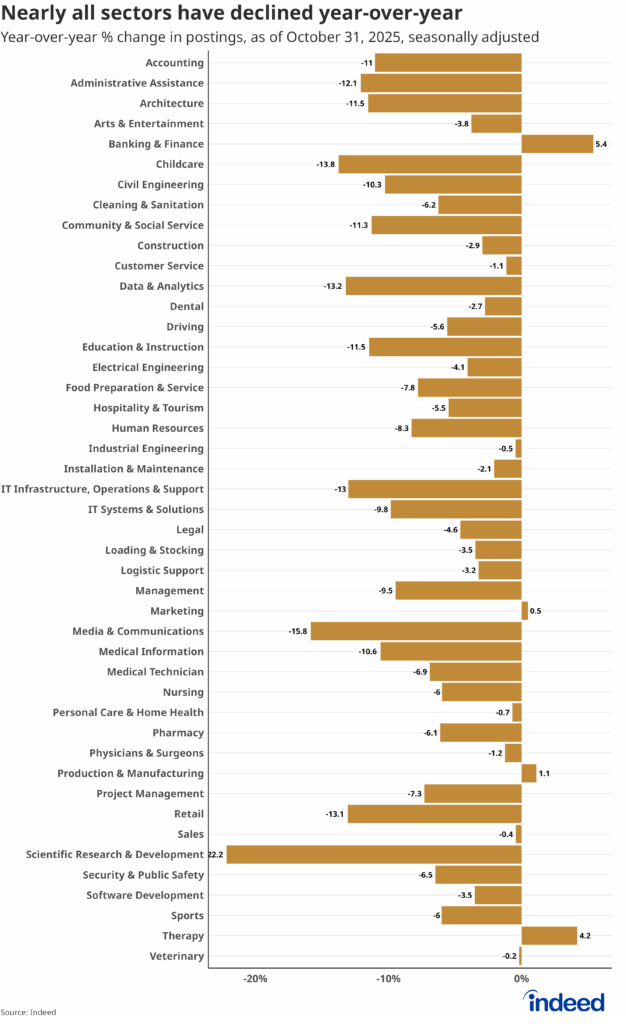
This bar chart shows year-over-year changes in U.S. job postings by sector as of Oct. 31, 2025, with steep declines in many white-collar categories (e.g., project management, media & communications, software development, legal, HR, finance) versus relative resilience in healthcare. It visualizes the tightening of professional/white-collar opportunities—fewer seats and longer searches—consistent with the theme that the professional middle is undergoing a slow liquidation.
Source: Indeed Hiring Lab
Research Brief
What our analysis found
A wave of high-profile white-collar layoffs is lending credibility to fears that the "professional middle" — salaried knowledge workers earning six figures to summarize, coordinate, and manage organizational complexity — faces a structural contraction driven by generative AI. In January 2026, U.S. layoff announcements surged to 108,435, the highest January figure since 2009, according to Challenger, Gray & Christmas. Major employers are explicitly tying cuts to AI-driven efficiency: Amazon announced roughly 16,000 corporate job cuts in late January 2026, with CEO Andy Jassy stating AI will continue to shrink the corporate workforce in coming years. Block eliminated approximately 4,000 of its 10,000 staff, framing the move around AI gains. And Salesforce CEO Marc Benioff disclosed that AI agents replaced roughly 4,000 customer support roles, cutting support costs by about 17%.
The labor data beneath the headlines paints a consistent picture of softening demand for white-collar talent. The Bureau of Labor Statistics reported that overall payrolls fell by 92,000 in February 2026, with the unemployment rate ticking up to 4.4%. Job openings in the JOLTS survey declined to 6.5 million in December 2025, with professional and business services — a sector dense with the coordination and analysis roles described in the tweet — seeing openings plunge by 257,000 in a single month. Meanwhile, 42.5% of recent college graduates were underemployed in Q4 2025, the highest rate since 2020, suggesting the pipeline into these professional roles is already backing up.
The housing dimension of the argument is equally data-rich. An FHFA working paper found that for every one-percentage-point gap between a homeowner's locked-in mortgage rate and the prevailing market rate, the probability of selling drops by 18.1%. This "lock-in effect" suppressed an estimated 1.33 million home sales between mid-2022 and late 2023 and cut fixed-rate home sales by 57% in Q4 2023. Federal Reserve research attributes roughly 44% of the decline in mortgage-borrower mobility to rate lock-in. If the professional class that anchors suburban housing markets begins losing income security while trapped by low-rate mortgages they cannot afford to refinance, the tweet's forecast of a labor shock and housing shock feeding each other moves from speculation toward plausible risk.
Fact Check
Evidence from both sides
Supporting Evidence
Major employers explicitly cite AI as the reason for white-collar cuts
Amazon announced approximately 16,000 corporate job reductions in January 2026, with CEO Andy Jassy publicly stating generative AI will continue to reduce the company's corporate workforce. Block cut about 4,000 of 10,000 staff, framing the layoffs around AI-driven efficiency. Salesforce disclosed that AI agents replaced roughly 4,000 customer support roles and lowered support costs by about 17%. Each case directly supports the tweet's claim that companies now have a "believable excuse" to thin the white-collar workforce.
Layoff announcements hit a post-Great Recession January high
Challenger, Gray & Christmas reported 108,435 announced job cuts in January 2026, the largest January total since 2009, suggesting the scale of professional-class displacement is historically significant, not routine cyclical churn.
White-collar job openings are declining steeply
The December 2025 JOLTS report showed total openings at 6.5 million, with professional and business services openings dropping by 257,000 in that month alone — a sector that encompasses many of the summarize-coordinate-report roles the tweet describes. BLS data for February 2026 showed professional and business services employment slipping by about 5,000, consistent with softening demand.
IMF and McKinsey research confirms high AI exposure for knowledge work
The IMF estimated that roughly 60% of jobs in advanced economies are exposed to AI, with the impact skewed toward cognitive and knowledge-intensive tasks. McKinsey's 2023 analysis found that generative AI particularly raises the automation potential for decision-making, documentation, and coordination — the precise functions the tweet identifies as vulnerable overhead.
New graduates are already being squeezed out of professional-track roles
The New York Fed reported that underemployment among recent college graduates reached 42.5% in Q4 2025, the highest since the pandemic, and their unemployment rate stood at 5.6% versus 3.1% for all college-educated adults — evidence that entry into the professional middle is already constricting.
Mortgage lock-in creates the geographic trap the tweet describes
An FHFA working paper found that rate lock-in cut fixed-rate home sales by 57% in Q4 2023 and prevented an estimated 1.33 million transactions. Federal Reserve research attributed about 44% of the decline in mortgage-borrower mobility to the rate gap. Realtor.com data through early 2026 showed delistings as a share of new listings roughly quadrupled across recent Januaries, confirming that homeowners are frozen in place — precisely the "restraint device" dynamic the tweet warns about.
Contradicting Evidence
The February layoff number dropped sharply, complicating the "slow liquidation" narrative
While January 2026 layoff announcements were the highest since 2009 at 108,435, the Challenger report showed February falling to 48,307 — a steep month-over-month decline that suggests the pace may be uneven rather than relentlessly accelerating. A single elevated month does not establish the sustained, grinding compression the tweet predicts.
Overall labor market remains relatively intact by historical standards
The February 2026 unemployment rate of 4.4%, while rising, is still well below recessionary levels. Professional and business services shed only about 5,000 jobs in the month, far from the mass displacement the tweet envisions. The BLS data does not yet show a white-collar employment collapse.
AI exposure does not equal AI displacement
The IMF's finding that 60% of advanced-economy jobs are "exposed" to AI explicitly notes that about half of those could see AI complement rather than replace workers, potentially raising productivity and wages. McKinsey's automation timeline places the midpoint for broad task automation at 2045, suggesting the tweet's 12-to-18-month window dramatically compresses what research frames as a multi-decade transition.
Companies may be using AI as rhetorical cover for ordinary cost-cutting
Some labor economists have noted that firms frequently invoke the technology narrative du jour to justify restructurings that are primarily driven by slowing revenue, margin pressure, or strategic pivots. The fact that companies "can say AI" — as the tweet itself acknowledges — does not prove AI is the actual cause, and conflating the two overstates AI's near-term impact.
Housing lock-in predates AI concerns and may ease independently
The mortgage lock-in effect is driven almost entirely by the gap between sub-4% pandemic-era rates and current market rates, not by job losses. If rates decline — several forecasters project gradual easing — the lock-in constraint loosens regardless of what happens in the labor market. The FHFA and Fed research attributes reduced mobility to rate differentials, not to income shocks, which means the tweet's causal chain from AI layoffs to housing freeze oversimplifies the mechanism.
Historical precedent suggests technology transitions create new roles alongside displacement
Past waves of automation — from ATMs in banking to ERP systems in back-office operations — ultimately restructured rather than eliminated professional employment. While generative AI may be qualitatively different, the blanket assertion that six-figure jobs are "going away" without equivalent replacements discounts the possibility that new categories of AI-augmented professional work will emerge, as multiple economists and the IMF itself have cautioned.
Report an Issue
Found something wrong with this article? Let us know and we'll look into it.