AI is reshaping the American workplace. 66.3% of US workers earning over $200,000 used AI tools at work over the last 12 months, according to a Fed survey. This is followed by those earning $100,000-$200,000 and $50,000-$100,000, at 51.6% and 40.2%, respectively. By comparison, just 15.9% of Americans earning less than $50,000 used AI tools at work over the same period. Furthermore, college graduates were more than twice as likely to use AI at work as those without a degree, at 58.7% versus 22.9%. Full-time workers used AI at nearly 2 times the rate of part-time workers, at 42.7% versus 24.7%. Among workers who do use AI, 68.0% said it makes their job easier, and 56.7% claimed it boosts their productivity. AI is transforming how Americans work.
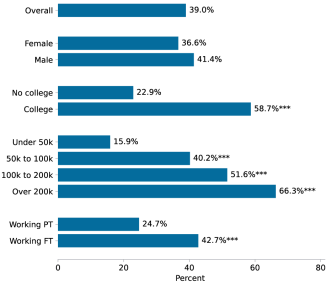
Horizontal bar chart from the NY Fed showing the share of employed respondents who used generative AI in the past 12 months broken down by income, education, and full-/part-time status (e.g., 66.3% for >$200K, 15.9% for <$50K; 58.7% college grads vs 22.9% non-grads). This directly illustrates the post’s claim that AI adoption is concentrated among higher‑earning, higher‑educated, full‑time workers and supports the point that AI is reshaping the American workplace and productivity dynamics.
Source: Federal Reserve Bank of New York (Liberty Street Economics)
Research Brief
What our analysis found
AI tools are rapidly transforming the American workplace, but the benefits are flowing disproportionately to higher earners, according to a Federal Reserve Bank of New York analysis published in April 2026. The survey, drawn from the November 2025 Survey of Consumer Expectations, found that 66.3% of U.S. workers earning over $200,000 used AI tools at work in the past year, compared to just 15.9% of those earning under $50,000 — a gap of more than four to one. Workers in the middle-income brackets fell in between, with adoption rates of 51.6% for those earning $100,000–$200,000 and 40.2% for the $50,000–$100,000 range.
The divide extends well beyond income. College graduates were more than twice as likely to use AI at work compared to those without a degree, at 58.7% versus 22.9%. Full-time workers adopted AI at nearly double the rate of part-time workers, 42.7% versus 24.7%. Among those who do use AI, the perceived benefits are substantial: 68.0% said it makes their job easier and 56.7% reported productivity gains. Yet the New York Fed researchers warned that these patterns suggest AI may be widening existing labor market inequalities rather than leveling the playing field.
Adding to concerns about an emerging AI divide, only about 16% of employers offered AI training despite roughly 38% of workers considering AI upskilling important. Workers without college degrees, who reported the lowest usage rates, paradoxically placed high value on AI training but had the least access to it. Meanwhile, PwC data from 2025 showed workers with AI skills commanding a 56% wage premium, up sharply from 25% the year prior — underscoring the growing economic stakes of being left behind in the AI transition.
Fact Check
Evidence from both sides
Supporting Evidence
Federal Reserve Bank of New York survey confirms the data
The statistics in the tweet directly match findings from the New York Fed's April 14, 2026 publication, "Use of Gen AI in the Workplace and the Value of Access to Training," which drew on the November 2025 Survey of Consumer Expectations. The income, education, and employment disparities are accurately cited.
Researchers explicitly flagged widening inequality
New York Fed researchers concluded that "AI adoption at work currently favors higher-income, higher-educated, and full-time workers," warning that AI may exacerbate existing labor market inequalities — a finding also reported by Yahoo Finance and Seeking Alpha.
A growing digital divide reinforces adoption gaps
A Harvard Business School study from February 2025 highlighted a "digital divide" in which rural areas lag in computer use, potentially limiting career opportunities in an increasingly AI-driven economy.
AI skills carry a surging wage premium
PwC data from 2025 showed workers with AI skills earned a 56% wage premium, more than double the 25% premium recorded the previous year, confirming the escalating economic value of AI proficiency.
Employer training gaps deepen the divide
The same New York Fed survey found only about 16% of employers offered AI training, even though approximately 38% of workers considered AI upskilling important. Workers without college degrees valued training highly but had the lowest access to it, reinforcing the structural nature of the adoption gap.
Contradicting Evidence
Overall adoption figures vary widely depending on the survey
While the New York Fed reported 39% of employed respondents using AI tools, a Udacity survey from September 2025 claimed 90% of workers used some form of AI. These discrepancies likely stem from differing definitions of "AI tools" and varying methodologies, meaning the scale of AI's workplace penetration is less settled than the tweet implies.
Hidden usage suggests official numbers undercount adoption
A Conference Board survey found that 29% of respondents used AI without their management's knowledge, indicating that true adoption rates — including among lower-income and part-time workers — may be higher than reported figures suggest.
Many workers actively resist or abandon AI tools
A Udacity report from September 2025 found that three out of four workers frequently abandon AI tools mid-task over accuracy or quality concerns, and nearly half distrust AI-assisted work. Separately, research from Knowledge at Wharton reported that 31% of U.S. knowledge workers actively resist their company's AI initiatives, complicating the narrative that AI straightforwardly "makes jobs easier."
AI has had limited impact on overall employment levels so far
The U.S. Census Bureau's 2023 Annual Business Survey found that AI adoption had little impact on total worker numbers between 2020 and 2022. A separate New York Fed study from April 2026 suggested AI is more likely to augment jobs than cause widespread displacement in the near term.
AI-attributed layoffs remain a small share and may be overstated
While AI was cited in 25% of layoffs in early 2026, up from 5% the year prior, this still represents a small portion of total job cuts. Some experts caution that CEOs may attribute layoffs to AI partly to justify cost reductions and signal investment in technology rather than reflecting genuine AI-driven displacement.
Report an Issue
Found something wrong with this article? Let us know and we'll look into it.