Elon Musk just described the white-collar extinction event. On Joe Rogan. Casually. Musk: “Anything that is digital, which is like just someone at a computer doing something, AI is going to take over those jobs like lightning.” Not gradually. Not eventually. Lightning. The assumption most professionals are operating on is that AI will assist them. Make them faster. Augment what they do. That assumption is the most expensive mistake a person can make right now. Musk: “Just like digital computers took over the job of people doing manual calculations. But much faster.” Think about that analogy for a moment. We used to employ entire rooms of people whose sole function was arithmetic. Highly educated. Well-compensated. Essential to every organization that ran on numbers. Then the computer arrived and the entire category disappeared. Not shrank. Disappeared. Nobody talks about it as a tragedy anymore because the transition happened before most people alive today were born. It’s just history. A curiosity. That same transition is happening right now to coding, writing, analysis, research, legal work, financial modeling. Every profession whose output lives entirely on a screen. The difference is the speed. Digital computers took decades to displace manual calculation. This is moving in years. If your work begins and ends on a screen, you are not competing with a tool that makes someone else more productive. You are competing with a replacement that does not sleep, does not need benefits, and gets cheaper every six months. Musk is not predicting this future. He is describing the present tense.
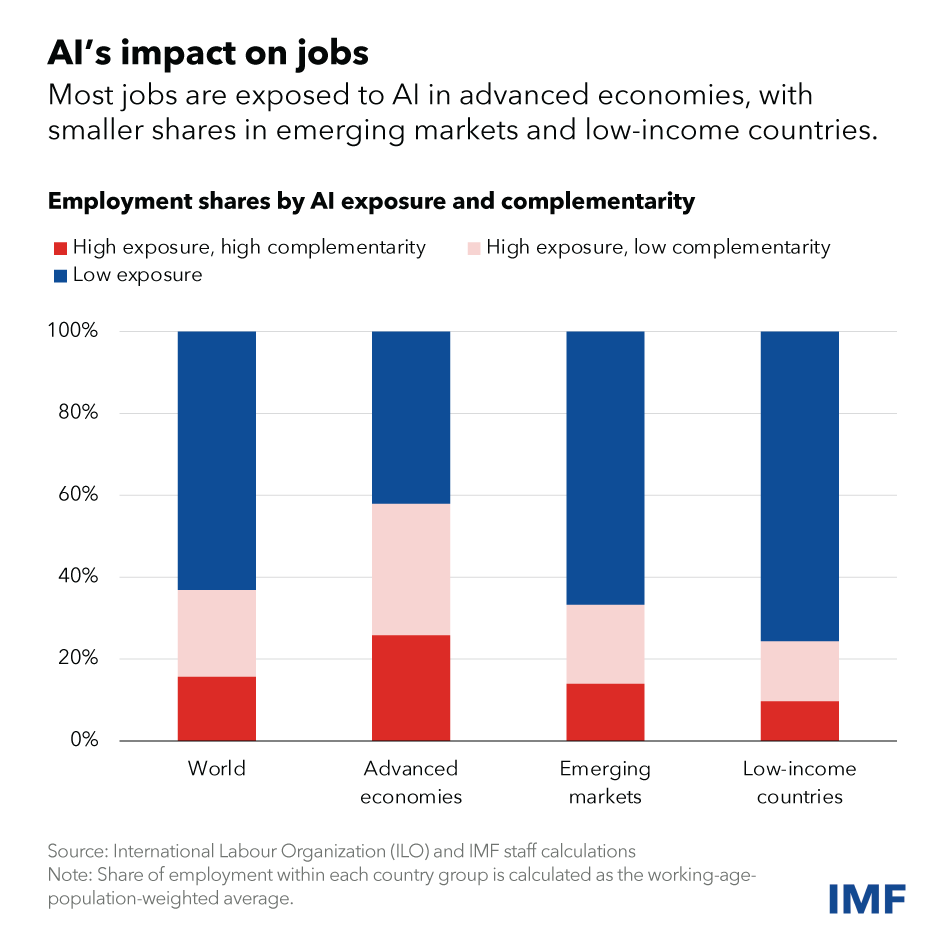
This IMF chart shows the share of employment by AI exposure and complementarity, highlighting that advanced economies—where many white‑collar, screen‑based jobs are concentrated—have a much larger proportion of roles highly exposed to AI. It directly illustrates that cognitive/digital professions face significant automation pressure now, aligning with the tweet’s argument.
Source: International Monetary Fund (IMF)
Research Brief
What our analysis found
On October 31, 2025, Elon Musk appeared on Joe Rogan Experience episode #2404 and declared that "anything that is digital … AI is going to take over those jobs like lightning," drawing an analogy to how electronic computers wiped out entire rooms of human calculators at institutions like NASA. The claim has ignited fierce debate, but major institutional research lends it at least partial credibility. The IMF estimates that roughly 60% of jobs in advanced economies are exposed to AI, while an OpenAI-University of Pennsylvania study found that approximately 19% of U.S. workers could see at least half their tasks affected by large language models. The World Economic Forum projects a net loss of 14 million jobs globally by 2027, roughly 2% of total employment, with about 23% of all roles expected to change significantly in that window.
Real-world corporate deployments already illustrate the trend Musk describes. Swedish fintech Klarna reported that its AI customer-service assistant handled 69–80% of all service chats by mid-2025, contributing to a workforce reduction from roughly 5,500 employees in 2022 to about 2,900 in 2025. IBM paused hiring for approximately 7,800 back-office roles it expects AI to absorb within five years. Morgan Stanley deployed GPT-4-powered assistants to 15,000 wealth advisors to automate note-taking, email drafting, and research retrieval. Randomized controlled trials show GitHub Copilot users completing coding tasks roughly 55% faster, while a Fortune 500 call-center study found AI assistants boosted issues resolved per hour by about 14%, with the largest gains among less experienced workers.
Yet the picture is more nuanced than a simple extinction narrative. The ILO concluded in 2023 and reaffirmed in 2025 that generative AI is more likely to augment than fully automate most occupations. The OECD pegs outright automation potential at only 5.1% of jobs in high-income economies, versus 13.4% showing augmentation potential. McKinsey estimates up to 30% of U.S. work hours could be automated by 2030 but frames this as task-level displacement requiring occupational transitions rather than wholesale role elimination. Musk himself acknowledged a "benign scenario" involving "universal high income" and work becoming "optional," suggesting even he does not view the transition as purely catastrophic.
Fact Check
Evidence from both sides
Supporting Evidence
Musk's verbatim quote is confirmed
Transcript aggregators place the statement "Anything that is digital … AI is going to take over those jobs like lightning" at approximately timestamp 2:39:16 of JRE #2404, aired October 31, 2025, verifying the tweet's central quotation.
IMF finds high white-collar exposure
The International Monetary Fund estimates that about 60% of jobs in advanced economies are exposed to AI disruption, with exposure concentrated in cognitive, desk-based roles — directly supporting the claim that digital work is most at risk.
OpenAI/UPenn study quantifies task-level vulnerability
The "GPTs are GPTs" paper found that roughly 80% of the U.S. workforce could have at least 10% of their tasks affected by large language models, and about 19% could see 50% or more of their tasks impacted, reinforcing the breadth of white-collar exposure.
Klarna's workforce shrank dramatically alongside AI adoption
Klarna's AI assistant absorbed 69–80% of customer service chats by mid-2025, and the company's headcount fell from approximately 5,500 to 2,900, providing a concrete case of AI replacing screen-based work at scale.
IBM froze hiring for thousands of back-office roles
In May 2023, IBM paused hiring for roughly 7,800 non-client-facing positions it projected AI could replace within five years, illustrating corporate anticipation of digital-role elimination.
Coding productivity gains suggest rapid task substitution
Randomized trials showed GitHub Copilot users completed coding tasks approximately 55% faster, demonstrating that AI can dramatically compress the labor input required for a core white-collar function.
Historical analogy holds up
NASA's own historical records confirm that large teams of human computers performing manual calculations at NACA/NASA were displaced as electronic computers diffused from the late 1940s through the 1970s, validating Musk's analogy.
WEF projects net job losses by 2027
The World Economic Forum's Future of Jobs 2023 report estimates 83 million jobs eliminated against 69 million created by 2027, a net loss of 14 million, suggesting structural displacement is already underway on a compressed timeline.
Contradicting Evidence
ILO says augmentation is far more likely than full automation
The International Labour Organization concluded in both 2023 and a 2025 update that generative AI is more likely to augment existing jobs than to fully automate them, contradicting the tweet's framing that AI is a wholesale "replacement" rather than an assistive tool.
OECD pegs outright automation potential at only 5.1%
The OECD's 2024 analysis found that just 5.1% of jobs in high-income economies face genuine automation risk from generative AI, while 13.4% show augmentation potential — a ratio that undercuts the "extinction event" language.
"Exposure" does not equal "elimination"
The IMF's 60% figure and the OpenAI/UPenn 80% figure measure task-level exposure, not job destruction; many exposed roles may be restructured or enhanced rather than eliminated, a distinction the tweet collapses entirely.
McKinsey frames displacement as occupational transition, not vanishing
McKinsey's 2023 analysis projects up to 30% of U.S. work hours could be automated by 2030 but emphasizes roughly 12 million occupational transitions — workers moving between roles — rather than mass unemployment.
Productivity gains can create jobs, not just destroy them
The WEF projects 69 million new jobs created alongside 83 million eliminated; historically, automation waves have generated new occupational categories, as the computer revolution itself produced software engineering, IT support, and data science roles that did not previously exist.
Field evidence shows AI helps the least-skilled workers most
The NBER call-center study found that AI assistance disproportionately boosted novice worker productivity by 34%, suggesting AI may level the playing field rather than eliminate roles, functioning more as training infrastructure than a replacement.
Musk himself hedged with "benign scenario" language
In the same JRE appearance, Musk described a scenario of "universal high income" and work becoming "optional," implicitly acknowledging that policy responses and economic adaptation could mitigate the displacement he described.
Speed comparison is historically misleading
The tweet claims digital computers took "decades" while AI will act in "years," but enterprise AI adoption faces regulatory, legal, organizational, and trust barriers that historically slow technology diffusion well beyond the pace of raw capability improvement, as the OECD and McKinsey analyses both note.
Report an Issue
Found something wrong with this article? Let us know and we'll look into it.