BREAKING: The value of US data centers under construction has officially surpassed the value of office buildings under construction for the first time in history. Data centers under construction are up+29% YoY, to a record $45.1 billion. Meanwhile, the value of offices under construction are down -13%, to $43.5 billion, the lowest since October 2015. Since November 2022, when ChatGPT was launched, data center construction is up +228%. Over that same period, office construction is down -38%. AI is reshaping the US economy.
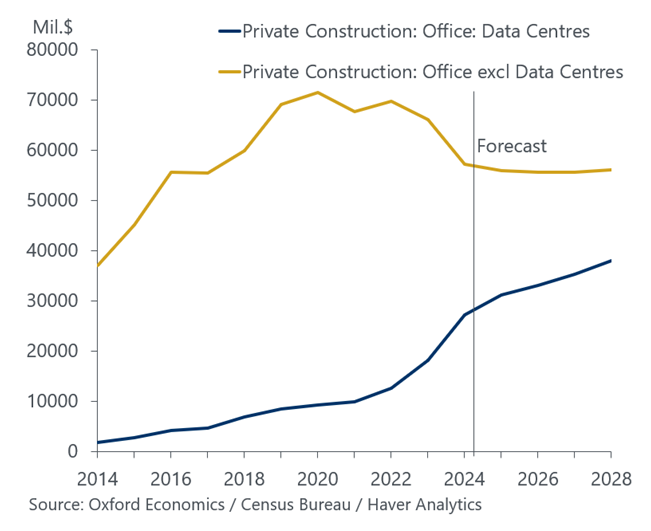
This Oxford Economics chart plots U.S. private construction spending for data centers versus office buildings excluding data centers since 2014. It shows data center spending surging to record highs while non–data center office spending declines to multi‑year lows, illustrating the crossover dynamic behind the claim that data center construction has overtaken traditional office construction.
Source: Oxford Economics
Research Brief
What our analysis found
For the first time in the U.S. Census Bureau's construction spending series, the value of data center construction has officially overtaken traditional office building construction. In December 2025, private data center construction spending hit a seasonally adjusted annual rate (SAAR) of $45.134 billion, up 29.0% year-over-year, while general office construction (excluding data centers and financial offices) fell to $43.546 billion, down 13.1% from the prior year and its lowest level since October 2015. The crossover marks a dramatic structural shift in what America is building — and why.
The acceleration traces back to the explosion of generative AI. Since ChatGPT's launch in late November 2022, data center construction spending has surged roughly 228%, climbing from the low-teens billions to its current record. Over the same period, traditional office construction has contracted by approximately 38%, falling from a peak near $74 billion SAAR in late 2022. According to the Associated Builders and Contractors (ABC), data centers and manufacturing together accounted for 94% of the increase in total nonresidential construction spending during 2024, underscoring just how concentrated the boom has become.
Yet the picture is more complex than the headline suggests. The Census Bureau only recently broke out data centers as a separate line item from the broader "Office" category, meaning historical comparisons require careful interpretation. Meanwhile, physical constraints are mounting: CBRE reports that data center capacity under construction actually declined to 5,994 MW at year-end 2025 from 6,350 MW a year earlier — the first year-over-year drop since 2020. Power shortages, equipment delays, and a wave of more than 10 new moratorium proposals across U.S. municipalities in early 2026 suggest the torrid pace of data center buildout could face significant headwinds ahead.
Fact Check
Evidence from both sides
Supporting Evidence
December 2025 figures match Census data exactly
The tweet's $45.1 billion for data centers and $43.5 billion for general office correspond precisely to the U.S. Census Bureau's "Value of Private Construction Put in Place — SAAR" tables for December 2025, published February 27, 2026. The year-over-year changes of +29% and −13% are also confirmed by the Census series (census.gov).
First-ever crossover in the Census series
December 2025 is indeed the first month in which the Census Bureau's data center line exceeds the general office line, supporting the tweet's "first time in history" framing, though the separate data center series is relatively new.
Post-ChatGPT growth trajectory is directionally accurate
Census data and third-party analyses show data center SAAR rising from the low-teens billions in late 2022 to $29.6 billion by September 2024 and $45.1 billion by December 2025, consistent with the tweet's cited +228% increase. Office (ex-data center) fell from approximately $74 billion SAAR in December 2022 to $43.5 billion, aligning with the cited −38% decline (continuumag.com).
Data centers dominate nonresidential construction growth
ABC's analysis of Census data confirms that data centers and manufacturing comprised 94% of the total increase in nonresidential construction spending from December 2023 to December 2024, reinforcing the narrative that AI-driven infrastructure is reshaping the construction sector (abc.org).
Rapid year-over-year acceleration is well documented
NAIOP research shows private data center spending rose 44.6% in 2023 and 59% in the 12 months through September 2024, consistent with the multi-year surge described in the tweet (tradeandindustrydev.com).
Contradicting Evidence
The metric is spending rate, not "value under construction"
The tweet describes "value of data centers under construction," but the Census series actually measures "value of construction put in place" — a seasonally adjusted annual spending rate, not the total pipeline or backlog of projects currently underway. The directional story holds, but the terminology is imprecise (census.gov).
The separate data center series is new, complicating "first time in history" claims
The Census Bureau only recently split "Data center" out from the broader "Office" category. Previously, most data center spending was counted within office totals. While the Bureau has backfilled data, the historical series is limited, making sweeping historical comparisons less robust than the tweet implies (wolfstreet.com, ecmag.com).
Physical data center construction capacity actually declined in late 2025
CBRE reports that North American data center capacity under construction fell to 5,994 MW at year-end 2025 from 6,350 MW a year earlier — the first year-over-year decline since 2020. This suggests the spending surge may not translate to an ever-accelerating physical buildout (cbre.com).
Power, permitting, and equipment constraints threaten future growth
As of early 2026, more than 10 new U.S. moratorium proposals targeting data centers emerged in a single month, and analysts estimate 30–50% of data center capacity expected online in 2026 may be delayed due to power, equipment, and permitting bottlenecks, complicating the narrative of unchecked AI-driven expansion.
Attributing the entire shift to AI oversimplifies multiple trends
The decline in office construction reflects post-pandemic remote work adoption and elevated interest rates reducing commercial development broadly, trends that predate ChatGPT. Similarly, data center demand was already accelerating due to cloud computing growth before generative AI emerged, meaning the tweet's framing overstates AI as the singular cause.
Report an Issue
Found something wrong with this article? Let us know and we'll look into it.