Had meetings and a dinner with 20+ enterprise AI and IT leaders today. Lots of interesting conversations around the state of AI in large enterprises, especially regulated businesses. Here are some of general trends: * Agents are clearly the big thing. Enterprises moving from talking about chatbots to agents, though we’re still very early. Coding is still the dominant agentic use-case being adopted thus far, with other categories of across knowledge work starting to emerge. Lots of agentic work moving from pilots and PoCs into production, and some enterprises had lots of active live use-cases. * Agentic use-cases span every part of a business, from back office operations to client facing experiences from sales to customer onboarding workflows. General feeling is that agentic workflows will hit every part of an organization, often with biggest focus on delivering better for customers, getting better insights and intelligence from data and documents, speeding up high ROI workflows with agents, and so on. Very limited discussion on pure cost cutting. * Data and AI governance still remain core challenges. Getting data and content into a spot that agents can securely and easily operate on remains a huge task for more organizations. Years of data management fragmentation that wasn’t a problem now is an issue for enterprises looking to adopt agents. And governing what agents can do with data in a workflow still a major topic. * Identity emerging as a big topic. Can the agent have access to everything you have? In a world of dozens of agents working on behalf, potentially too much data exposure and scope for the agents. How do we manage agents with partitioned level of access to your information? * Lots of emerging questions on how we will budget for tokens across use-cases and teams. Companies don’t want to constrain use-cases, but equally need to be mindful of ultimate token budgets. This is going to become a bigger part of OpEx over time, and probably won’t make sense to be considered an IT budget anymore. Likely needs to be factored into the rest of operating expenses. * Interoperability is key. Every enterprise is deploying multiple AI systems right now, and it’s unlikely that there’s going to be a single platform to rule them all. Customers are getting savvier on how to handle agent interoperability, and this will be one of the biggest drivers of an AI stack going forward. Lots more takeaways than just this, but needless to say the momentum is building but equally enterprises are acutely aware of the change management and work ahead. Lots of opportunity right now.
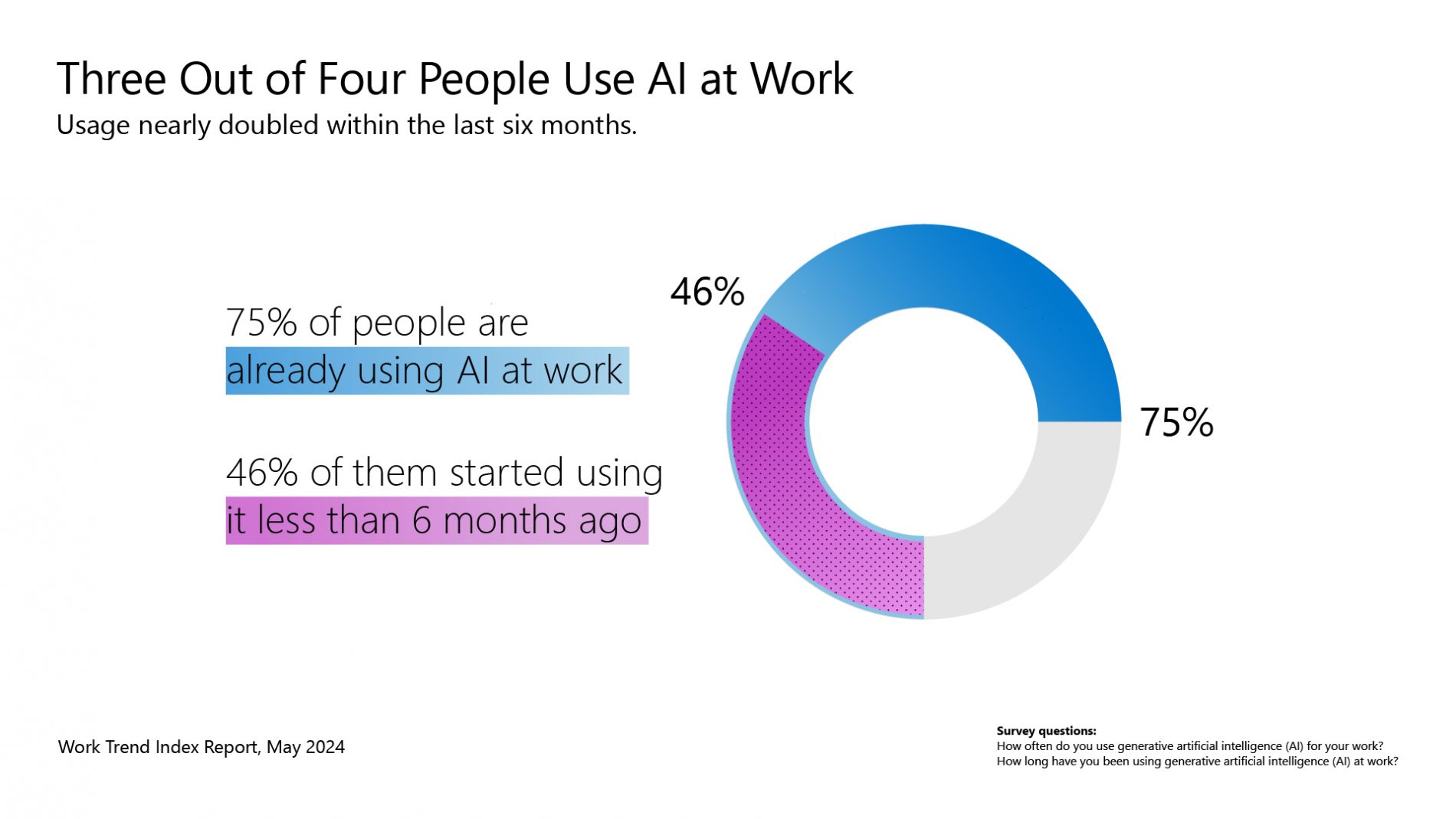
This Microsoft Work Trend Index graphic shows that 75% of employees are already using AI at work and 46% began within the last six months, illustrating how quickly AI is spreading inside enterprises. It supports the thread’s points about accelerating adoption, movement from pilots to production, and the growing urgency of governance and identity controls as usage scales.
Source: Microsoft (Work Trend Index 2024)
Research Brief
What our analysis found
The enterprise AI landscape is undergoing a decisive shift from experimental chatbots to autonomous agents capable of executing complex workflows, and the numbers underscore the scale of this transformation. Worldwide AI spending is forecast to reach $2.52 trillion in 2026, a 44% year-over-year increase according to Gartner. Coding has emerged as the dominant agentic use case: a January 2026 arXiv study analyzing 129,134 GitHub projects found that coding agent adoption already sits between 15.85% and 22.60%, with the trajectory still climbing. GitHub's own Octoverse 2025 report reinforces this, noting 4.3 million AI-related projects on the platform and that 80% of new developers use Copilot within their first week.
Beyond coding, enterprises are deploying agents across virtually every business function. PwC disclosed that it is building more than 120 enterprise AI agents spanning 24 cross-functional workflows with Google Cloud, while ServiceNow has launched thousands of pre-trained agents for IT, HR, customer service, and CRM. Salesforce made its AI-powered Slackbot generally available in January 2026, branding Slack as the "agentic enterprise" front door. Notably, the strategic emphasis is tilting toward customer experience and revenue growth rather than pure headcount reduction. Gartner has warned that generative AI's cost per resolution in customer service could actually exceed offshore human agent costs by 2030, suggesting that enterprises pursuing AI purely for savings may be disappointed.
Yet formidable obstacles remain. Data governance fragmentation, identity management for autonomous agents, and token-cost budgeting are all surfacing as top-tier concerns. AWS launched AgentCore with enterprise identity integrations tied to Okta and Microsoft Entra ID, while Microsoft expanded Purview's AI Observability tools to monitor agent activity across data estates. The EU AI Act, with most obligations taking effect August 2, 2026, adds a regulatory layer that will force enterprises — especially those in regulated industries — to formalize how agents access, process, and act on sensitive data. Meanwhile, interoperability is gaining momentum through standards like Anthropic's Model Context Protocol (MCP), which has attracted cross-vendor adoption from OpenAI and Google, signaling that a multi-platform agent ecosystem is becoming the industry default.
Fact Check
Evidence from both sides
Supporting Evidence
Agents are clearly the big thing
AP's coverage of Microsoft Ignite 2025 described the company's explicit pivot from chatbot-style Copilot features to "agentic AI" that can act autonomously on users' behalf. Salesforce and ServiceNow have simultaneously launched or expanded dedicated agent platforms, confirming the industry-wide shift the tweet describes.
Coding leads agentic adoption
A January 2026 arXiv study of 129,134 GitHub projects estimates coding agent adoption at 15.85%–22.60%, and GitHub's Octoverse 2025 report shows 4.3 million AI projects and 80% first-week Copilot usage among new developers, corroborating that coding is the dominant agentic use case in production today.
Use cases span every part of a business
PwC's partnership with Google Cloud involves more than 120 AI agents across 24 cross-functional workflows covering back-office and client-facing operations. ServiceNow announced thousands of pre-trained agents for IT, customer service, HR, and CRM, plus an AI Agent Studio for custom builds.
Focus on customer value over pure cost cutting
Bain's 2025 analysis emphasizes that AI's greatest enterprise value lies in reinventing the customer experience and driving revenue growth rather than simple cost reduction. Gartner's January 2026 prediction that GenAI cost per resolution in customer service may exceed offshore human agent costs by 2030 further discourages a cost-cutting-only rationale.
Data and AI governance remain core challenges
Microsoft expanded Purview's Data Security Posture Management to provide visibility and policy controls for agents across Microsoft and non-Microsoft environments. The EU AI Act's August 2026 enforcement deadline is compelling regulated enterprises to formalize data governance for agentic systems.
Identity is emerging as a critical topic
AWS launched AgentCore with enterprise identity integrations connecting to Okta and Microsoft Entra ID, while Okta's 2026 release notes include specific "AI agent token exchange" guidance, directly validating the tweet's observation that partitioned agent access is a top concern.
Interoperability is key
Anthropic's Model Context Protocol has gained cross-vendor adoption from OpenAI and Google ecosystems. Google Cloud explicitly references MCP for connecting agents to external tools and data, confirming that multi-platform agent interoperability is a primary architectural driver.
Token budgeting is a growing concern
With worldwide AI spending projected at $2.52 trillion in 2026 (a 44% increase), enterprises face rapidly growing inference costs. The tweet's observation that token budgets will shift from IT into broader operating expenses aligns with the scale at which AI consumption is growing across business units.
Contradicting Evidence
"Very early" may understate coding agent maturity
While the tweet characterizes enterprise agentic adoption as "very early," the arXiv study already shows 15.85%–22.60% adoption among 129,134 GitHub projects, and GitHub reports 80% of new developers using Copilot in their first week — suggesting that at least in software development, agentic tooling has moved well past the early-adopter phase.
Cost cutting remains a real driver despite the tweet's dismissal
Although the tweet notes "very limited discussion on pure cost cutting," many enterprises still pursue AI primarily for efficiency gains. Gartner's warning that GenAI customer-service costs could exceed offshore human agent costs by 2030 implies that some organizations are indeed deploying agents with cost reduction as the primary motivation, even if that strategy may ultimately disappoint.
Regulatory pressure may slow the momentum described
The EU AI Act's most significant obligations take effect August 2, 2026, with high-risk provisions extending into 2027. Regulated enterprises — the exact audience the tweet references — may find compliance requirements substantially slow agentic deployment rather than merely adding governance overhead, a friction the tweet does not emphasize.
Interoperability standards are still fragmented
While the Model Context Protocol has gained notable cross-vendor traction, it remains one of several competing approaches; Google Cloud, AWS, and Microsoft each maintain proprietary orchestration layers alongside MCP support. True interoperability is aspirational rather than solved, and the tweet's framing that "customers are getting savvier" may overstate how standardized the ecosystem actually is.
Enterprise-wide agentic deployment evidence is thin outside large tech partnerships
The most cited examples of broad agent deployment — PwC's 120+ agents, ServiceNow's platform, Salesforce's Slackbot — involve major technology vendors or consulting firms. Independent evidence of mid-market or heavily regulated enterprises running diverse production agents at scale remains limited, suggesting the tweet's optimistic framing may reflect a self-selecting sample of early movers rather than a general trend.
Report an Issue
Found something wrong with this article? Let us know and we'll look into it.