78% Gen-Z can spot AI-generated images and it hurts conversion (one marketer saw click-through-rates fall 40% when it tried AI-generated lifestyle images) https://t.co/9gZ7lezqux
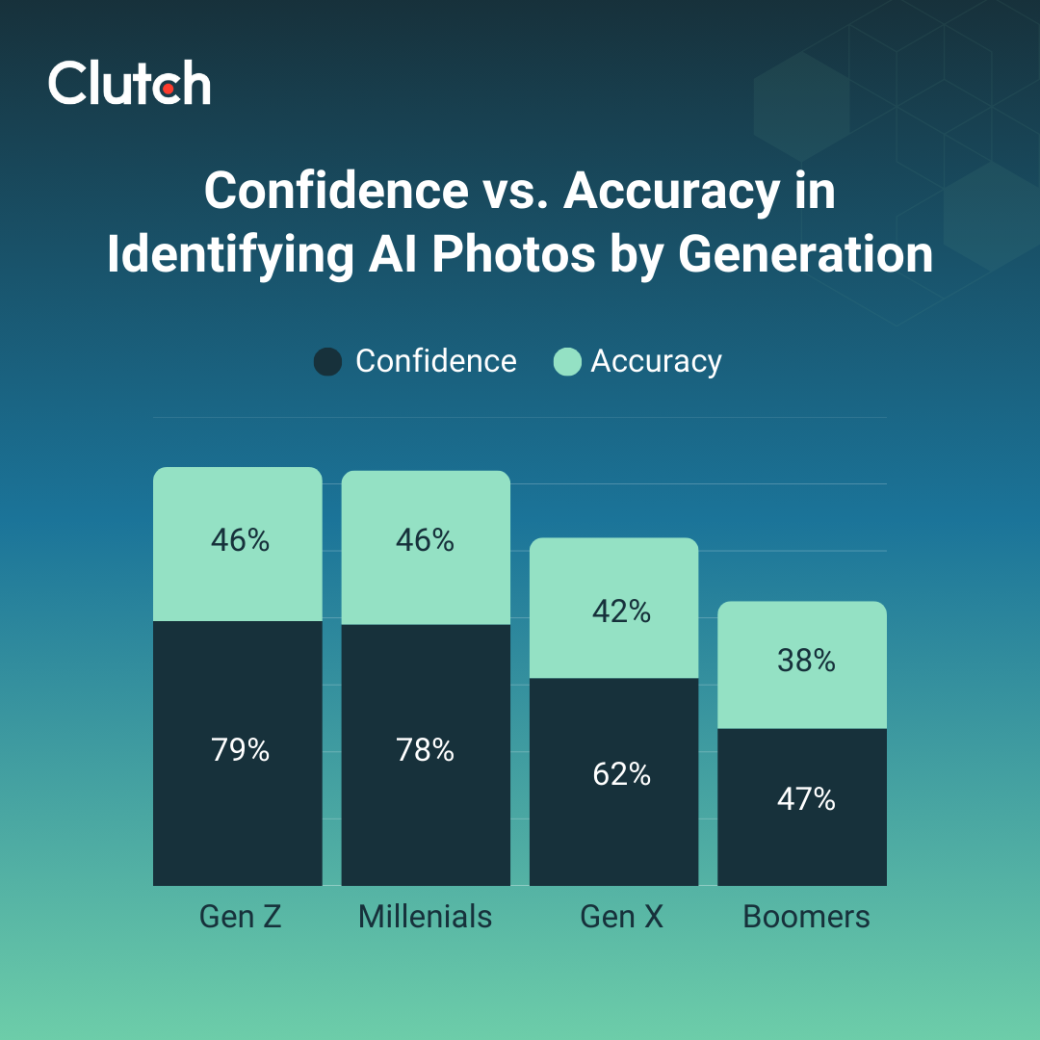
This infographic compares confidence vs. accuracy in identifying AI-generated photos by generation; Gen Z report 79% confidence (and 46% accuracy), illustrating that Gen Z believe they can spot AI images. This supports the tweet’s point and helps explain why obviously AI-looking lifestyle visuals can hurt engagement or conversion.
Source: Clutch
Research Brief
What our analysis found
A viral tweet claims that 78% of Gen Z can spot AI-generated images and that this detection ability is cratering marketing performance, citing one brand that saw click-through rates fall 40% after switching to AI-generated lifestyle photos. The claim has struck a nerve with marketers racing to adopt generative AI tools — 83% of ad executives now use AI in creative production, according to the IAB's January 2026 report — but the underlying data tells a more complicated story than the tweet suggests.
The 40% CTR drop appears to trace back to anecdotal reports on LinkedIn and Reddit, not a peer-reviewed study. One apparel brand targeting 18-to-25-year-olds reportedly swapped real product photography for AI lifestyle shots and watched engagement collapse. A large-scale field experiment on the Google Display Network, published as an SSRN working paper in late 2025, lends partial support: explicitly labeling ads as AI-generated reduced CTR by up to 31.5% compared to unlabeled human-created benchmarks. But the same study found that unlabeled AI-generated ads actually lifted CTR by up to 19% versus human creatives — suggesting the problem may be perception and disclosure, not the imagery itself.
The claim that Gen Z can reliably detect AI imagery is where the tweet diverges most sharply from the evidence. A Clutch consumer test found Gen Z reported 79% confidence in their ability to spot fakes, but their actual accuracy was just 46%. An Attest study using a Nike-style visual test found only 39.1% of Gen Z respondents identified the AI image correctly. A Microsoft AI for Good Lab analysis of nearly 287,000 image evaluations found humans overall managed just 62% accuracy — described as "slightly above chance." What Gen Z does exhibit, however, is heightened suspicion: IAB data shows 39% of Gen Z hold negative attitudes toward AI-generated ads, nearly double the 20% rate among Millennials.
Fact Check
Evidence from both sides
Supporting Evidence
High Gen Z self-reported confidence in spotting AI
A Clutch consumer survey (fielded September
found that 79% of Gen Z respondents said they were confident they could identify...
found that 79% of Gen Z respondents said they were confident they could identify AI-generated images, closely matching the tweet's 78% figure — though this measures belief, not proven ability.
Significant CTR declines when AI labeling is present
A large-scale field study on the Google Display Network (SSRN working paper, October
found that explicitly labeling ads as AI-generated reduced click-through rates b...
found that explicitly labeling ads as AI-generated reduced click-through rates by up to 31.5% compared to unlabeled human-created benchmarks, demonstrating a real performance penalty tied to AI perception.
Anecdotal reports of a 40% CTR crash with AI lifestyle images
Both a LinkedIn post and a Reddit r/marketing thread describe an apparel brand targeting 18-to-25-year-olds that switched from real product photos to AI-generated lifestyle shots and experienced a 40% drop in CTR — matching the tweet's specific claim, though neither account constitutes a controlled or peer-reviewed study.
Brand backlash when AI imagery is suspected
J.Crew faced public criticism in August 2025 for allegedly using AI-generated "vintage" images in its J.Crew x Vans Instagram campaign, illustrating the reputational risk brands face with Gen Z and fashion-savvy audiences when synthetic content is suspected.
Gen Z negativity toward AI ads is measurably higher
IAB's January 2026 survey found that 39% of Gen Z respondents expressed negative attitudes toward AI-generated advertising, nearly double the 20% rate among Millennials, confirming that this cohort is more resistant to AI creative even if they cannot always detect it.
Contradicting Evidence
Gen Z's actual detection accuracy is far below 78%
The Clutch study found Gen Z achieved only 46% accuracy when tested on real versus AI images, despite their 79% confidence level. An Attest visual test recorded just 39.1% accuracy among Gen Z respondents, and a Microsoft AI for Good Lab analysis of 287,000 evaluations found average human accuracy of only 62%, described as slightly above chance.
The 40% CTR figure comes from unverified anecdotes, not controlled research
The specific 40% drop cited in the tweet traces to a LinkedIn post and a Reddit thread — neither is a peer-reviewed study, and neither provides sufficient methodological detail to confirm that AI imagery alone caused the decline rather than other variables like creative quality or audience targeting changes.
Unlabeled AI ads can actually outperform human-created ads
The same SSRN field study that showed a 31.5% CTR penalty for labeled AI ads also found that fully AI-generated ads lifted CTR by up to 19% versus human-created creatives when they were not labeled as AI, indicating that the quality of AI imagery is not inherently the problem.
Academic research confirms humans generally cannot distinguish AI images
A December 2025 preprint concluded that humans are broadly unable to identify AI-generated images, and a 2022 PNAS study found that AI-synthesized faces can be indistinguishable from real ones and are sometimes rated as more trustworthy — undermining the premise that Gen Z has a reliable detection advantage.
Disclosure may help rather than hurt
IAB data shows that 73% of Gen Z and Millennials say knowing an ad was created with AI would either increase or have no effect on their purchase likelihood, and the IAB's 2026 AI Transparency Framework recommends standardized disclosure as a trust-building strategy rather than a liability.
Report an Issue
Found something wrong with this article? Let us know and we'll look into it.