NEW: Google claims 75% of all new code written at the company is now AI-generated.
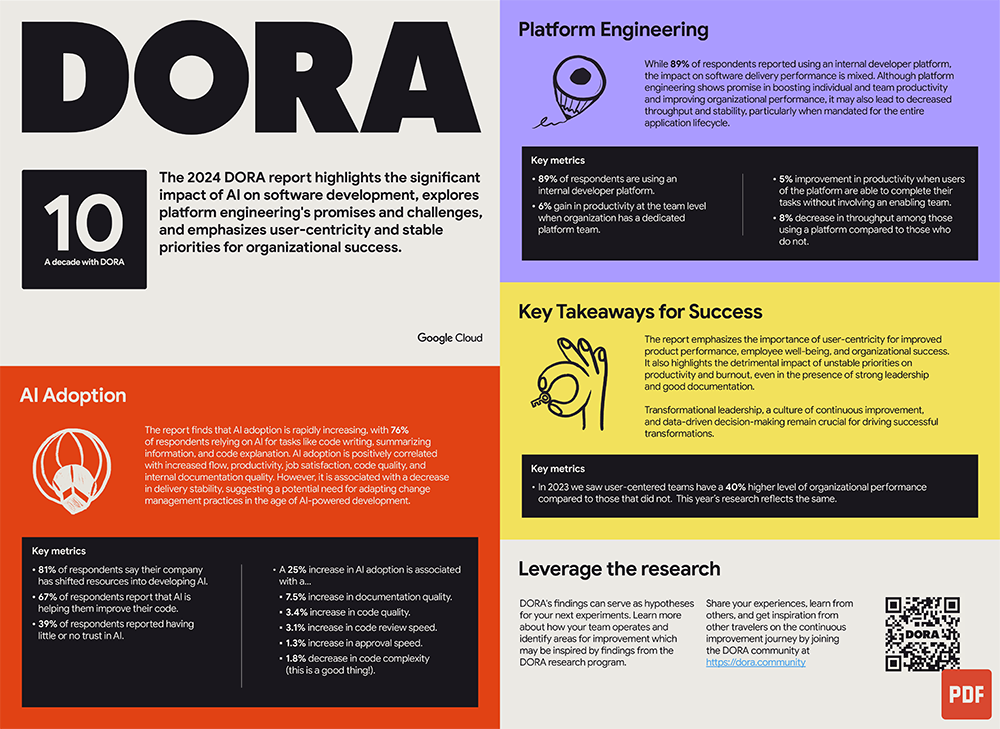
A DORA (Google Cloud) infographic summarizing the 2024 Accelerate State of DevOps findings — it highlights that roughly 76% of respondents report relying on AI for tasks such as writing or explaining code. This data visualization (from a reputable Google Cloud research program) directly contextualizes and supports the topic by showing high developer-level AI adoption that makes a 75% AI-generated-code claim plausible.
Source: DORA (Google Cloud)
Research Brief
What our analysis found
Google CEO Sundar Pichai announced at Google Cloud Next 2026 on April 22-23, 2026, that approximately 75% of all new code written at Google is now AI-generated and subsequently reviewed and approved by human engineers. The figure represents a dramatic acceleration in AI-assisted development: Google reported roughly 25% in October 2024, over 30% in April 2025, and 50% by fall 2025, meaning the share has tripled in just 18 months.
Pichai characterized the shift as a move toward "truly agentic workflows" in which engineers orchestrate "fully autonomous digital task forces" of AI agents rather than writing code line by line. A complex code migration completed with AI agents and engineers was reportedly finished six times faster than the same task accomplished by engineers alone a year earlier. Google developers rely primarily on its Gemini family of models and internal tools, including a new platform called Antigravity, which was used to prototype the Gemini macOS app from concept to native Swift application in just a few days.
Despite the headline figure, Google has stressed that human engineers remain the "ultimate gatekeepers," reviewing every line of AI-generated code before it ships. The company is also formalizing adoption by integrating AI usage goals into engineer performance reviews, signaling that AI-assisted development is now an organizational operating standard rather than an optional experiment.
Fact Check
Evidence from both sides
Supporting Evidence
Direct CEO disclosure
The 75% figure comes directly from Sundar Pichai in a blog post on Google's official publication, The Keyword, titled "Momentum and innovation at Google scale," and was reiterated at the Google Cloud Next 2026 keynote on April 22-23, 2026.
Consistent upward trajectory
The claim is consistent with previously reported milestones — roughly 25% in October 2024, over 30% in April 2025, and 50% by fall 2025 — creating a credible growth curve rather than an overnight jump.
Wide corroboration by major outlets
The announcement was independently reported by numerous reputable publications including Business Insider, The Register, Hindustan Times, The Times of India, and Free Press Journal, all citing Pichai's statements.
Concrete internal examples
Google cited a specific code migration project completed six times faster with AI agents plus engineers than with engineers alone, and referenced the rapid prototyping of the Gemini macOS app using its Antigravity platform, providing tangible evidence of productivity gains.
Institutional commitment
Google's decision to embed AI tool usage targets in employee performance reviews lends credibility to the scale of adoption, indicating company-wide integration rather than isolated experimentation.
Contradicting Evidence
Human approval is baked into the number
The 75% figure specifically describes code that is AI-generated "and approved by engineers," meaning humans still act as quality controllers for every line. AI functions as a high-velocity draft writer, not an autonomous developer, which makes the headline figure sound more dramatic than the underlying workflow may be.
Developer trust remains low
A Google DORA report from September 2025 found that only 24% of developers highly trust AI-generated code, while nearly a third trust it "a little" or not at all — a significant trust paradox that could limit the reliability and autonomy of AI-written code at scale.
Quality and debugging concerns
Industry research warns that AI-generated code can be verbose, complex, or inefficient, potentially shifting engineering time from writing code to reviewing and debugging it, which may offset some of the claimed productivity gains.
Elevated deployment error rates
A May 2025 survey found that over half of software engineering leaders experienced deployment errors from AI-written code, 92% believed AI increased the "blast radius" from bad code in production, and 68% reported spending more time on AI-related security vulnerabilities.
Internal tool friction
Some Google DeepMind employees have reportedly been permitted to use third-party AI coding tools such as Anthropic's Claude Code, suggesting that Google's own Gemini-based tools may not fully satisfy all internal developers, which complicates the narrative of seamless adoption.
Potential marketing incentive
External commentators have noted that such announcements coincide with major product launches — in this case, the Gemini Enterprise Agent Platform — raising questions about whether the figure is partly intended to generate commercial hype for Google's AI offerings.
Report an Issue
Found something wrong with this article? Let us know and we'll look into it.