Geoffrey Hinton on AI's job loss: History’s tech revolutions replaced one job with another. e.g. Tractors replaced farm jobs with factories & office jobs. But AI will break that cycle, because AI can replace both physical+intellectual labor. https://t.co/OzRQoM9gOf
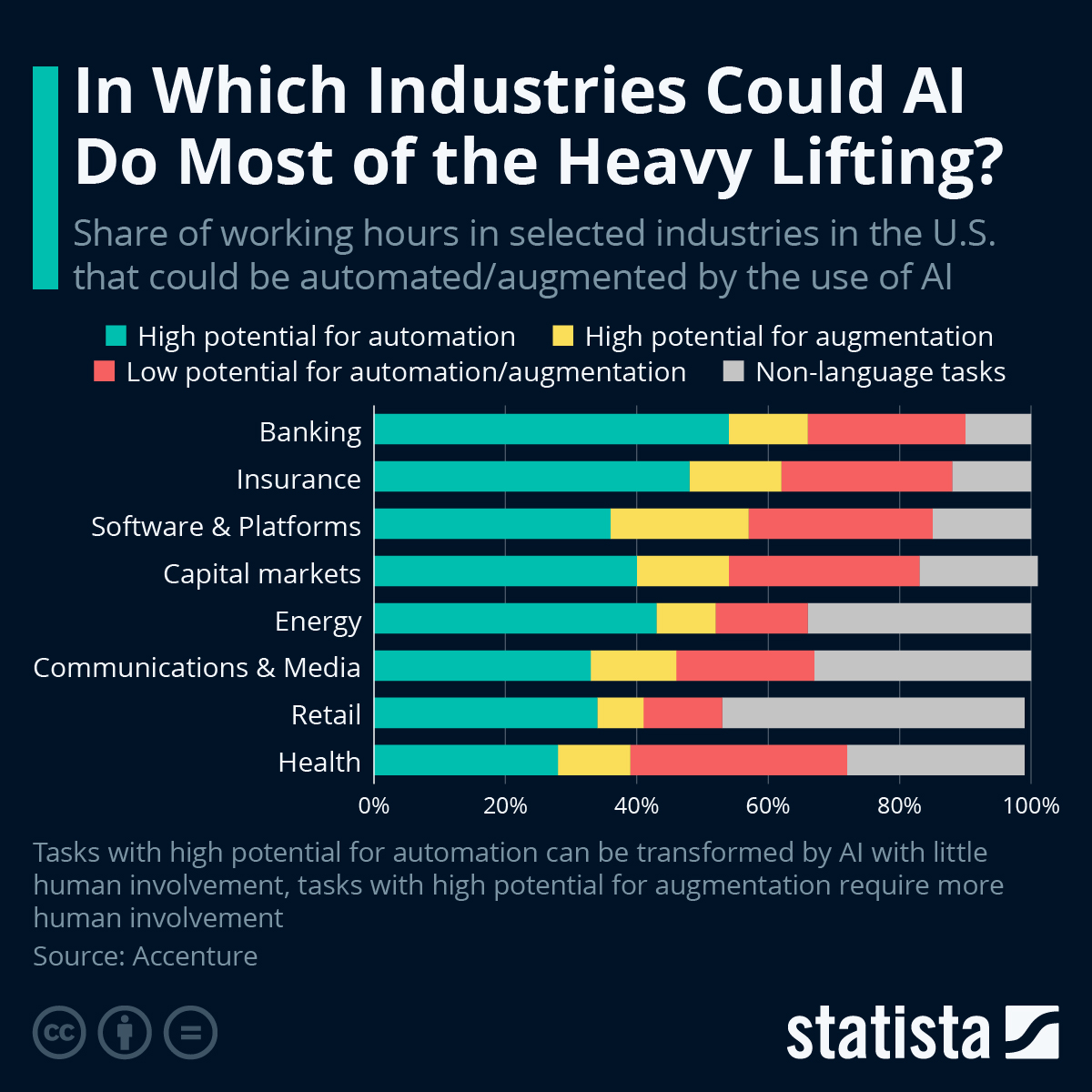
Infographic showing which industries/tasks AI could ‘do the heavy lifting’ for (percentage of work AI can automate/augment by industry). It illustrates that AI exposure spans both cognitively‑heavy sectors (e.g., finance, ICT) and more physical/operations sectors (e.g., manufacturing, logistics), supporting the tweet’s point that modern AI has the potential to replace both intellectual and physical labour.
Source: Statista
Research Brief
What our analysis found
Geoffrey Hinton, the Nobel Prize-winning scientist often called the "godfather of AI," warned in a CNN State of the Union interview aired December 28, 2025, that artificial intelligence "is going to make intelligence more or less irrelevant" and could upend the historical pattern in which one wave of technology simply replaced old jobs with new ones. His argument — that AI uniquely threatens both physical and intellectual labor — has reignited debate about whether this technological revolution is fundamentally different from those that came before.
Recent research lends weight to the scale of the disruption. A joint MIT / Oak Ridge National Laboratory study known as Project Iceberg (October–November 2025) mapped 32,000 skills across 923 occupations for 151 million U.S. worker profiles and concluded that current AI capabilities already overlap with roughly 11.7% of U.S. labor-market wage value — approximately $1.2 trillion. On the physical side, the International Federation of Robotics reported more than 542,000 industrial robots installed worldwide in 2024, with global factory robot density roughly doubling over the prior seven to ten years. Meanwhile, the World Economic Forum's Future of Jobs Report 2025 projects 92 million jobs displaced globally by 2030, offset by 170 million new roles for a net gain of 78 million — though it cautions that 22% of all jobs face significant disruption in the same period.
The tension at the heart of the debate is whether AI's demonstrated ability to pass professional exams, write software, and manage logistics means the traditional economic safety valve — new job creation — will hold. Peer-reviewed analyses show GPT-4 already achieves passing or top-percentile scores on the Uniform Bar Exam and medical-licensing-level questions, while GitHub's controlled experiments report AI coding assistants cutting task completion times by roughly 55%. Whether that translates into mass displacement or mass augmentation remains the trillion-dollar question economists are racing to answer.
Fact Check
Evidence from both sides
Supporting Evidence
AI already overlaps with a significant share of the economy
The MIT / Oak Ridge "Project Iceberg" study (Oct–Nov
simulated 151 million U.S. worker profiles and found current AI capabilities are...
simulated 151 million U.S. worker profiles and found current AI capabilities are technically capable of performing tasks equivalent to roughly 11.7% of U.S. wage value — about $1.2 trillion — with especially heavy exposure in finance, healthcare administration, HR, and professional services, supporting Hinton's claim about intellectual-labor displacement.
Physical automation continues to accelerate
The International Federation of Robotics' World Robotics 2025 report documents over 542,000 industrial robot installations in 2024 and a near-doubling of global factory robot density over the past seven to ten years, confirming that AI-adjacent technology is actively replacing physical labor at a growing pace.
LLMs demonstrate professional-grade cognitive performance
Peer-reviewed evaluations published in 2023–2024 show GPT-4 achieved passing or top-percentile scores on the Uniform Bar Exam, USMLE-style medical questions, and other professional credentialing tests — tasks long considered exclusively human intellectual work.
Enterprise productivity gains are already measurable
GitHub's published research on its AI coding assistant, Copilot, found developers completed certain software engineering tasks roughly 55% faster in controlled experiments, demonstrating that cognitive knowledge work is already being partially automated by current tools.
Leading AI scientists echo the "this time is different" warning
Hinton's CNN interview is part of a broader pattern of public statements from prominent AI researchers and industry leaders between 2023 and 2025 cautioning that next-generation models can substitute for many cognitive tasks simultaneously, lending expert credibility to the claim that AI breaks the historical one-for-one job replacement cycle.
Contradicting Evidence
Historical economics research shows exposure rarely equals displacement
McKinsey Global Institute (
estimated roughly 49% of global work activities are technically automatable at the task level, yet only a small fraction of whole occupations are fully automatable
The OECD (
placed only about 14% of jobs across member countries at high risk of automation
These analyses caution that technical capability does not automatically or immediately translate into mass unemployment.
New-task creation could offset losses again
Research by economists Daron Acemoglu and Pascual Restrepo argues that outcomes depend heavily on whether AI primarily substitutes for labor or complements it by generating new tasks, roles, and demand. They stress that institutional choices and policy design — not technology alone — determine whether job creation keeps pace with displacement.
Aggregate employment data show limited impact so far
Labor-market trackers and early empirical analyses through 2024 found no dramatic aggregate employment declines following the release of ChatGPT and subsequent large language models, suggesting a significant lag between demonstrated AI capability and realized workforce disruption.
The WEF itself projects net job growth
The World Economic Forum's Future of Jobs Report 2025 forecasts 170 million new roles created globally by 2030 against 92 million displaced — a net gain of 78 million jobs — indicating that even organizations sounding alarms about disruption still expect the economy to generate substantial new employment categories.
Task-level automation is not the same as full job replacement
Multiple studies emphasize that most occupations consist of bundles of tasks, only some of which are automatable. Workers may see their roles restructured rather than eliminated, with AI handling routine components while humans focus on judgment, creativity, and interpersonal skills that remain difficult to replicate.
Report an Issue
Found something wrong with this article? Let us know and we'll look into it.