Microsoft's license to OpenAI IP becomes non-exclusive Microsoft and OpenAI just restructured their partnership: OpenAI can now serve its products across any cloud provider, not just Azure, and Microsoft's license to OpenAI IP becomes non-exclusive. Microsoft stops paying revenue share to OpenAI, while OpenAI's payments to Microsoft continue through 2030 with a cap. This is the clearest signal yet that OpenAI is positioning itself as an independent platform company, not Microsoft's AI division. Microsoft stock went -5% after their blogpost.
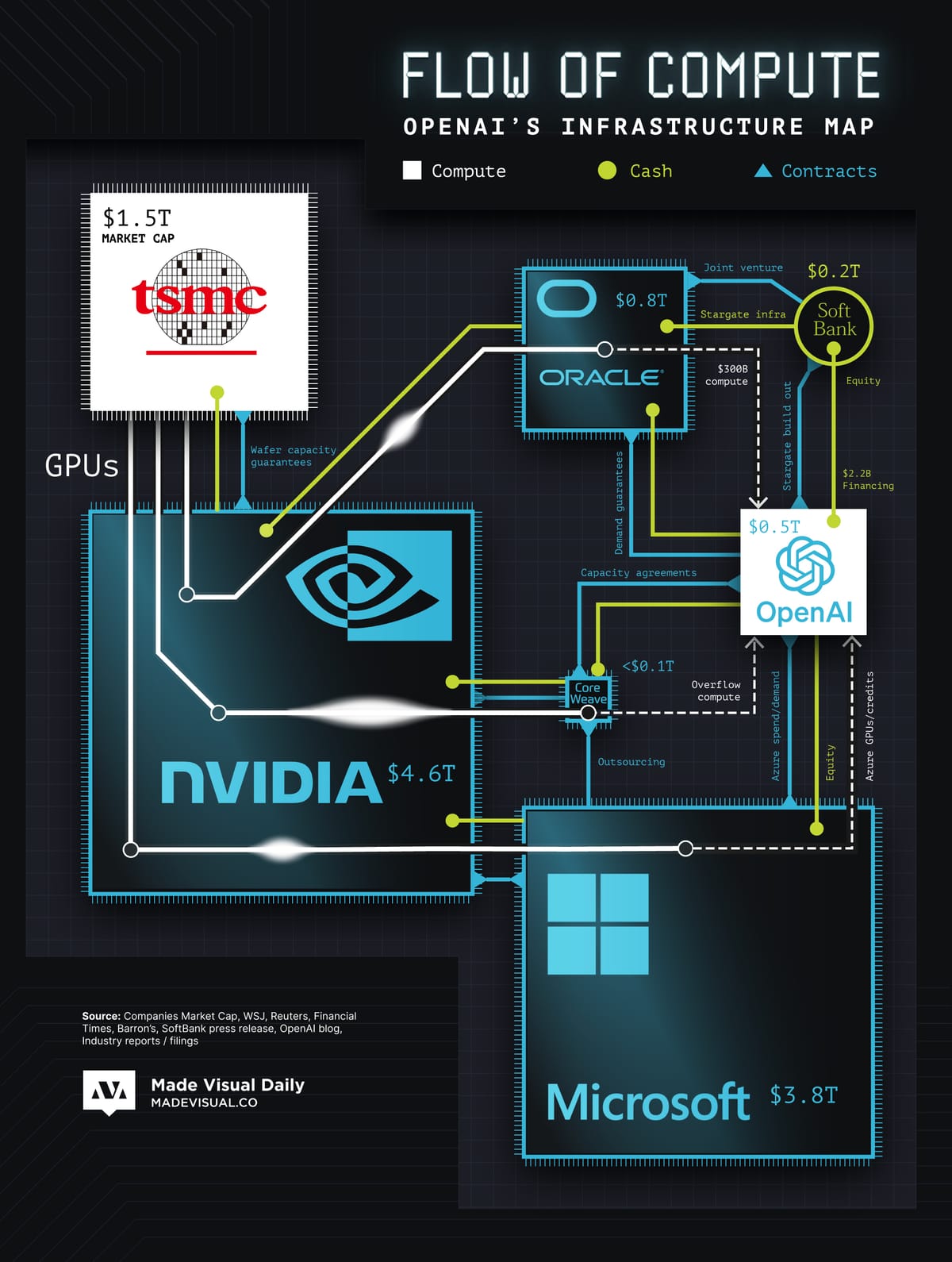
A data-driven infographic mapping OpenAI’s ‘compute, cash, and contracts’ ecosystem that visually shows Microsoft’s dual role as a major cloud/compute provider and investor alongside Nvidia, Oracle, TSMC, etc. It directly supports the topic by illustrating the contractual and compute ties that underpinned the prior exclusive relationship — context that makes Microsoft’s newly non‑exclusive license and OpenAI’s multi‑cloud freedom materially meaningful.
Source: Visual Capitalist / Made Visual Daily
Research Brief
What our analysis found
On April 27, 2026, Microsoft and OpenAI jointly announced a sweeping restructuring of their partnership that grants OpenAI significantly more independence. Under the amended agreement, Microsoft's license to OpenAI's intellectual property becomes non-exclusive and extends through 2032, while OpenAI gains the freedom to serve its products across competing cloud providers such as Amazon Web Services (AWS) and Google Cloud, rather than exclusively through Microsoft Azure. Microsoft will no longer pay a revenue share to OpenAI, but OpenAI will continue paying Microsoft a revenue share of approximately 20% through 2030, subject to a total cap.
Despite granting OpenAI broader operational flexibility, Microsoft retains a substantial 27% equity stake in the AI company and remains its primary cloud partner, with OpenAI products still slated to ship first on Azure. The previous agreement's controversial AGI clause — which could have triggered changes in partnership terms if OpenAI achieved artificial general intelligence — has been removed entirely, simplifying the commercial framework. The restructuring follows OpenAI's growing push to diversify its infrastructure, including a strategic partnership with Amazon announced in February 2026.
Microsoft's stock experienced volatility on the day of the announcement, with shares dropping as much as 5% intraday before recovering to close down approximately 0.37%. Analysts remain divided on the implications: some view the deal as positioning OpenAI as a truly independent platform company, while others argue Microsoft's locked-in IP access, equity stake, and ongoing revenue share make the restructuring a net positive for the tech giant. Further financial details are expected during Microsoft's upcoming Q3 earnings call.
Fact Check
Evidence from both sides
Supporting Evidence
Non-exclusive IP license confirmed
Multiple sources corroborate that Microsoft's license to OpenAI's intellectual property is now non-exclusive and extends through 2032, consistent with the tweet's central claim.
OpenAI gains multi-cloud flexibility
The restructured agreement allows OpenAI to serve its products across any cloud provider, including AWS and Google Cloud, not just Azure — a major shift verified across numerous reports.
Microsoft stops paying revenue share to OpenAI
Reporting consistently confirms that Microsoft will no longer pay a revenue share to OpenAI under the new terms.
OpenAI's payments to Microsoft continue through 2030
OpenAI will continue paying Microsoft approximately 20% revenue share through 2030, with a total cap on payments, exactly as described in the tweet.
OpenAI positioning as independent platform
The combination of multi-cloud access, non-exclusive licensing, and removal of the AGI clause is widely interpreted by analysts as OpenAI asserting itself as an independent platform company rather than a Microsoft-dependent subsidiary.
Contradicting Evidence
Stock drop of 5% is an overstatement of the closing price
While Microsoft shares did fall as much as 5% intraday on April 27, the stock recovered significantly and closed down only approximately 0.37%, making the tweet's framing of a 5% decline misleading if interpreted as the sustained or closing loss.
Microsoft remains deeply entangled with OpenAI
The characterization that OpenAI is no longer "Microsoft's AI division" oversimplifies the relationship. Microsoft retains a 27% equity stake and remains OpenAI's primary cloud partner, with products still shipping first on Azure unless Microsoft is unable or unwilling to support necessary capabilities.
Some analysts view the deal as a net positive for Microsoft
Rather than a loss for Microsoft, several analysts have characterized the restructuring favorably for the company, citing its locked-in IP access through 2032, continued revenue share from OpenAI, and substantial equity position as significant advantages.
Revenue share cap details add nuance
The tweet states OpenAI's payments to Microsoft continue through 2030 "with a cap" but omits that these payments are approximately 20% and are now decoupled from technological milestones like AGI, which represents a simplification of the commercial framework rather than a straightforward concession.
Report an Issue
Found something wrong with this article? Let us know and we'll look into it.