⚡️ Oracle has laid off up to 30,000 employees and replaced them with AI they trained — TIME One of the world’s крупнейших IT companies is cutting thousands of jobs globally. Many of those affected helped train the very systems now replacing them. At the same time, the company continues to spend billions on data centers and AI development. Congratulations! You have successfully completed the project of replacing yourself.
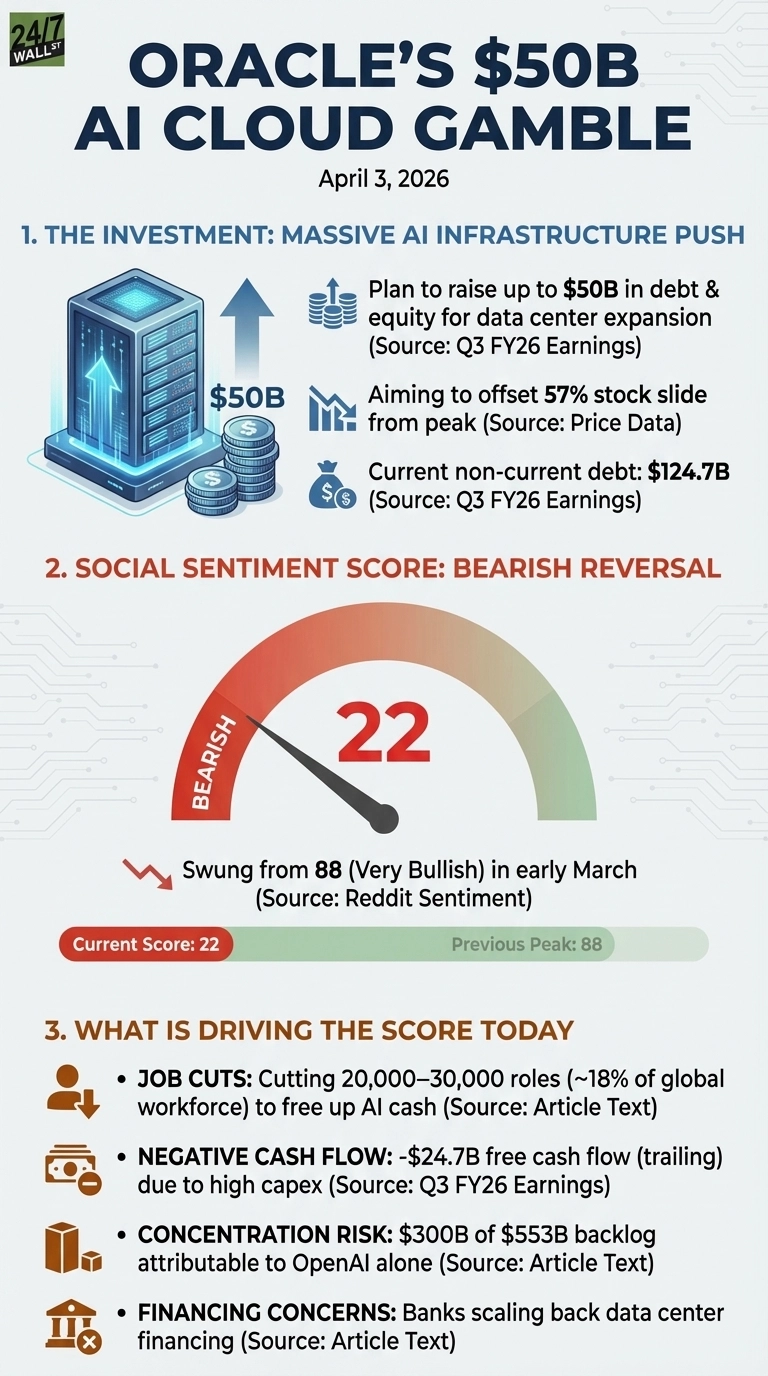
An April 3, 2026 infographic titled "Oracle’s $50B AI Cloud Gamble" that visualizes Oracle’s planned $50B data‑center/AI investment, a bearish social‑sentiment gauge, and a bullet listing driving factors — including job cuts of 20,000–30,000 — directly illustrating the claim that Oracle is cutting large numbers of employees while reallocating capital into AI infrastructure.
Source: 24/7 Wall St.
Research Brief
What our analysis found
On March 31, 2026, Oracle laid off approximately 30,000 employees globally — roughly 18% of its workforce — in one of the largest single-day mass layoffs in recent tech history. Internal sources suggest the total number of cuts could reach as high as 45,000. India was hardest hit, with 12,000 jobs eliminated, representing 40% of Oracle's workforce in the country, while significant reductions also struck the US, Canada, and Mexico. Affected roles spanned database administrators, solution engineers, technical support staff, senior engineers, architects, and product managers across divisions including Oracle Health, Sales, Cloud, Customer Success, and NetSuite. A survey of those impacted found that 62% were over 40 years old and 22% had worked at the company for more than 15 years.
The layoffs came not from financial distress but amid a period of aggressive growth. Oracle's cloud infrastructure revenue had surged by 84%, and the company disclosed a $2.1 billion restructuring plan in its March 2026 SEC filing. Simultaneously, Oracle committed an estimated $156 billion in capital spending on AI infrastructure and secured a $300 billion infrastructure deal with OpenAI. A TIME report published on May 1, 2026, confirmed many former employees felt they had been directed to train the very AI systems that replaced them. Oracle founder Larry Ellison reportedly told investors that AI models are now writing the company's code, replacing human engineers.
The aftermath has been swift and contentious. More than 600 laid-off employees sent a letter to Oracle management on April 17, 2026, demanding increased severance and extended healthcare benefits. Oracle's stock price rose 6% the day after the layoffs were announced, though Bloomberg projects the company will be cash flow negative until at least 2030 due to its massive AI infrastructure investments. The episode has become a flashpoint in the broader debate over how tech companies are redesigning their workforces around artificial intelligence.
Fact Check
Evidence from both sides
Supporting Evidence
TIME confirmed the 30,000 figure
A TIME article published on May 1, 2026, reported that up to 30,000 workers were laid off by Oracle "in the last month as the company pivots toward AI," directly corroborating the tweet's central claim.
Employees reported training their own replacements
The TIME report highlighted that many former employees "felt they had been told to train AI systems to replace them." A former technical writer identified as Jill stated, "They're having you do something, it's recorded, and then they're going to replace you with whatever you just built."
AI is directly replacing specific technical roles
Elevate Icons Magazine reported that AI is directly replacing database administrators, solution engineers, and technical support staff, and that Oracle's AI pilot programs showed AI systems can detect and resolve approximately 94% of database issues without human intervention.
Larry Ellison confirmed AI is replacing human engineers
Oracle's founder reportedly informed investors that AI models are now responsible for writing the company's code, replacing human engineers — a direct acknowledgment from leadership that AI substitution is driving workforce changes.
Billions are being spent on AI infrastructure as stated
Oracle has committed an estimated $156 billion in capital spending and secured a $300 billion infrastructure deal with OpenAI, confirming the tweet's claim that the company "continues to spend billions on data centers and AI development."
Industry analysts describe it as deliberate workforce redesign
The HR Digest characterized the layoffs as "less about cost-cutting and more about workforce redesign to align goals with AI expansion," noting Oracle is "slowly eliminating legacy roles" with the understanding that "what can be coded will be replaced."
Contradicting Evidence
Capital reallocation, not pure AI replacement
Derek Tomei of The PeopleSoft Insider argued that the 30,000 layoffs were primarily a "capital reallocation strategy" to fund $8-10 billion annually for AI data center construction, rather than a straightforward case of AI directly replacing human workers in their roles.
Oracle is still actively hiring for human roles
Despite the mass layoffs, Oracle Consulting is actively recruiting for PeopleSoft consultants, indicating ongoing demand for human expertise in certain areas and suggesting the narrative of total human-to-AI replacement is oversimplified.
Workforce redesign includes new hiring plans
The HR Digest reported that Oracle plans aggressive hiring in "high skill, future-facing roles," particularly in cloud and AI, even as legacy and support roles are automated — pointing to a workforce transformation rather than a complete elimination of human labor.
Oracle has not officially confirmed the AI replacement narrative
Oracle has not publicly confirmed the exact number of layoffs or explicitly stated that AI is directly replacing employees across all affected roles. An Oracle representative declined to comment to TIME on the layoffs, leaving the company's official position ambiguous.
The tweet's framing omits financial complexity
Bloomberg data projects Oracle will be cash flow negative until at least 2030 due to its AI infrastructure investments, suggesting the strategy carries significant financial risk and is not the seamless, triumphant AI transition the tweet implies.
Report an Issue
Found something wrong with this article? Let us know and we'll look into it.