What does portfolio construction look like in a world shaped by inflation, geopolitics, and #AI? In this episode of The Bid #podcast, Vivek Paul joins host Oscar Pulido to unpack why investors may need to move beyond static asset allocation and rethink portfolios for a more uncertain and fast-changing market environment. 🎧 Listen: https://t.co/XjrgOULpEN
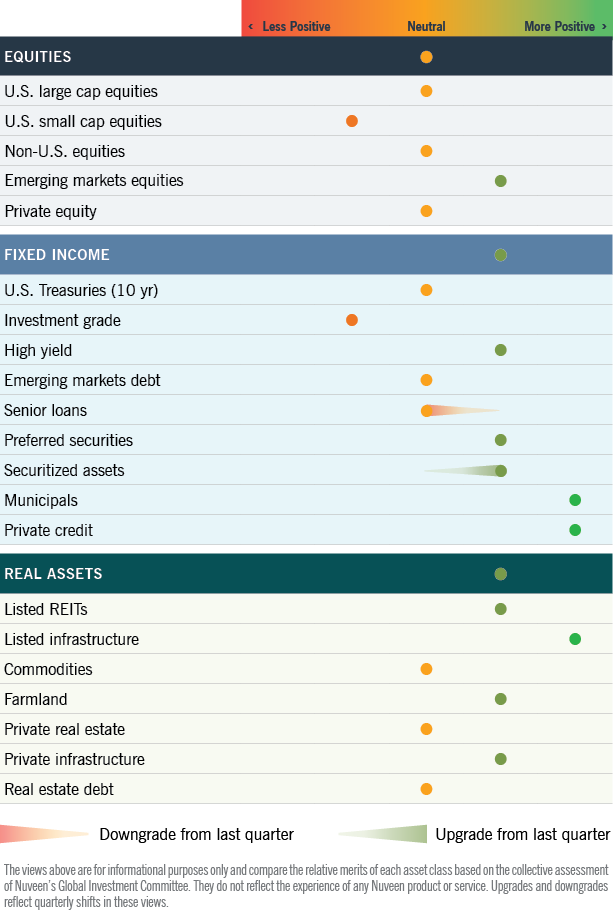
Nuveen’s 'Asset class heat map' (Investment Outlook, Sept 30, 2024) visualizes cross‑asset convictions for a one‑year horizon—showing favored tilts (e.g., infrastructure, private credit, municipals) and areas to underweight. It directly supports the podcast theme by illustrating how portfolio construction is being adjusted tactically in response to inflation, geopolitical risk, and AI‑driven market dynamics rather than relying on a static allocation.
Source: Nuveen
Research Brief
What our analysis found
BlackRock's latest episode of The Bid podcast, released on April 24, 2026, features Vivek Paul, Head of Portfolio Research and UK Chief Investment Strategist at the BlackRock Investment Institute, making the case that traditional portfolio construction frameworks are no longer fit for purpose. Paul argues that persistently high core inflation, structurally elevated geopolitical risk, and the accelerating influence of artificial intelligence are fundamentally reshaping how investors should think about asset allocation — moving away from static models toward more dynamic, granular approaches.
The data underscores why this shift matters. An average inflation rate of just 3% per year can cause the cost of goods and services to double roughly every 24 years, steadily eroding the real value of fixed-income holdings and cash. Meanwhile, historical analysis over the last three decades shows that elevated geopolitical risk correlates with lower equity returns and increased forecast volatility, while persistent geopolitical friction can raise risk premia and alter the diversification characteristics of traditional asset classes. On the AI front, the sector is projected to grow at 36.6% year-on-year through 2030, and 29% of investment professionals are already integrating AI into their strategies, with 81% of clients expressing interest in AI-managed funds.
The convergence of these forces is challenging a foundational assumption of modern portfolio theory: that stocks and bonds reliably move in opposite directions. Capital Group's analysis found that during periods of high and volatile inflation, both asset classes can decline simultaneously, undermining traditional diversification benefits. Experts from firms including William Blair, Russell Investments, PIMCO, and Baird echo the conclusion that investors must adopt flexible, dynamically adjusted portfolios to navigate what Paul describes as a fundamentally changed market environment.
Fact Check
Evidence from both sides
Supporting Evidence
BlackRock's own podcast confirms the thesis
The April 2026 episode of The Bid, titled "Portfolio Construction for a Changing World," features Vivek Paul explicitly arguing that higher inflation, shifting interest rates, and accelerating megaforces like AI and geopolitics are challenging traditional assumptions about diversification and static asset allocation.
Capital Group identifies inflation's threat to diversification
An August 2023 Capital Group analysis found that high inflation can cause stocks and bonds to move in tandem rather than inversely, negating the core diversification benefit that static portfolios rely on and making multi-asset inflation adjustments essential.
William Blair documents a structural inflation shift
A William Blair paper from April 2026 identifies a regime change toward higher and more volatile inflation that is altering how major asset classes interact, specifically challenging the traditional stock-bond diversification relationship.
Russell Investments links geopolitics to portfolio risk
In March 2026, Russell Investments noted that sustained geopolitical friction can increase risk premia and modify the diversification characteristics of assets, reinforcing the need for investors to account for these forces in portfolio construction.
PIMCO warns of unstable cross-asset correlations
PIMCO's research shows that globalization has made asset class correlations less stable, with correlations tending to spike during market turbulence — meaning previously uncorrelated assets may suddenly exhibit similar risk exposures, undermining static allocation models.
AI adoption in investment management is accelerating
Industry data shows 29% of investment professionals are integrating AI into strategies, 64% are developing AI and machine learning skills, and 81% of clients have expressed interest in AI-managed funds, confirming AI's growing role as a portfolio construction force.
Multiple firms advocate dynamic allocation
Several financial analyses from Baird, PIMCO, and others explicitly advocate for dynamic asset allocation strategies that adjust portfolio mixes in response to evolving market conditions, directly supporting the podcast's central argument against static approaches.
Contradicting Evidence
Static allocation has historically delivered strong long-term results
Despite calls for dynamic approaches, decades of evidence show that simple, static balanced portfolios such as the classic 60/40 stock-bond mix have delivered competitive long-term returns, and frequent tactical adjustments can introduce trading costs, tax inefficiencies, and the risk of mistiming markets — meaning the case against static allocation may overstate its shortcomings.
Dynamic strategies are difficult to execute consistently
Academic research has long shown that market timing and tactical asset allocation are extremely difficult to implement successfully over time, with many active and dynamic strategies underperforming their static benchmarks after fees, suggesting that moving beyond static allocation is easier to recommend than to profitably execute.
AI's investment impact remains partly speculative
While AI adoption is growing, the technology's actual track record in portfolio management is limited, and projections of 36.6% annual sector growth through 2030 reflect commercial expansion rather than proven superiority in investment outcomes — meaning AI's transformative role in portfolio construction may be more aspirational than demonstrated at this stage.
Geopolitical risk premiums can be short-lived
Historical analysis shows that while geopolitical shocks can trigger immediate market volatility, equity markets have frequently recovered quickly from such events, suggesting that permanently restructuring portfolios around geopolitical risk may lead to unnecessary defensiveness and missed returns.
Inflation may already be moderating
Some economists argue that the inflationary spike of recent years was driven by pandemic-era supply disruptions and fiscal stimulus rather than a permanent structural shift, and that central bank tightening is bringing inflation back toward target levels — potentially reducing the urgency to abandon inflation-era portfolio frameworks.
Report an Issue
Found something wrong with this article? Let us know and we'll look into it.