JASON: “Elon seems to think we're gonna have one robot for every human.” JENSEN HUANG: “I'm hoping more … We're millions of people short in labor today. We're actually really desperately in need of robotics. All of these companies could grow more if they had more labor.” https://t.co/tpWYctGAaz
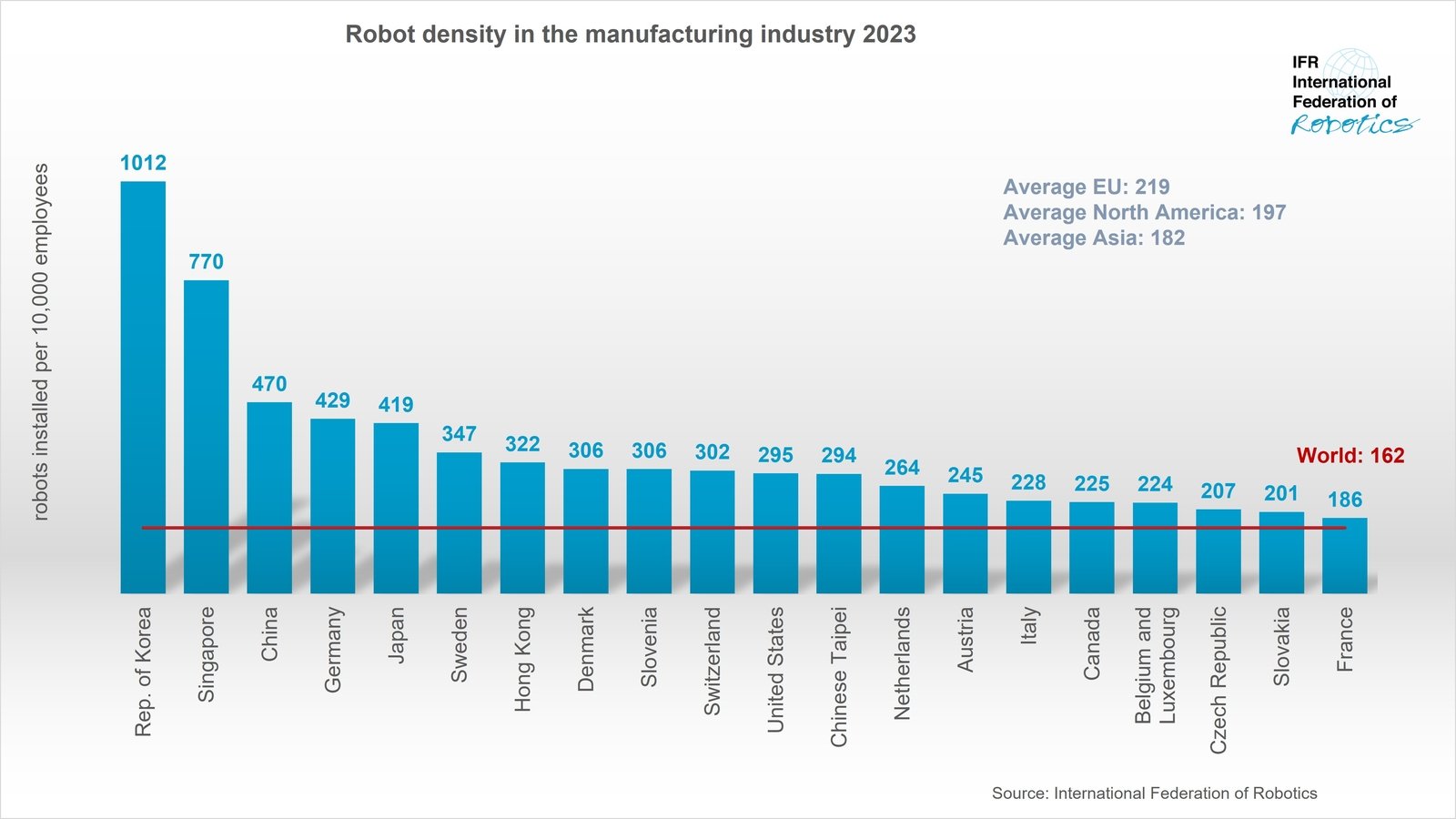
Bar chart showing robot density in manufacturing (robots installed per 10,000 employees) by country for 2023 with a world average of 162 per 10,000; it directly illustrates that current robot adoption is far below a 1:1 robot-to-human ratio and provides recent, reputable data relevant to the tweet's discussion of robots versus human labor.
Source: International Federation of Robotics (IFR)
Research Brief
What our analysis found
Tech industry titans are escalating their rhetoric around humanoid robotics as the solution to global labor shortages, with Nvidia CEO Jensen Huang and Tesla CEO Elon Musk offering competing but complementary visions. In a March 2025 CNBC interview, Huang stated the world is "short of tens of millions of workers" and projected that the labor gap could reach 30 to 50 million workers by the end of the decade, framing robotics and "physical AI" as an urgent necessity rather than a futuristic novelty. Musk, meanwhile, has pitched an even more ambitious consumer-facing vision, telling attendees at Tesla's October 2024 "We, Robot" event that "everyone among the 8 billion people on Earth will want an Optimus buddy," with a projected price target of $20,000 to $30,000 per unit.
The gap between these aspirations and current reality remains enormous. According to the International Federation of Robotics, there were only approximately 4.28 million industrial robots in operation globally at year-end 2023, with a robot density of just 162 units per 10,000 manufacturing workers. Scaling from that baseline to anything approaching one robot per person would require manufacturing and technological advances of several orders of magnitude. Nvidia has moved aggressively to position itself as the infrastructure provider for this anticipated wave, launching "Physical AI" initiatives and partnerships with U.S. manufacturing and robotics firms, as detailed in a May 2025 company press release focused on American reindustrialization.
Yet credible reporting has raised questions about how close the technology actually is. Bloomberg, Ars Technica, and other outlets revealed that Tesla's Optimus robots at the October 2024 event were partially human-assisted and teleoperated, suggesting the gap between demonstration and true autonomy remains significant. Robotics experts have cautioned that general-purpose humanoids for home and workplace use are likely years or decades away from reliable deployment, and that useful adoption will be gradual and sector-specific rather than the sweeping revolution both CEOs describe.
Fact Check
Evidence from both sides
Supporting Evidence
Huang explicitly cited massive labor shortfalls
In CNBC interviews on March 19 and May 28, 2025, Jensen Huang stated the world is short "tens of millions of workers" and projected shortfalls of 30 to 50 million by the end of the decade, directly framing robotics as an urgent economic necessity.
Musk has publicly pitched mass-market humanoid adoption
At Tesla's "We, Robot" event on October 10–11, 2024, Elon Musk said "everyone among the 8 billion people on Earth will want an Optimus buddy" and floated consumer price targets of $20,000–$30,000, supporting the "one robot per person" aspiration attributed to him in the tweet.
The "one robot per person" narrative is spreading across the industry
Companies such as Robotis and PersonaAI have adopted "one person, one robot" language at CES and in corporate communications, indicating this is a growing industry-wide narrative rather than an isolated statement from two CEOs.
Nvidia is investing heavily in physical AI infrastructure
In a May 2025 press release, Nvidia announced partnerships with U.S. manufacturing and robotics leaders through its Omniverse platform and physical AI tools, providing concrete corporate investment backing the rhetoric.
Persistent global labor shortages provide real economic rationale
OECD and ILO data confirm ongoing sectoral skills shortages across multiple regions, with millions of positions difficult to fill, lending empirical support to the labor-gap argument both CEOs invoke.
Contradicting Evidence
Current robot numbers are nowhere near these projections
The International Federation of Robotics reported only approximately 4.28 million industrial robots operating worldwide at year-end 2023, compared to roughly 8 billion humans — achieving one robot per person would require a manufacturing scale-up of more than a thousandfold from today's installed base.
Tesla's Optimus demos relied on human operators
Reporting from Bloomberg, Ars Technica, and Fortune revealed that Tesla's Optimus robots at the October 2024 "We, Robot" event were partially teleoperated by humans behind the scenes, demonstrating that true humanoid autonomy remains far from the seamless consumer product Musk describes.
Robotics experts warn timelines are overly optimistic
Prominent researchers and industry analysts have publicly cautioned that general-purpose humanoid robots for home use are significantly harder to develop than CEO rhetoric implies, and that practical deployment will likely remain gradual and limited to specific industrial domains for the foreseeable future.
Economic and deployment constraints limit scaling
Even existing industrial robots are concentrated in a handful of sectors — automotive, electronics, and logistics — and extending automation to less structured environments such as homes, healthcare, and small businesses presents engineering, regulatory, and cost barriers that no company has yet overcome at scale.
Report an Issue
Found something wrong with this article? Let us know and we'll look into it.