さぁさぁ半導体脅威的なAI実需が始まる 史上最強の生産能力拡大の年!TSMC、MediaTek、ASEはまだ利益のピークを迎えておらず、「真の好景気」が到来した。 AI需要の高まりを受け、台湾の三大半導体企業であるTSMC、MediaTek、ASE Technology Holdingのファンダメンタルズはいずれも強化されている。サプライチェーン関係者によると、今年はTSMCとASEにとって過去最高の生産能力拡大の年となる見込みだ。関連する生産能力の導入はまだ初期段階にあるものの、今後2年間で大規模な生産能力が徐々に稼働開始すると予想される。半導体生産能力拡大ブームは徐々に経済成長を後押しし、業界の繁栄はまだピークに達していない。 24日、TSMC、MediaTek、ASE Technology Holdingの3社は、株価と時価総額の両方で過去最高値を更新し、時価総額はそれぞれ56兆6700億台湾ドル、3兆9000億台湾ドル、2兆2000億台湾ドルに達した。これら台湾の大手半導体企業の幹部らは、3社の中でもTSMCとASEはそれぞれの分野で世界最大手であり、MediaTekは台湾最大のIC設計会社であると指摘し、台湾の産業構造の急速な変革を象徴していると述べた。 サプライチェーン関係者は、過去2~3年間、世界の半導体およびAI関連投資が年々増加していると指摘した。ウェハー製造会社であるTSMCやIC設計会社のMediaTekから、パッケージングおよびテストの大手企業であるASEに至るまで、設備投資額は年々過去最高を更新している。高度なプロセス、高度なパッケージング、テスト能力が同時に拡大され、業界チェーン全体が包括的な拡大段階へと移行している。 半導体業界は現在、「生産能力の拡大が需要に追いつかない」という構造的な現象に直面している。業界関係者によると、新工場の建設には用地取得から生産開始まで数年かかることが多いという。AI需要の急速な増加に伴い、既存の工場資源は極めて不足しており、工場を見つけることさえ困難な状況に陥っている。多くのメーカーは、生産開始までの期間を短縮するために、合併・買収や既存工場のリースなどを通じて生産能力の拡大を加速させており、市場需要が予想をはるかに上回っていることを示している。 サプライチェーン関係者によると、大手半導体企業3社のうち、TSMCは先進プロセスとパッケージングへの投資を継続的に拡大しており、現在世界中で12の新工場が計画中または建設中である。MediaTekは新竹高速鉄道駅前に17階建ての本社ビルを建設中で、2027年に開業予定である。また、苗栗通洛科学園区にデータセンターを建設中で、チップ設計プロセスを強化し、強化学習と生成AIを組み込む予定である。ASE Technology Holding Co., Ltd.は、先進パッケージングとテスト能力を全面的に拡大している。これら3社の半導体企業は、設計・製造からパッケージング・テストまで完全なサプライチェーンを形成しており、サプライチェーンの上流と下流に利益をもたらし、世界の半導体産業における台湾の戦略的地位を強化している。
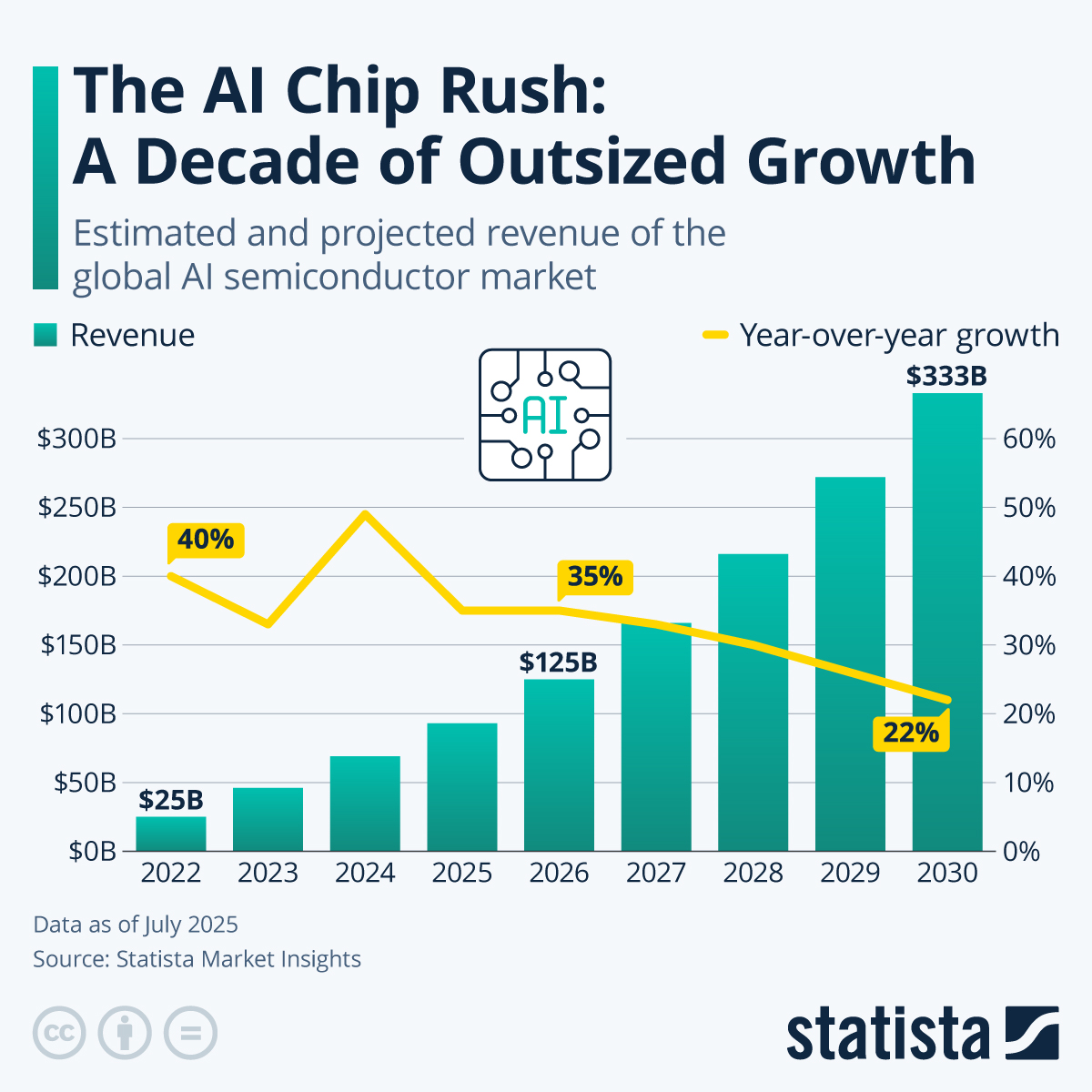
このインフォグラフィックはグローバルAI半導体市場の推定・予測収益(2022–2030)を示しており、AI向けチップ需要が急拡大していることを視覚的に示しています。TSMC/MediaTek/ASEらの生産能力拡大や設備投資がAI需要によって駆動されている、という本文の主張(需要拡大が供給拡大を促す)を裏付ける資料として直接関連します。
Source: Statista
Research Brief
What our analysis found
Taiwan's semiconductor industry is riding an unprecedented wave of AI-driven demand, with the country's three largest chip companies — TSMC, MediaTek, and ASE Technology Holding — all hitting record stock prices and market capitalizations on April 24, 2026. TSMC, which produces over 90% of the world's most advanced chips, saw its market cap reach NT$56.67 trillion, while MediaTek hit NT$3.9 trillion and ASE reached NT$2.2 trillion. The surge reflects a structural transformation in global technology spending, with the World Semiconductor Trade Statistics organization forecasting the global chip market will reach a record USD $760.7 billion in 2026, representing 8.5% annual growth. Taiwan's stock market has climbed past $4 trillion in total value, surpassing the United Kingdom, largely on the back of its semiconductor giants.
The scale of capital expenditure is staggering. TSMC expects its 2026 capex to hit the high end of a $52–56 billion range, up as much as 40% from 2025, with up to 10 fabs under construction or starting across Taiwan and 12 new plants globally in planning or construction. ASE, the world's largest chip packaging and testing provider, has earmarked an initial $7 billion capex budget for 2026 — a 27% increase over 2025 — and plans to break ground on six new plants worldwide, including a facility in Kaohsiung worth over NT$108.3 billion (US$3.41 billion). MediaTek, pivoting aggressively toward data centers, is targeting $1 billion in data center revenue in 2026 and plans to double its investment in related technologies.
TSMC's first-quarter 2026 results underscore the boom: revenue hit US$35.9 billion, a 40.6% year-on-year increase, with net profit surging 58% to approximately $18 billion. High-performance computing, including AI workloads, accounted for 61% of Q1 sales. ASE expects its advanced packaging business alone to double to $3.2 billion in 2026, driven by demand from AI chipmakers like Nvidia. Industry leaders report a structural phenomenon where production capacity expansion cannot keep up with demand, forcing companies to pursue mergers, acquisitions, and factory leases to accelerate timelines. Some 93% of semiconductor executives anticipate revenue growth in 2026, signaling broad confidence that the industry's peak remains ahead.
Fact Check
Evidence from both sides
Supporting Evidence
TSMC's record financial performance confirms AI-driven boom
TSMC's Q1 2026 revenue of US$35.9 billion represented a 40.6% year-on-year increase, with net profit rising 58% to approximately $18 billion. High-performance computing including AI accounted for 61% of sales, validating claims of surging AI real demand.
Historic capital expenditure levels across all three companies
TSMC's 2026 capex is projected at $52–56 billion (up 40% from 2025), ASE's initial 2026 budget is $7 billion (up 27%), and MediaTek is doubling data center technology investment — all consistent with the tweet's claim of the strongest production capacity expansion year in history.
Record market capitalizations confirmed by market data
TSMC's ADRs gained 5.17% on April 24, 2026, and its shares rose to NT$2,310 on April 27. ASE's market cap was $68.93 billion (approximately NT$2.03 trillion on TPE) as of late April 2026, broadly supporting the tweet's record valuation claims.
Massive global fab construction validates expansion narrative
TSMC has up to 10 fabs under construction in Taiwan for 2nm and below nodes, plus global facilities. ASE is breaking ground on six new plants worldwide in 2026, including its massive Kaohsiung Renwu facility. These confirm the tweet's assertion of 12 TSMC plants and unprecedented ASE expansion.
Structural supply shortage supports 'peak not yet reached' thesis
Multiple industry sources confirm that new fab construction takes years from land acquisition to production, and existing capacity is severely strained. ASE indicated potential upward revision of its already record capex, and TSMC raised its 2026 revenue growth forecast to over 30% year-over-year, suggesting fundamentals are still strengthening.
Global market data validates Taiwan's strategic semiconductor position
Taiwan produces over 60% of the world's semiconductors and over 90% of the most advanced chips. TSMC alone accounts for over 40% of Taiwan's total market capitalization, and 93% of semiconductor executives expect 2026 revenue growth.
Contradicting Evidence
MediaTek's all-time high on April 24 is not fully corroborated
Available market data shows MediaTek fell 0.41% to NT$2,425 on April 27, 2026. While the tweet claims all three companies hit all-time highs on April 24, the specific MediaTek record on that exact date is not explicitly confirmed by independent sources.
MediaTek's new HQ and Miaoli data center details lack independent verification
The tweet's specific claims about a 17-story headquarters near Hsinchu HSR station opening in 2027 and a data center in Miaoli's Tongluo Science Park are not explicitly detailed in available independent research, though MediaTek's broader aggressive investment posture is well documented.
ASE's reported market cap figures show slight discrepancy
The tweet states ASE's market cap reached NT$2.2 trillion, but available data from April 23, 2026 shows NT$2.03 trillion for TPE:3711. While the figures are in a similar range and may reflect intraday fluctuations on April 24, the exact NT$2.2 trillion figure is not precisely corroborated.
Geopolitical risks could disrupt the boom narrative
The tweet presents an unqualified optimistic outlook, but Taiwan's semiconductor industry faces significant geopolitical vulnerabilities including cross-strait tensions with China, U.S.-China trade restrictions, and the challenges of diversifying manufacturing globally — factors that could impede the projected growth trajectory.
Capacity expansion timelines involve significant execution risk
While the tweet frames massive expansion as imminent, new fabs typically require years from groundbreaking to volume production. TSMC's Fab 25 in Central Taiwan for 1.4nm processes targets risk production only by late 2027, and ASE's Kaohsiung facility begins phase one production in April 2027, meaning actual revenue impact is further out than the tweet's urgency suggests.
Cyclical downturn risks are not acknowledged
The semiconductor industry is historically cyclical. While current AI demand is robust, the tweet's assertion that the true boom is just beginning does not account for potential demand normalization, inventory corrections, or macroeconomic slowdowns that have repeatedly interrupted past semiconductor upcycles.
Report an Issue
Found something wrong with this article? Let us know and we'll look into it.