"Top earners are more afraid for their employment than lower income as AI threat increases," per CNBC
Source: Pew Research Center
Research Brief
What our analysis found
A February 2026 CNBC report by Jeff Cox highlights a striking trend: America's highest earners are exhibiting historically elevated levels of employment anxiety, with University of Michigan consumer survey data showing labor confidence among the top income tercile near its lowest point since 2009 and approaching lows not seen since the late 1970s. The report draws on multiple data sources to paint a picture of white-collar workers clinging to their current positions amid growing fears that artificial intelligence could reshape or eliminate their roles.
The data supporting this narrative is broad-based. The New York Fed's Survey of Consumer Expectations for December 2025 found that the perceived probability of finding a job within three months of losing one fell to a series low of 43.1%. Meanwhile, ADP's National Employment Report for February 2026 showed the job-switcher pay premium narrowing to a record low, with job-stayers earning 4.5% more year-over-year versus 6.3% for job-changers — a gap so slim it removes a key incentive to leave. Total turnover hit 5.8% in January 2026, near a decade low, with the sharpest declines in white-collar sectors: Information sector turnover plunged to 4.4% from 7.8% year-over-year, and Professional and Business Services fell to 5.8% from 6.6%.
Academic research provides a structural explanation for why top earners may feel uniquely threatened. A landmark 2023 study by OpenAI and the University of Pennsylvania found that higher-income occupations have significantly greater exposure to large language model capabilities, a finding echoed by the Bank for International Settlements in 2024. However, actual unemployment in many high-income fields remained relatively low entering 2026 — professional and technical services stood at just 3.1% in January — suggesting the anxiety may be running well ahead of real job losses, at least for now.
Fact Check
Evidence from both sides
Supporting Evidence
University of Michigan survey shows historic lows for top earners
CNBC's Jeff Cox report explicitly cites Michigan consumer survey data showing labor confidence among the top income tercile at its lowest since 2009 and near lows dating back to the late 1970s, directly supporting the claim that top earners are unusually fearful.
NY Fed job-finding expectations hit a record low
The December 2025 Survey of Consumer Expectations found the perceived probability of finding a new job within three months fell to 43.1%, a series low, reflecting broad but pronounced employment anxiety consistent with the claim.
ADP data confirms white-collar job-hugging
Turnover in Information fell to 4.4% from 7.8% year-over-year, and Professional and Business Services dropped to 5.8% from 6.6%, with the job-switcher pay premium at a record low — all indicating high-income workers are staying put out of fear.
JOLTS data shows professional sector quits plunging
The December 2025 JOLTS report recorded a quits rate of 2.0% overall, with Professional and Business Services quits dropping by 151,000 month-over-month, reinforcing reduced mobility among white-collar workers.
AI exposure research supports structural anxiety
The 2023 OpenAI/UPenn study and 2024 BIS research both found that higher-wage, higher-skill occupations face greater exposure to AI task automation, providing an empirical basis for why top earners would feel disproportionately threatened.
Contradicting Evidence
Pew Research finds small income-based differences in AI worry
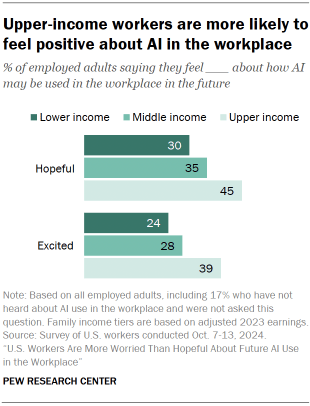
A February 2025 Pew survey found that upper-income workers were actually more likely to say AI would not change their job opportunities, with only 26% saying AI would reduce their future prospects — suggesting the fear gap between income groups may be overstated.
Lower-wage workers also report high AI anxiety
An Axios/HarrisX survey from January 2026 found that most lower-wage workers believe AI threatens their jobs, contradicting the framing that fear is concentrated primarily among top earners and suggesting anxiety is widespread across the income spectrum.
Actual unemployment in high-income fields remains low
Despite elevated anxiety, professional and technical services unemployment stood at just 3.1% in January 2026 and hospital sector unemployment at 1.9%, indicating that top earners' fears may be disproportionate to the actual labor market risk they currently face.
AI exposure may complement rather than replace
While research confirms high-income jobs are more exposed to AI capabilities, both the BIS and recent NBER work emphasize that much of this exposure operates through complementarity rather than pure substitution, meaning AI may augment rather than eliminate many top-earner roles.
Report an Issue
Found something wrong with this article? Let us know and we'll look into it.