Weyerhaeuser, the country’s top logger, is betting artificial intelligence can deliver big changes to American forestry https://t.co/rD1GSCkQAi
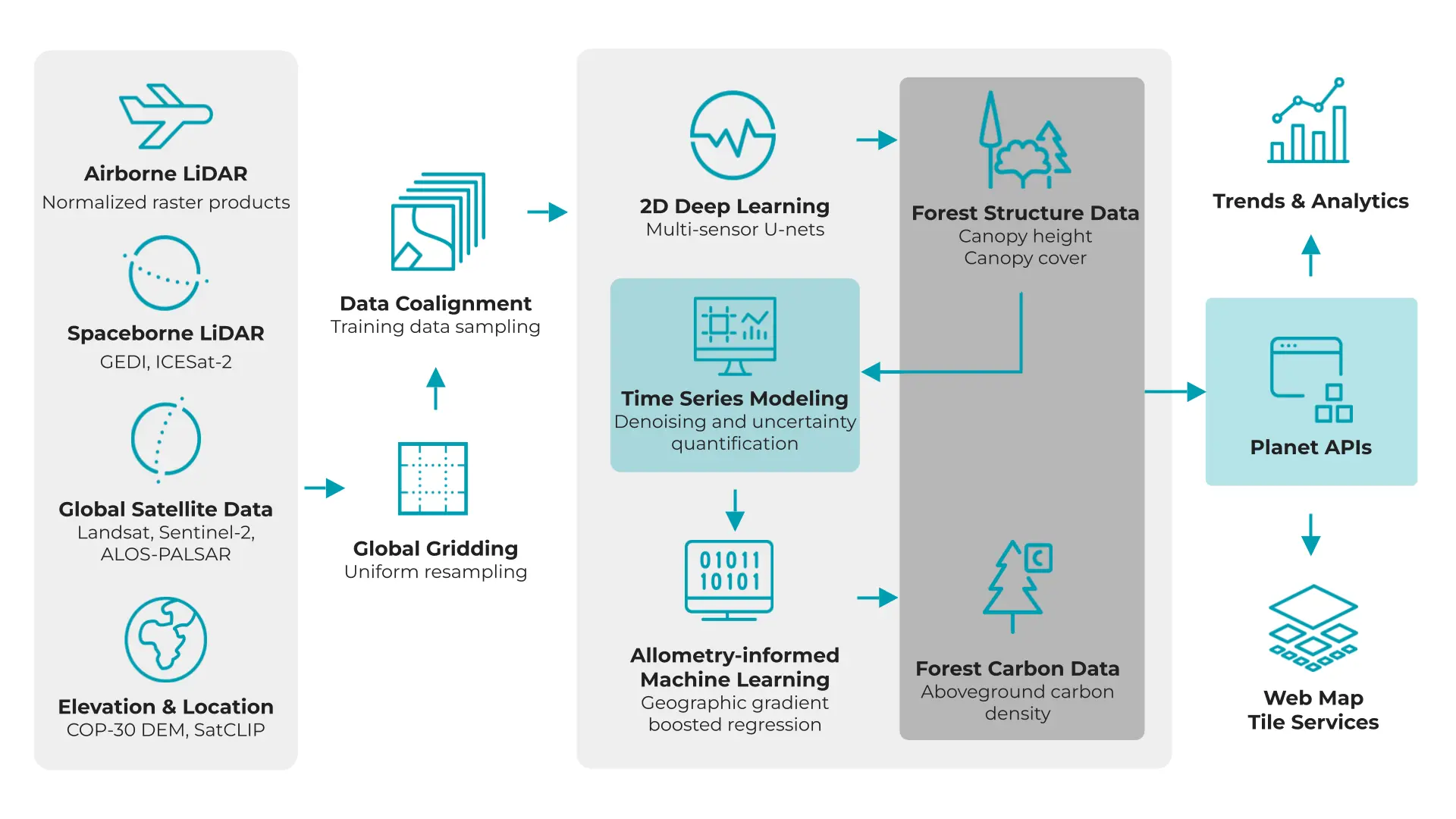
A clear workflow infographic showing how airborne LiDAR, spaceborne LiDAR and satellite imagery are fused with machine‑learning and time‑series modeling to produce canopy height, canopy cover and aboveground carbon data and web/API delivery — directly illustrating the kind of AI + remote‑sensing ‘digital twin’ tools Weyerhaeuser is investing in to map, monitor and manage large timberland holdings.
Source: Planet Labs (Planet Documentation)
Research Brief
What our analysis found
Weyerhaeuser, the nation's largest private timberland owner managing approximately 11 million acres of forests across the Pacific Northwest, South, and Northern Rockies, is making a sweeping bet that artificial intelligence can fundamentally reshape American forestry. The company, which plants roughly 130 to 150 million seedlings annually and operates 35 sawmills and 15 oriented strand board (OSB) facilities, is deploying AI across nearly every stage of its operations — from digital twins of its vast timberlands to machine-learning-optimized harvest scheduling and computer-vision-powered lumber grading. Executives say these initiatives could generate approximately $1 billion in added annual profits, with the company targeting an incremental $1.5 billion in Adjusted EBITDA by 2030.
The AI applications span a remarkable breadth. In the forests, satellite imagery, drones, and LiDAR are being used to build digital replicas of Weyerhaeuser's holdings, while AI-assisted seed selection programs leveraging genomic data could increase timber volume yields by 10-15% on new planting cycles. In sawmills, computer vision systems analyze incoming logs in milliseconds to determine optimal cutting patterns, improving lumber recovery rates by 2-4%. At the Sutton OSB mill in West Virginia, a custom AI system automatically adjusts dryer settings, reducing energy consumption per unit by approximately 7-9%.
However, analysts caution that AI's impact remains "modest and primarily positive" rather than transformational to the top line. Weyerhaeuser's revenues are still overwhelmingly driven by commodity lumber and OSB prices tied to U.S. housing construction — a market that faced significant headwinds in 2025 due to high borrowing costs. The company's fundamental competitive advantage remains its irreplaceable physical asset base of timberland and manufacturing infrastructure, which AI enhances but cannot substitute.
Fact Check
Evidence from both sides
Supporting Evidence
Digital Timberland Twins
Weyerhaeuser is constructing a comprehensive digital twin of its 11 million acres of timberland using satellite imagery, drones, and LiDAR technology to guide long-term harvesting decisions and improve forest management precision.
Harvest Optimization Yields Significant Savings
Machine learning models optimizing harvest scheduling across the company's forest portfolio have shown early pilot results suggesting a 3-5% reduction in harvesting costs and 2-4% improvement in stumpage realization, potentially yielding $80-120 million annually at full deployment.
AI-Driven Sawmill Efficiency at Scale
Computer vision log optimization and AI-based lumber grading systems are improving lumber recovery rates by 2-4%, while RFID and computer vision log yard management systems tracking approximately 500,000 logs per major sawmill deliver an estimated $40-70 million in annual benefits across the sawmill portfolio.
Energy Reduction in Manufacturing
A custom AI machine learning system at the Sutton OSB mill in West Virginia, designed by AI2Infinity, reduces energy consumption per unit of OSB by approximately 7-9% by automatically adjusting dryer settings, with the technology already replicated at a plant in Eugene, Oregon.
AI-Assisted Seed Selection and Faster Rotations
Genomic data and machine learning in seed selection programs could increase timber volume yields by 10-15%, while AI-driven forest growth modeling may shorten rotation periods from 45 years to 38-40 years for Douglas Fir, potentially increasing annual harvest volumes by 8-12% and generating $150-200 million in incremental annual revenue.
Carbon Monetization Opportunity
AI-driven carbon measurement and verification tools are helping the company target $100 million in Adjusted EBITDA from Climate Solutions by end of 2025 and $250 million by 2030.
Climate Risk Assessment
AI-driven climate modeling improves the precision of identifying forest parcels at risk from drought, bark beetle infestation, and wildfire, enabling proactive management adjustments.
Contradicting Evidence
AI Cannot Move the Revenue Needle Directly
Analysts describe AI's financial impact on Weyerhaeuser as "modest and primarily positive" because the company's revenues are fundamentally driven by commodity prices for lumber, OSB, and logs, which are determined by housing construction demand, manufacturing capacity, and global fiber supply — factors AI cannot control.
Housing Market Weakness Threatens the Foundation
Weyerhaeuser's earnings are highly sensitive to the U.S. housing market, which faced significant challenges in 2025 due to high borrowing costs and weak activity, potentially delaying the company's ability to establish a solid growth foundation until 2026 regardless of AI adoption.
Operator Adoption Is Not Guaranteed
At the Sutton OSB mill, operators retain discretion over whether to follow the AI system's recommendations, currently choosing to use it only about 80% of the time, illustrating the gap between AI capability and full operational adoption across the workforce.
AI Arms Race Among Homebuilders
Housing builders are increasingly deploying AI-driven just-in-time procurement platforms that optimize material purchasing timing, potentially compressing order-to-delivery windows and tightening price negotiations, which could offset some of Weyerhaeuser's own AI-driven efficiency gains by squeezing margins on the demand side.
Physical Assets Remain the True Competitive Moat
Weyerhaeuser's 11 million acres of U.S. timberland represent an irreplaceable physical asset that AI cannot replicate or displace, suggesting that while AI enhances operations, the company's fundamental competitive advantage is its land holdings and manufacturing infrastructure rather than its technology strategy.
Report an Issue
Found something wrong with this article? Let us know and we'll look into it.