Derek Mobley applied to over 100 jobs. He was rejected from every single one. Several rejections came at 1am, within minutes of submitting. He just became the lead plaintiff in the largest AI lawsuit ever certified. May 2025, Judge Rita Lin granted preliminary certification of a nationwide ADEA collective in Mobley v. Workday. Workday's own court filings represent that 1.1 billion job applications were rejected through its software in the relevant period. The court discussed potential class size in the hundreds of millions. If you're over 40 and you applied to a Fortune 500 in the last 7 years, your application was probably processed by Workday. You may be in the class. The legal precedent matters more than the headline number. For decades, the vendor screening applicants for an employer was not directly liable under Title VII. The employer was the only defendant. In July 2024, Judge Lin ruled the AI vendor itself qualifies as an "agent" of the employer and can be sued directly. First time. The "we're just the tools" defense evaporated in a single ruling. Same precedent now extends to every HR tech AI vendor in the pipeline. Greenhouse. Eightfold. HireVue. Paradox. None of it is priced into any of their valuations. Combine that with the rest of 2024. Air Canada lost in February for $812 because its chatbot hallucinated a refund policy, killing the chatbot-as-separate-entity defense. iTutorGroup paid $365K to the EEOC, confirming the algorithm doing the discriminating moves liability nowhere. Gemini cost Alphabet roughly $90B in market cap in days for one weekend of bad image generation. Every legal shield around AI in production got tested in court and lost. The AI PMs interviewing for foundation model roles can recite all four by month. Most engineers shipping AI at work cannot.
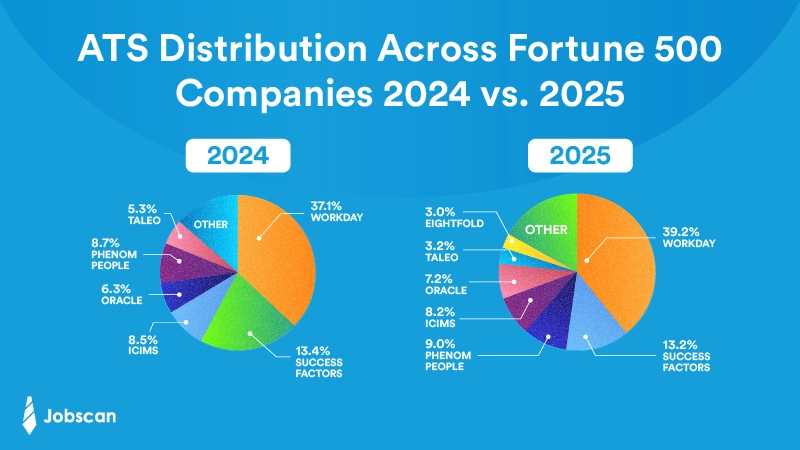
Jobscan’s 2025 ATS Usage infographic shows that 97.8% of Fortune 500 companies use an applicant-tracking system and that Workday is the largest single ATS (~39% of Fortune 500 in 2025). This directly supports the tweet’s point that most Fortune 500 applications are routed through Workday—helping illustrate the scale of applicants who could be affected by Mobley v. Workday.
Source: Jobscan (jobscan.co)
Research Brief
What our analysis found
Derek Mobley, an African American man over 40 with anxiety and depression, applied to more than 100 jobs using Workday's AI-powered hiring platform between 2017 and 2024 and was rejected every time without receiving a single interview. Some rejections arrived as quickly as 55 minutes after submission, with one coming at 1:50 AM — clear indicators of automated screening rather than human review. In February 2023, Mobley filed suit in the U.S. District Court for the Northern District of California, alleging race, age, and disability discrimination under Title VII, Section 1981, the ADEA, and the ADA.
On May 16, 2025, Judge Rita Lin granted preliminary certification of a nationwide ADEA collective action in Mobley et al v. Workday, Inc., encompassing all job applicants aged 40 and over who were denied employment recommendations through Workday's platform since September 24, 2020. Workday's own court filings revealed that its tools rejected approximately 1.1 billion job applications during the relevant period, with the court discussing a potential class size in the hundreds of millions. The case focuses on disparate impact — whether Workday's AI system disproportionately screens out older applicants — after Judge Lin dismissed the intentional discrimination claim.
The ruling's broader significance lies in a July 2024 decision by Judge Lin holding that Workday could be directly liable as an "agent" of employers under federal anti-discrimination law, marking the first time a court treated an AI hiring vendor not as a mere tool but as a legally accountable actor. This precedent arrives alongside a series of 2024 legal defeats for AI-deploying companies: Air Canada was ordered to pay $812 after a tribunal rejected its claim that a hallucinating chatbot was a separate entity; iTutorGroup settled with the EEOC for $365,000 over age-discriminatory algorithms; and Google's Gemini image-generation debacle wiped roughly $90 billion from Alphabet's market cap in a matter of days. Together, these cases signal a rapidly closing window for AI vendors seeking to avoid direct liability.
Fact Check
Evidence from both sides
Supporting Evidence
Preliminary ADEA collective certification confirmed
Multiple legal sources confirm that Judge Rita Lin granted preliminary certification of a nationwide ADEA collective action on May 16, 2025, in Mobley et al v. Workday, Inc., covering applicants aged 40 and over denied recommendations through Workday's platform since September 24, 2020.
1.1 billion rejected applications from Workday's own filings
Court documents and legal reporting confirm that Workday's own submissions to the court stated its tools processed and rejected approximately 1.1 billion applications during the relevant period, with potential class sizes discussed in the hundreds of millions.
Judge Lin's July 2024 "agent" ruling is a first-of-its-kind precedent
On July 12, 2024, Judge Lin ruled that Workday could be held directly liable as an "agent" of employers under Title VII, the ADEA, and the ADA, rejecting Workday's argument that it was merely a software provider. Legal analysts describe this as the first ruling treating an AI hiring vendor as directly accountable under federal anti-discrimination law. The EEOC filed an amicus brief on April 9, 2024, supporting the plaintiff's theory of direct vendor liability.
Air Canada chatbot ruling confirmed
A Canadian small claims tribunal ruled on February 14, 2024, ordering Air Canada to pay $812.02 (C$650.88 plus interest and fees) after its chatbot provided incorrect bereavement fare information. The tribunal explicitly rejected Air Canada's defense that the chatbot was a "separate legal entity" responsible for its own statements.
iTutorGroup EEOC settlement verified
The EEOC settled with iTutorGroup Inc. for $365,000 on September 8, 2023, after the company's recruiting software was programmed to automatically reject female applicants over 55 and male applicants over 60, affecting more than 200 candidates.
Gemini market cap impact confirmed
Google's Gemini AI faced widespread backlash in February 2024 for generating biased and historically inaccurate images, leading to a reported single-day loss of approximately $90 billion in Alphabet's market capitalization and prompting Google to pause the image generation feature.
Contradicting Evidence
"Largest AI lawsuit ever certified" is difficult to independently verify
While Mobley v. Workday is widely described as the largest AI hiring discrimination case to date, confirming it as the "largest AI lawsuit ever certified" across all AI-related litigation globally would require a comprehensive survey that available sources do not provide. The description reflects the case's extraordinary scale but remains a superlative claim without definitive comparative proof.
"Not priced into any of their valuations" is an unsubstantiated market claim
The tweet's assertion that the legal precedent is not reflected in the valuations of HR tech vendors like Greenhouse, Eightfold, HireVue, and Paradox is a financial analysis opinion, not a verified fact. Legal technology analysts have noted that AI vendors are already employing aggressive risk-shifting strategies in their contracts, including liability caps and broad indemnification clauses, suggesting at least some market awareness of growing legal exposure.
"Fortune 500 in the last 7 years" oversimplifies Workday's reach
While Workday serves more than 10,000 organizations globally, including many large enterprises, the claim that any applicant to a Fortune 500 company in the past seven years "probably" had their application processed by Workday is an approximation. Not all Fortune 500 companies use Workday for applicant screening, and competitors like Oracle, SAP SuccessFactors, and others also hold significant market share in enterprise HR technology.
Preliminary certification is not final certification
The May 2025 ruling grants preliminary, not final, certification of the ADEA collective. Workday can still challenge the collective's scope and composition, and the case has not yet reached a merits determination. The legal process remains in its early stages, and courts can decertify collectives if conditions change.
Disparate impact versus intentional discrimination distinction matters
Judge Lin dismissed Mobley's intentional discrimination claim, allowing only the disparate impact theory to proceed. This means the case does not allege that Workday deliberately targeted older workers, but rather that its algorithms produced discriminatory outcomes — an important legal nuance that the tweet does not fully convey.
Report an Issue
Found something wrong with this article? Let us know and we'll look into it.