What makes ChatGPT Images 2.0 a state-of-the-art image generation model? Researchers behind the model explain. A thread: Thinking & Intelligence in ChatGPT Images 2.0, demonstrated by @ayaanzhaque https://t.co/yxFCITwWhd
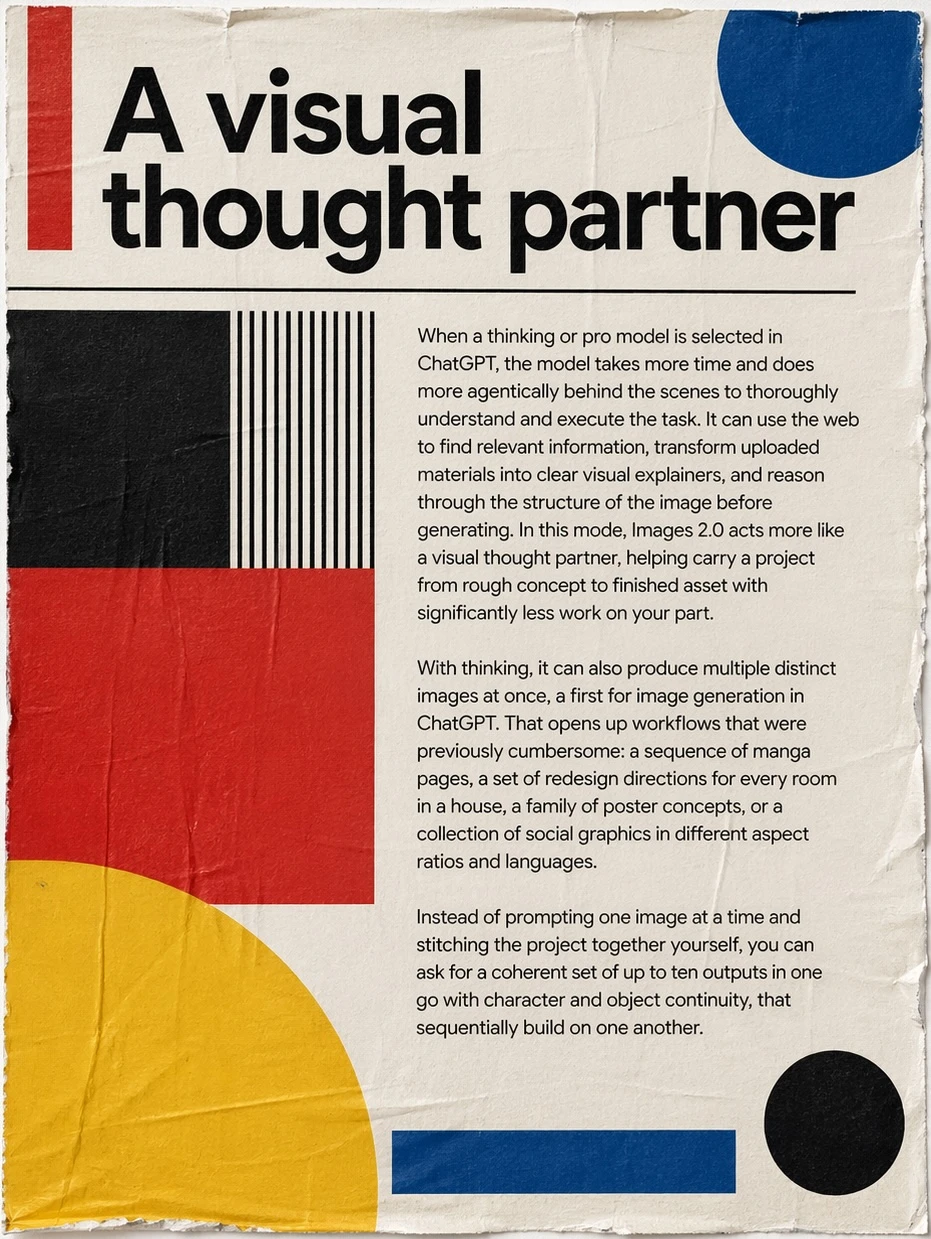
Titled "A visual thought partner," this poster-style infographic explains ChatGPT Images 2.0's "thinking/pro" mode — describing how the model takes extra time to reason, use external information, structure images before generating, and produce multiple coherent outputs. It directly visualizes the "Thinking & Intelligence" capabilities referenced in the tweet, showing how Images 2.0 functions as a visual collaborator for complex image-generation workflows.
Source: OpenAI
Research Brief
What our analysis found
On April 21, 2026, OpenAI publicly launched ChatGPT Images 2.0, a major upgrade to its image generation capabilities integrated directly into ChatGPT. The model, also known by its API identifier gpt-image-2, introduces a suite of new features including a "thinking" mode capable of built-in web search, multi-image generation from a single prompt, and automated self-checking of results. According to OpenAI and confirmed by TechCrunch, the model supports outputs at up to approximately 2K resolution, a significant leap for rendering fine details such as small text, iconography, and UI elements.
OpenAI's product page showcases a broad range of real-world outputs — posters, multi-panel comics, print-ready mockups, and multilingual text samples — while advertising improved control over aspect ratios and professional design guidance. TechCrunch's hands-on review described the model as "surprisingly good at generating text," noting reliable rendering of non-Latin scripts and small UI elements. The model's internal knowledge cutoff is reported to be December 2025. Community blind tests and early A/B comparisons on platforms like LM Arena also indicated clear quality improvements over predecessor models.
However, the launch has not been without caveats. OpenAI declined to disclose the exact model architecture, making the "state-of-the-art" label partly a marketing claim rather than a fully transparent, reproducible benchmark result. Independent users have flagged remaining failure modes including inconsistent image-to-image edits and hallucinated translations. OpenAI's own deployment safety card warns that the model's heightened realism raises the risk of more convincing deepfakes, and the company has documented multilayered safety classifiers applied at the prompt, image, and output stages. Additionally, developers face migration friction as OpenAI moves to deprecate older DALL·E endpoints, with a removal deadline of May 12, 2026.
Fact Check
Evidence from both sides
Supporting Evidence
Official launch with extensive real-world demonstrations
OpenAI's product page for Images 2.0 showcases a wide variety of outputs including design mockups, multilingual text rendering, multi-panel comics, and print-ready assets, explicitly claiming stronger text generation, flexible aspect ratios, and new "thinking" capabilities (OpenAI, April 21, 2026).
Independent hands-on review confirms text quality leap
TechCrunch's Amanda Silberling reported on April 21, 2026 that the model is "surprisingly good at generating text," follows detailed instructions reliably, preserves requested details, and renders small UI and text elements at up to 2K fidelity — a significant improvement over previous models.
Professional production readiness highlighted by press
Axios coverage from the same day emphasized OpenAI's claim that Images 2.0 is suited for professional assets such as advertisements, posters, and mockups, noting that improved text and layout capabilities make the model substantially more practical for real production workflows.
Community blind tests show measurable quality gains
Early A/B testers and participants on the LM Arena leaderboard reported clear quality jumps during April 2026, with users noting more realistic and detail-consistent outputs compared to prior OpenAI image models, consistent with a significant behind-the-scenes upgrade.
New "thinking" mode adds intelligent capabilities
Both OpenAI and TechCrunch confirmed that the model includes built-in web search, multi-image generation from a single prompt, and self-checking of results — features that go beyond traditional image generation and support the claim of a meaningfully advanced system.
Contradicting Evidence
Architecture details withheld, limiting independent verification
OpenAI declined to disclose the exact model architecture or training details in press briefings, meaning the "state-of-the-art" label is partly a marketing claim rather than a fully transparent, reproducible research finding (TechCrunch, April 21, 2026).
Benchmark rankings are mixed and metric-dependent
Community leaderboards including Arena, Artificial Analysis, and third-party trackers show that competing models from Google, Microsoft, FLUX, and others outperform or trade places with OpenAI depending on the specific metric evaluated — photorealism, speed, text legibility, or edit quality — meaning "state-of-the-art" status depends heavily on which dimension is prioritized.
Remaining failure modes documented by users
Independent user reports on Reddit and other forums from April 2026 flagged inconsistent image-to-image edits, hallucinated translations when modifying foreign-language text in comics, and output instability across repeated attempts, demonstrating the model is not uniformly reliable.
Higher realism increases deepfake and misuse risks
OpenAI's own deployment safety card explicitly warns that the model's improved realism enables more convincing deepfakes involving political, sexual, or otherwise sensitive imagery, documenting multilayered safety classifiers as a necessary countermeasure — a significant nuance to the narrative that "better" quality is purely beneficial.
Ecosystem disruption and developer friction
OpenAI is deprecating older DALL·E API endpoints with a May 12, 2026 removal deadline, and community forum posts indicate significant migration friction and mixed developer appetite for switching to the new gpt-image-2 endpoint, showing that model quality improvements come alongside operational complications.
Report an Issue
Found something wrong with this article? Let us know and we'll look into it.