🚨 Let me explain what happened in 2008 because nobody's connecting the dots.. > In 2008 companies started giving out "peanut butter raises." Tiny pay bumps spread thin across everyone so nobody felt special but nobody could complain either.. > Then mass layoffs hit.. 2.6 million jobs gone in a single year... its crazy the raises weren't generosity.. they were the quiet part before the loud part.. Companies were buying time while they figured out who to cut.. > Now Fortune is reporting the exact same pattern is back... Nearly half of companies are doing peanut butter raises again right now.. But here's what's different this time > In 2008 they laid you off and hired someone cheaper... The job still existed... Someone still sat in your chair > In 2026 they lay you off and nobody sits in your chair. The chair is gone... The desk is gone... A $20/month AI subscription is doing what you did and it doesn't need a raise next year either.. > Forbes just reported 93% of US jobs can be partly done by AI.. Same day... Same week companies started freezing pay.. Last time this happened millions of Americans lost their jobs This time the jobs aren't coming back. there's no recovery hire... the job itself stops existing.. AI is eating them all The peanut butter raise is the last nice thing they'll ever do for you. Enjoy it
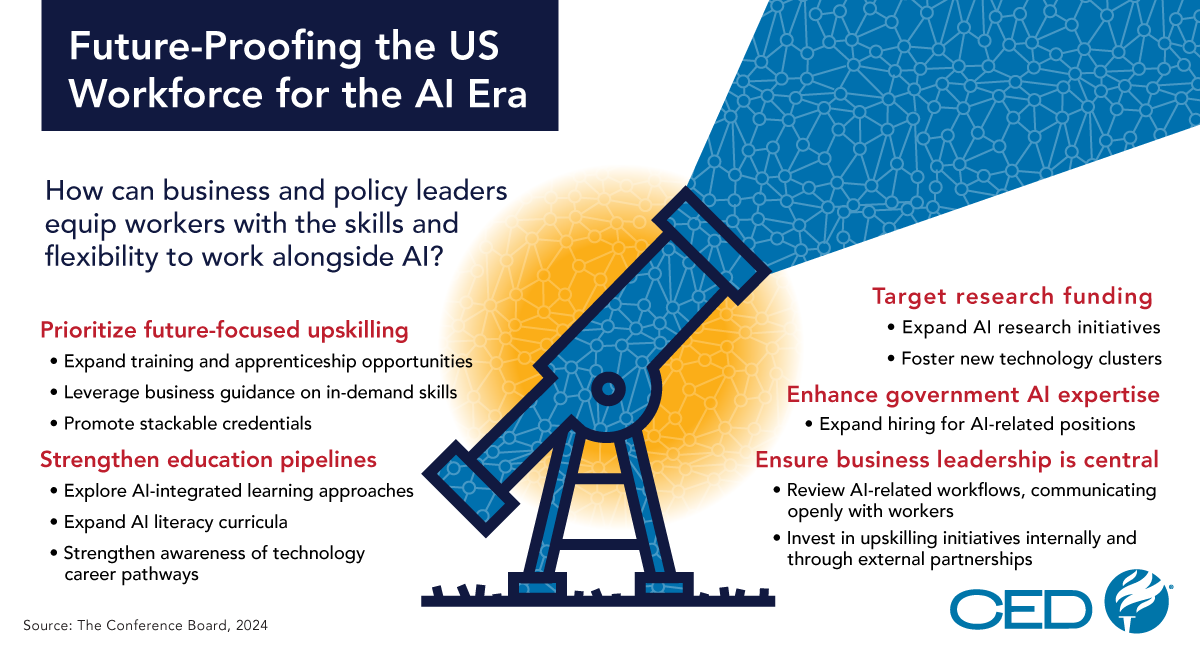
This April 15, 2024 infographic visualizes how AI is reshaping the U.S. workforce—highlighting which occupations and tasks are most exposed and the scale of reskilling needed. It supports the post’s point that, unlike in 2008, many roles are now being automated rather than refilled, explaining why flat 'peanut butter' raises can coincide with job elimination.
Source: The Conference Board
Research Brief
What our analysis found
A viral tweet warning that "peanut butter raises" — small, uniform pay bumps spread across all employees — are a harbinger of mass layoffs is drawing comparisons between today's economy and the 2008 Great Recession, when the U.S. shed 2.6 million jobs in a single year. The claim is anchored in a February 2026 Fortune report showing that roughly 44% of employers plan to use across-the-board pay increases in 2026, with average salary budgets hovering around 3.5% — a pattern compensation experts say mirrors the cost-containment strategies companies deployed just before the 2008 downturn.
The tweet's most alarming assertion — that this time jobs won't come back because AI will absorb them — draws on a Cognizant report, covered by Forbes, estimating that AI can assist with tasks in 93% of U.S. jobs, representing approximately $4.5 trillion in "assistable" work. Meanwhile, Challenger, Gray & Christmas reported that January 2026 layoff announcements hit 108,435, the highest January figure since 2009. However, the tweet conflates task-level AI exposure with wholesale job elimination. The 93% figure refers to partial task assistance, not full replacement, and organizations like the OECD and ILO have found that AI's aggregate employment effects remain limited so far, with augmentation far more common than outright displacement.
Current labor market data also complicates the doomsday framing. Weekly initial jobless claims stood at just 213,000 for the week ending March 7, 2026 — historically low — and February layoff announcements dropped sharply to 48,307. The February 2026 jobs report did show a payroll decline of 92,000 and unemployment ticking up to 4.4%, but average hourly earnings still rose 0.4% month-over-month. Only about 8% of 2026 layoff plans have explicitly cited AI as a factor, suggesting the technology is not yet the primary driver of job cuts the tweet implies.
Fact Check
Evidence from both sides
Supporting Evidence
Peanut butter raises are real and widespread
Fortune reported on February 24, 2026, that roughly 44% of employers plan uniform, across-the-board pay increases in 2026, with average budgets of about 3.5% according to Payscale — echoing the same compensation strategy seen before the 2008 recession.
The 2008 job-loss figure is accurate
Bureau of Labor Statistics and CNN Money data confirm the U.S. lost 2.6 million jobs in 2008, with December 2008 alone shedding 524,000 positions and unemployment reaching 7.2%.
The 93% AI exposure stat has a real source
Cognizant's 2026 report, covered by Forbes on February 25, 2026, does estimate that AI can assist with tasks in 93% of U.S. jobs, accounting for roughly $4.5 trillion in work that could be augmented by the technology.
Early 2026 layoff announcements spiked
Challenger, Gray and Christmas reported 108,435 job-cut announcements in January 2026 — the highest January total since 2009 — lending credibility to concerns about a coming wave of layoffs.
Some major firms have explicitly tied cuts to AI
IBM signaled a hiring pause in back-office roles slated for automation (approximately 7,800 jobs), BT announced up to 10,000 AI-related cuts by 2030, and Klarna reported its AI assistant was handling work equivalent to hundreds of customer service agents.
Contradicting Evidence
The 93% figure describes task exposure, not job elimination
The Cognizant report measures AI's ability to assist with portions of jobs, not replace them entirely. The OECD and ILO have consistently found that AI's aggregate employment impact has been limited, with augmentation far more common than outright displacement.
Current labor data does not resemble a recession
Weekly initial jobless claims were just 213,000 for the week ending March 7, 2026 — historically low — and February layoff announcements dropped sharply to 48,307 after January's spike, suggesting no sustained collapse in employment.
AI is cited in only a small share of layoffs
Through February 2026, AI was explicitly mentioned in roughly 12,304 job-cut announcements, representing about 8% of all layoff plans — meaning more than 90% of announced cuts are driven by other factors.
The "jobs aren't coming back" claim lacks historical support so far
The IMF estimates about 60% of jobs in advanced economies have some AI exposure, but job openings rebounded to approximately 6.95 million in January 2026 after dipping to 6.5 million in December 2025, indicating employers are still actively hiring.
Wages are still growing
The February 2026 jobs report showed average hourly earnings rose 0.4% month-over-month, inconsistent with a scenario in which companies have already stopped investing in their workforce ahead of mass replacement by AI.
Report an Issue
Found something wrong with this article? Let us know and we'll look into it.