本周AI agent领域悄然发生了一个有意思的现象。 DeepMind、Anthropic、Alibaba等顶级实验室的最新论文集体指向同一个方向:智能体不再是简单调用工具的“聊天机器人”,而是正在变成可工程化、可审计、可规模化的真正生产力系统。 先看Agentic Harness Engineering——它把目前最头疼的“智能体支架”从手工调优、试错进化的黑箱,变成了可观测、可证伪的工程闭环。 系统被拆成三层:可版本回滚的组件文件、从百万轨迹token中提炼的结构化经验证据、以及可验证的决策预测。 每一次修改都变成可审计的契约。 结果? Terminal-Bench Pass@1从69.7%提升到77.0%,超越人类设计的Codex-CLI,还节省12% token。 更重要的是,这个框架的优化能跨模型迁移,证明它抓到了结构本质而非特定模型的过拟合。 再看Alibaba的AgenticQwen-30B-A3B—一个只有30B参数的MoE模型,激活参数仅3B,却在真实工具使用任务上接近235B级别的Qwen3表现。 秘诀是两个并行强化学习飞轮:一个从自身失败中挖掘更难的推理问题,另一个用模拟用户不断制造误导场景来进化多分支行为树。 这套方法让开源实验室第一次在极低激活参数下实现了高性能工具使用,成本曲线被彻底改变。 还有RecursiveMAS,它直接挑战了多智能体通信的传统方式:不再让每个agent用文本消息互相喊话,而是通过潜在空间的递归计算传递状态。 结果是token消耗降低34.6%-75.6%,推理速度提升1.2-2.4倍,同时准确率平均提高8.3%。 OneManCompany则把多智能体团队从固定组织图,变成了动态“人才市场”:每个agent都是可招聘的Talent,任务时实时匹配,最优组合,失败后还能自动迭代。 这些论文共同勾勒出一个清晰趋势:agent系统正在从“实验玩具”走向“生产级工程”。 当我们还在讨论模型参数谁更大的时候,真正决定落地胜负的,可能已经是“谁先把智能体工程化”这件事。 你觉得agent工程会成为下一波AI红利的主战场吗?
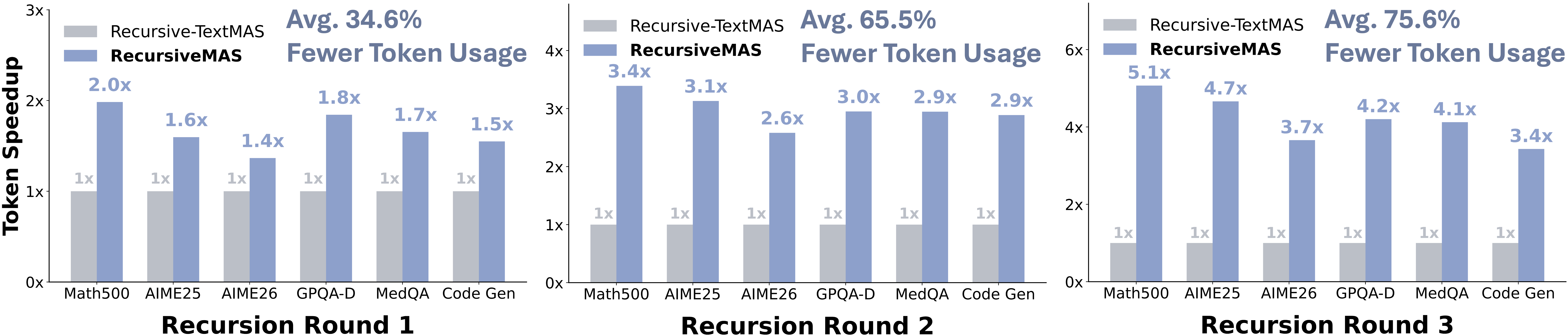
这张来自 RecursiveMAS 项目的网站图表(并列柱状图)展示了在不同递归轮数(r=1,2,3)下,RecursiveMAS 相较于基于文本的多智能体(Recursive-TextMAS)在各基准任务上的 token 使用减少比例(平均从 ~34.6% 到 ~75.6%)并标注了相应的推理速度提升和准确率增益。它直接支持你提到的『通过潜在空间递归通信显著降低 token 消耗、提升推理速度与准确率』这一现象,与推文中关于 RecursiveMAS 的结论高度契合。
Source: RecursiveMAS project (recursivemas.github.io)
Research Brief
What our analysis found
In the final days of April 2026, a striking convergence emerged across top AI laboratories: DeepMind, Anthropic, Alibaba, and others simultaneously published research reframing AI agents not as experimental curiosities but as engineerable, auditable production systems. The standout result came from Agentic Harness Engineering (AHE), which boosted Terminal-Bench Pass@1 scores from 69.7% to 77.0% in just ten iterations — surpassing human-designed harnesses like Codex-CLI (71.9%) — while cutting token usage by 12% on SWE-bench-verified. Crucially, the optimized harness transferred across model families including Deepseek V4 Flash and Qwen 3.6, yielding gains of +5.1 to +10.1 percentage points, evidence that the improvements reflect structural engineering rather than model-specific overfitting.
Alibaba's PAI team contributed AgenticQwen-30B-A3B, a Mixture-of-Experts model with 30.5 billion total parameters but only 3.3 billion activated, which scored 50.2 on real-world tool benchmarks — within striking distance of the vastly larger Qwen3-235B's 52.0. Its dual reinforcement learning flywheels, one mining harder reasoning problems from its own failures and the other simulating adversarial user scenarios to grow multi-branch behavior trees, fundamentally altered the cost-performance curve for agentic tool use. Meanwhile, RecursiveMAS replaced conventional text-message-based multi-agent communication with latent-space recursive computation, reducing token consumption by 34.6% to 75.6%, accelerating inference by 1.2x to 2.4x, and lifting accuracy by an average of 8.3% across nine benchmarks spanning math, science, medicine, and code generation.
Completing the picture, OneManCompany (OMC) reimagined multi-agent team architecture by replacing static organizational charts with a dynamic talent marketplace, where agents are recruited, matched, and iteratively reassembled per task. Together, these papers paint a coherent trajectory: the decisive competitive advantage in AI is shifting from raw model scale toward disciplined agent engineering — observable pipelines, efficient small-model deployment, and communication architectures that minimize waste while maximizing collaborative intelligence.
Fact Check
Evidence from both sides
Supporting Evidence
AHE performance gains are precisely documented
The arXiv paper (published April 29,
confirms that ten AHE iterations raised Terminal-Bench 2 Pass@1 from 69.7% to 77...
confirms that ten AHE iterations raised Terminal-Bench 2 Pass@1 from 69.7% to 77.0%, surpassing Codex-CLI's 71.9%, with a 12% token reduction on SWE-bench-verified — all figures match the tweet's claims.
Cross-model transferability validates structural insight
Ablation studies in the AHE paper show the optimized harness transferred to Deepseek V4 Flash and Qwen 3.6 with +5.1 to +10.1 point gains without re-evolution, supporting the tweet's assertion that AHE captures structural principles rather than model-specific overfitting.
AgenticQwen-30B-A3B approaches 235B-class performance at a fraction of the cost
The Alibaba PAI paper (April 24,
reports a score of 50.2 on TAU-2 and BFCL-V4 benchmarks versus Qwen3-235B's 52.0, with faster end-to-end inference (344.1s vs
449.5s), confirming the tweet's claim about a radically altered cost curve.
Dual data flywheel methodology is accurately described
The paper details an error-driven reasoning flywheel and an agentic flywheel using simulated adversarial users and multi-branch behavior trees, matching the tweet's characterization of two parallel RL flywheels.
RecursiveMAS efficiency and accuracy improvements are verified
The arXiv paper (April 28,
reports 34.6%–75.6% token reduction, 1.2x–2.4x inference speedup, and +8.3% aver...
reports 34.6%–75.6% token reduction, 1.2x–2.4x inference speedup, and +8.3% average accuracy across nine benchmarks, all consistent with the tweet's numbers.
Industry-wide convergence toward agent engineering is real
The simultaneous publication of AHE, AgenticQwen, RecursiveMAS, and OneManCompany within a single week from multiple leading labs provides concrete evidence for the tweet's central thesis about a collective shift toward production-grade agent systems.
Contradicting Evidence
AgenticQwen's context length limitation tempers the efficiency narrative
The Alibaba paper acknowledges that AgenticQwen's native 40K context window poses challenges in deep search tasks, suggesting that the small-model efficiency story has meaningful boundaries the tweet does not mention.
AHE system prompt optimizations did not transfer well
Ablation studies found that evolved system prompts actually regressed performance when transferred to new models, indicating that not all components of the AHE framework are universally structural — a nuance absent from the tweet's presentation.
Benchmark performance may not equal production readiness
All cited results are measured on academic benchmarks (Terminal-Bench, SWE-bench, TAU-2, BFCL-V4); real-world production environments introduce challenges around reliability, safety, and edge cases that benchmark scores do not capture, making the leap from benchmark gains to true production-grade status less certain than the tweet implies.
OneManCompany details are incomplete in available research
The tweet describes OMC's dynamic talent marketplace in specific terms, but the research brief provides limited verifiable detail on OMC's published results and benchmarks, making it harder to independently confirm the scope of its contribution.
The framing overstates consensus by conflating parallel publication with coordinated direction
While multiple labs published agent-engineering papers in the same week, simultaneous publication does not necessarily indicate a unified strategic pivot; it may partly reflect coincidental timing, shared benchmark availability, or publication cycle effects rather than a singular trend.
Report an Issue
Found something wrong with this article? Let us know and we'll look into it.