Um engenheiro do Google acabou de mostrar como substituir sua empresa inteira por agentes de IA Ivan Nardini subiu no palco de um evento da Anthropic e fez o que nenhum CEO tem coragem de dizer em público: Mostrou, passo a passo, como rodar uma empresa onde o único humano é o dono. CEO: 1 humano. Funcionários: agentes de IA. Infraestrutura: Google Cloud. Custo de um "funcionário" 24/7: menos de $60 dólares/mês. Sessenta dólares por mês para um agente que não dorme, não pede aumento, não marca reunião. E não é protótipo. Tudo que ele mostrou já está em produção com preço publicado: → Claude Code Agent Teams: múltiplos agentes trabalhando em paralelo, se coordenando sozinhos com tarefas compartilhadas → Managed Agents da Anthropic: deploy de agentes autônomos por US$ 0,08/hora de runtime. Oito centavos. → Vertex AI Agent Engine do Google: auto-scaling, monitoramento e governança prontos → Agent Development Kit: agentes multi-framework em menos de 100 linhas de código Os números já são brutais. A Stripe colocou Claude Code em 1.370 engenheiros. Uma equipe migrou 10.000 linhas de Scala para Java em 4 dias. A estimativa original era 10 semanas. Dez semanas virou quatro dias. Compressão de 92% do tempo de trabalho. Agora pensa em toda função que envolve processar informação, escrever código, gerar relatório, coordenar tarefa, responder ticket. Cada uma dessas cadeiras está com prazo de validade. O que está acontecendo nos bastidores é maior do que parece: O Google está se posicionando como a AWS dos agentes autônomos. A Anthropic fornece a inteligência. O Google fornece a infra de produção. Quando as duas convergem para o mesmo ponto e publicam a documentação juntas, não é experimento. É aposta declarada. E a aposta é que a empresa média do futuro não tem 50 funcionários. Tem 1 operador e uma frota de agentes. A pergunta deixou de ser "quantas pessoas você tem no time." Passou a ser "quantos agentes você consegue orquestrar."
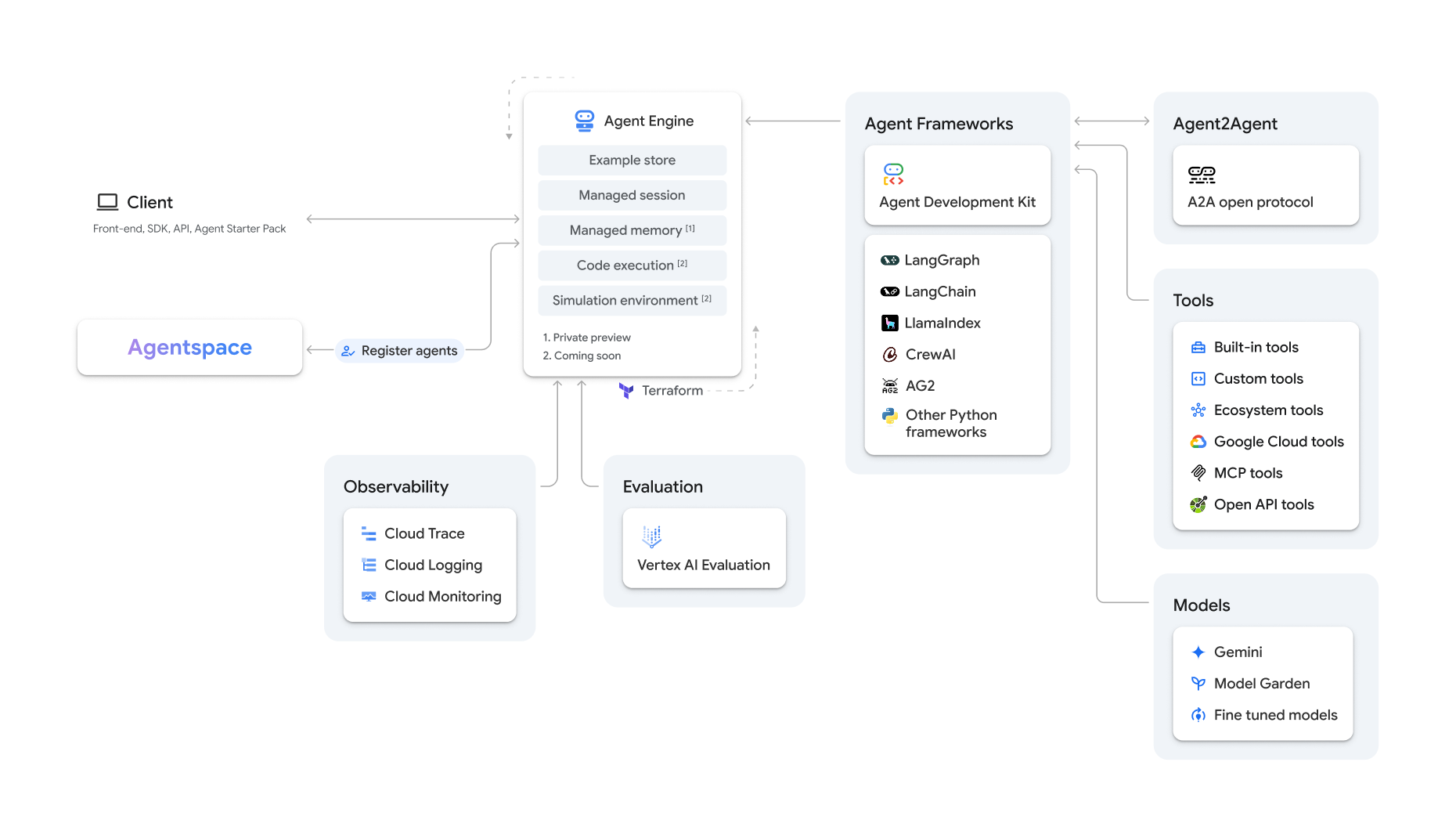
Diagrama arquitetural do Vertex AI Agent Engine mostrando Agent Development Kit (ADK), Agent Engine, Agent2Agent, ferramentas e modelos (incluindo provedores externos). Ilustra exatamente a convergência infraestrutura+agentes — como o Google fornece a plataforma de orquestração e integração que permite executar frotas de agentes autônomos em produção, sustentando a afirmação do tweet.
Source: Google Cloud Blog (cloud.google.com)
Research Brief
What our analysis found
Google Cloud Developer Relations Engineer Ivan Nardini has been demonstrating at joint Anthropic-Google events how to build and deploy AI agent systems capable of running business operations with minimal human involvement. The concept leverages Anthropic's Managed Agents, priced at $0.08 per session-hour of runtime, which translates to roughly $57.60 per month for a 24/7 agent — a figure that excludes token usage and tool-call costs. On the infrastructure side, Google Cloud's Vertex AI Agent Engine provides auto-scaling, monitoring, and governance, while the Agent Development Kit (ADK) enables multi-agent systems in under 100 lines of code. Google Cloud reports its models now process over 16 billion tokens per minute for customers as of April 2026, underscoring the scale of enterprise AI adoption.
The tweet's most striking efficiency claim is well-documented: Stripe deployed Claude Code across 1,370 engineers, and one team migrated 10,000 lines of Scala to Java in just four days — a task originally estimated at ten weeks, representing a 92% compression in work time. This case study has become a flagship example of agentic AI's potential to radically accelerate software development workflows.
However, the vision of a company with one human operator and a fleet of AI agents faces significant real-world friction. A November 2025 McKinsey study found that while roughly 60% of companies experimented with AI agents, fewer than 25% had scaled the technology meaningfully. Gartner estimates over 40% of agentic AI projects will be abandoned within the next two years. Experts consistently stress that human oversight remains essential for critical decision-making, handling exceptions, and managing the well-documented failure modes of autonomous AI systems.
Fact Check
Evidence from both sides
Supporting Evidence
Ivan Nardini's legitimate role and demonstrations
Nardini is a verified Developer Relations Engineer for AI/ML at Google Cloud who has presented at multiple joint Anthropic-Google events, demonstrating agent deployment using Claude on Vertex AI and Google's Agent Development Kit.
Managed Agents pricing confirms the $60/month claim
Anthropic's Managed Agents are priced at $0.08 per session-hour of runtime, which calculates to approximately $57.60 per month for continuous 24/7 operation (720 hours × $0.08), confirming the tweet's claim of under $60 per month for runtime costs alone.
Stripe's code migration efficiency gain is documented
Stripe deployed Claude Code to 1,370 engineers, and a team successfully migrated 10,000 lines of Scala to Java in four days versus an original estimate of ten weeks, confirming the 92% time compression figure cited in the tweet.
Google-Anthropic strategic convergence is real
The two companies have collaborated on joint webinars, documentation, and the adoption of open protocols including Anthropic's Model Context Protocol (MCP, launched November
and Google's Agent2Agent protocol (A2A, launched April 2025), supporting the cla...
and Google's Agent2Agent protocol (A2A, launched April 2025), supporting the claim of a declared strategic bet on agentic AI.
Production-ready infrastructure exists
Google Cloud's Vertex AI Agent Engine, Agent Development Kit, and Anthropic's Claude Code Agent Teams and Managed Agents are all publicly available products with published pricing, confirming these are not prototypes but production systems.
Contradicting Evidence
The $60/month figure is incomplete and misleading
The $57.60 monthly cost covers only runtime hours. It excludes token usage costs (input and output), tool-triggered charges such as web searches at $10 per 1,000 queries, and Vertex AI infrastructure costs based on vCPU and GiB hours, meaning the true operational cost of a functional agent is substantially higher.
Human oversight remains essential, contradicting the one-human company vision
Multiple sources emphasize that AI agents require human intervention for critical decision-making, objective-setting, source verification, exception handling, and establishing guardrails — making a company with literally one human operator impractical for most real-world scenarios.
AI agent failure rates and limitations are well-documented
AI agents exhibit complex hidden failures, struggle with reproducibility, face security vulnerabilities, and can display sycophancy or overconfidence. They require narrowly defined scopes and specific instructions rather than the broad responsibilities implied by replacing entire job functions.
Scaling agentic AI remains a major challenge in practice
A November 2025 McKinsey study found fewer than 25% of the approximately 60% of companies experimenting with AI agents had scaled the technology meaningfully. Gartner estimates over 40% of agentic AI projects will be abandoned within two years, suggesting the fully autonomous enterprise is far from mainstream reality.
Ethical and workforce concerns are significant and unaddressed
The wholesale replacement of human workers raises serious concerns about mass job displacement, workforce reskilling needs, algorithmic bias, and growing economic inequality — factors that regulatory bodies and society at large are unlikely to ignore as this technology scales.
Report an Issue
Found something wrong with this article? Let us know and we'll look into it.