A recent Redfin survey found 67% of Gen Z struggle with housing costs, way higher than 53% of Millennials/Gen X and 36% of Boomers. To manage rising costs, Gen Zers are selling belongings, taking extra jobs, skipping meals, or moving back home. Obviously, this is not the way it should be for young people. My generation hasn't had the runway that older generations did. We entered the workforce during a period of high housing costs, elevated rates, and extreme economic uncertainty. The traditional path to financial stability is broken for a lot of us. This is exactly why I think that access to investing (real, simplified, community-focused) matters more than ever for my generation. We're late to homeownership, late to traditional wealth accumulation, and that means we need other vehicles to build a financial foundation. The stock market has historically been one of the most powerful tools for doing that, and at @dubinvest, we're trying to ensure that tool is actually accessible to everyone, not just the people who already have a financial head start. With dub, we’re not just changing how people invest; we’re giving the younger generation a seat at the table.
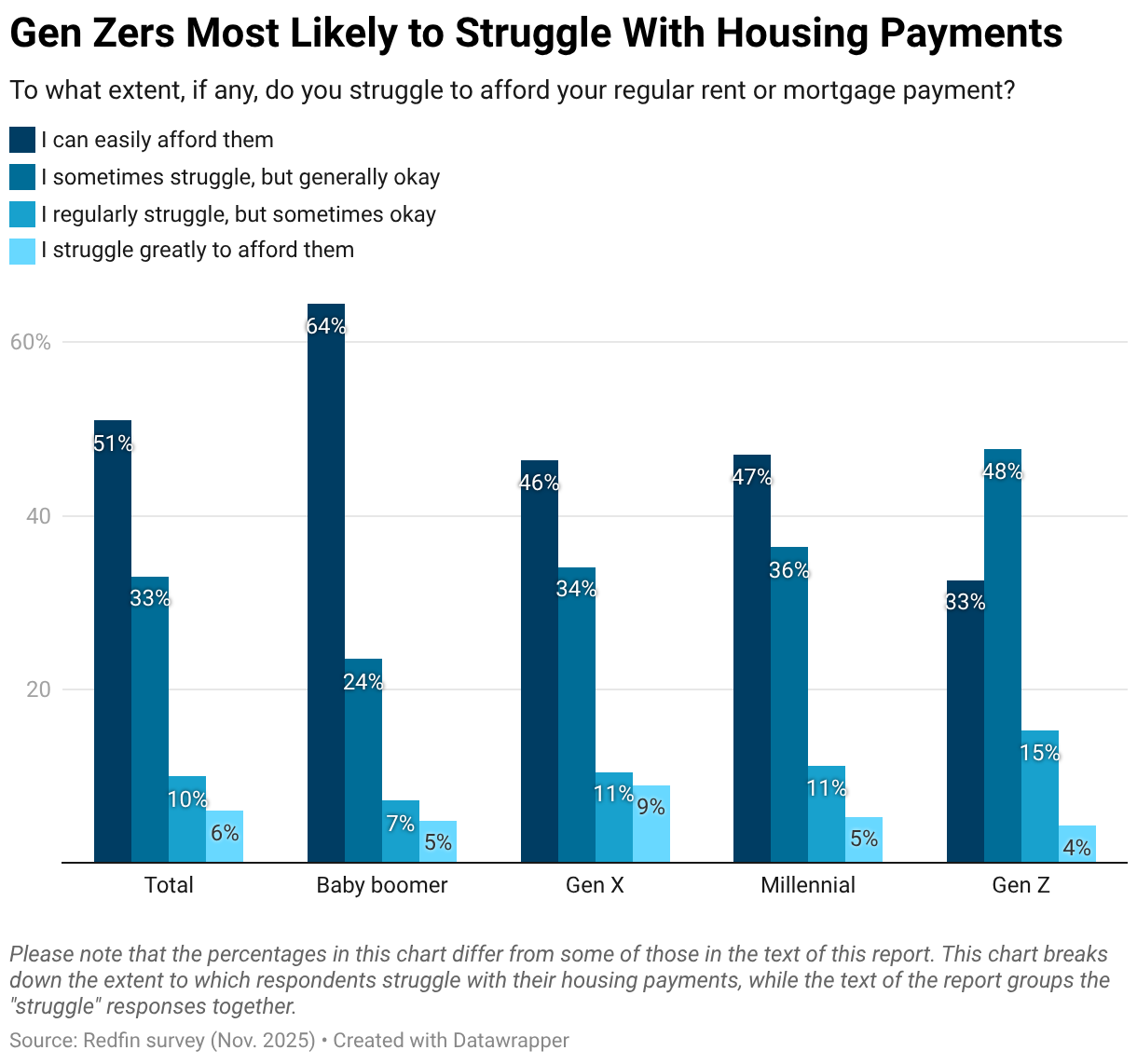
A Datawrapper infographic embedded in a Redfin article titled 'Gen Zers Most Likely to Struggle With Housing Payments' that visually breaks down how different generations report affordability of rent/mortgage — showing a much larger share of Gen Z reporting they struggle (about two-thirds). The same Redfin report also lists Gen Z-specific sacrifices (selling belongings, side hustles, skipping meals, moving back home), so this chart directly supports and illustrates the tweet's claims.
Source: Redfin
Research Brief
What our analysis found
A February 2026 Redfin survey, commissioned through Ipsos and fielded among approximately 4,000 U.S. adults in November 2025, found that 67% of Gen Z respondents reported struggling to afford their regular rent or mortgage payments. That figure significantly outpaces the 53% of millennials, 54% of Gen X, and 36% of baby boomers who said the same, underscoring a sharp generational divide in housing affordability. Nationally, 49% of all U.S. residents reported struggling with housing costs.
The coping strategies Gen Z respondents described are particularly stark. Among those who said they struggle, 20% sold personal belongings, 18% took on a side hustle, 18% skipped meals entirely, and 15% moved back in with parents. An additional 35% cut back on eating out. These findings echo an earlier August 2025 Redfin/Ipsos release that documented similar sacrifice patterns among younger renters throughout the year.
The affordability pressure is rooted in concrete economic conditions. Redfin estimated that buyers needed roughly $111,000 in annual income to afford the typical U.S. home as of late 2025, while Freddie Mac data showed 30-year fixed mortgage rates hovering near 6% in early 2026. Gen Z homeownership stood at just 27.1% in 2025, and the Federal Reserve's Survey of Household Economics and Decisionmaking confirmed that younger adults and lower-income renters face disproportionate rent pressure, with median reported rent reaching approximately $1,200 in 2024.
Fact Check
Evidence from both sides
Supporting Evidence
Redfin/Ipsos survey directly confirms the headline claim
The February 24, 2026 Redfin press release reports that 67% of Gen Z respondents said they struggle to afford rent or mortgage, compared to 53% of millennials, 54% of Gen X, and 36% of boomers, based on an Ipsos survey of approximately 4,000 U.S. adults fielded in November 2025.
Coping strategies are documented in the same survey
Among Gen Z respondents who reported struggling, Redfin found that 20% sold belongings, 18% worked side hustles, 18% skipped meals, 15% moved back home, and 35% reduced eating out, directly supporting the tweet's claims about extreme measures.
Earlier Redfin surveys reinforce the pattern
An August 25, 2025 Redfin/Ipsos release similarly documented that large shares of Gen Z and millennial renters were making significant sacrifices including side hustles, reduced dining, and skipped healthcare, showing the trend persisted across multiple survey waves in 2025.
Federal Reserve SHED data corroborates disproportionate burden on younger adults
The May 2025 Federal Reserve Survey of Household Economics and Decisionmaking, covering 2024 data, documents that younger adults and lower-income renters face more acute rent pressure, consistent with the claim that Gen Z is experiencing outsized housing-cost strain.
Harvard JCHS and HUD research support the structural affordability crisis
Reports from the Harvard Joint Center for Housing Studies and HUD analyses document high renter cost-burden rates that have tightened since 2020, and because younger cohorts disproportionately rent, they are more exposed to these pressures.
Contradicting Evidence
Self-reported "struggle" differs from standard cost-burden metrics
The Redfin survey measures subjective struggle by asking respondents to select among several response options, which is fundamentally different from the HUD and American Community Survey standard of spending more than 30% of income on housing. Self-reported struggle can reflect sentiment, recent financial shocks, or expectations rather than strictly objective cost burdens, making direct comparisons to government data imprecise.
Survey timing and sampling may amplify results
The Redfin/Ipsos survey was fielded in November 2025, a period of elevated home prices and near-6% mortgage rates, which may have heightened respondents' sense of financial strain. Different sampling frames, weighting methods, and question wording used by the Federal Reserve SHED and Census surveys can produce different magnitudes, meaning the 67% figure should not be treated as interchangeable with other housing surveys.
Gen Z homeownership has actually ticked upward
Redfin's own data shows that Gen Z homeownership rose slightly to 27.1% in 2025, and some analyses find that in certain age brackets and local markets, Gen Z ownership rates are not uniformly lower than what prior generations experienced at the same age. This complicates the narrative that Gen Z is universally locked out of housing.
Other surveys report different magnitudes
Non-Redfin surveys using different phrasing and methodologies, such as those from Credit Karma, produce varying estimates of housing strain among young adults. The specific 67% figure is tied to one survey's particular wording and should be contextualized rather than treated as a definitive, universally replicated statistic.
Report an Issue
Found something wrong with this article? Let us know and we'll look into it.