🇺🇸🇮🇷 Oil closed today at $112/barrel. Markets are now dark for 63 hours over Easter. While the markets observe the holidays, wars don't. If things in Iran escalate over the next few days, Monday’s open could be a very sharp adjustment. Source: @KobeissiLetter https://t.co/jWc59igumB
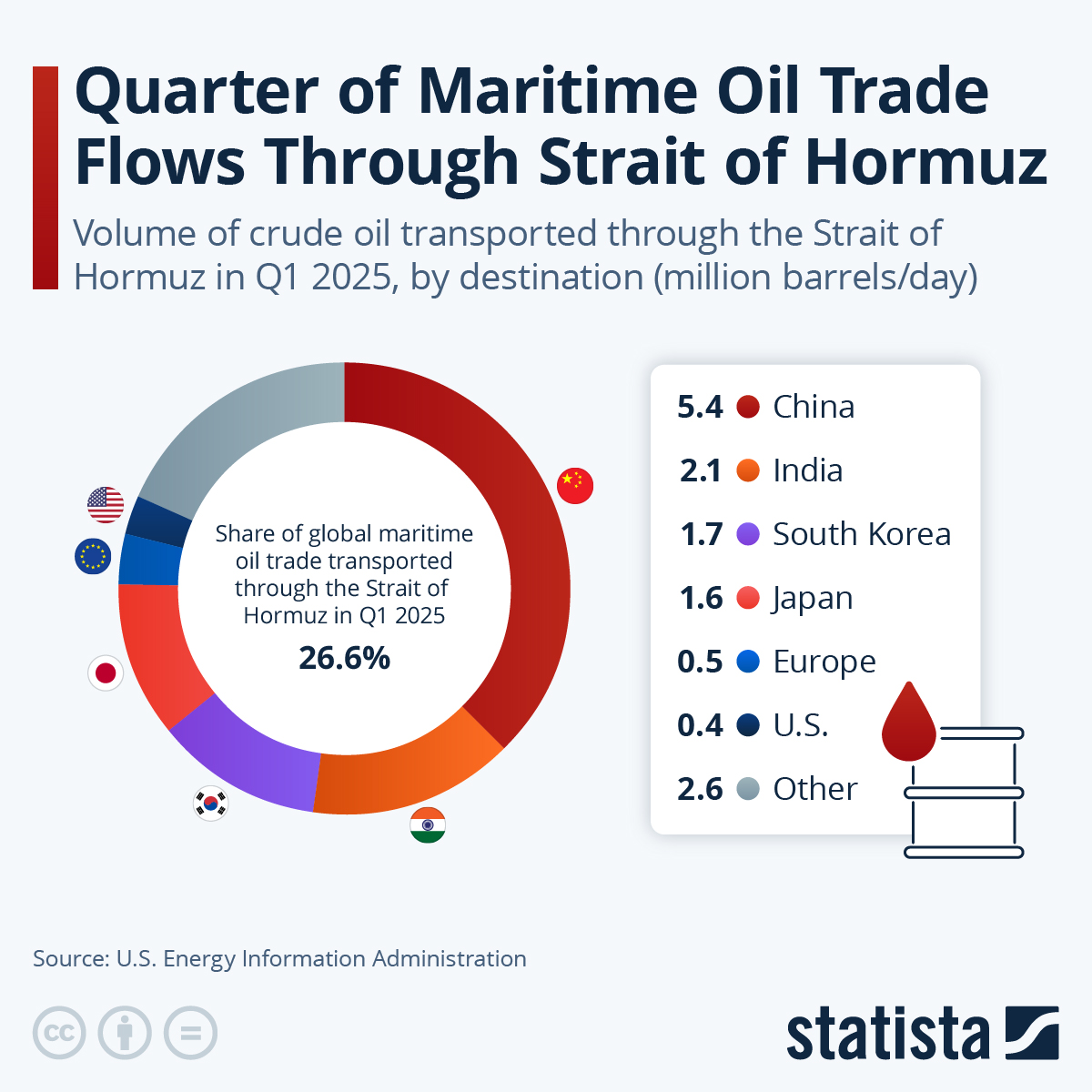
A data-visualization showing maritime crude-oil flows through the Strait of Hormuz (volume by destination, in million barrels per day). It illustrates how a large share of seaborne oil transits this chokepoint—directly supporting the tweet’s point that an escalation involving Iran (and disruptions at Hormuz) could produce a sharp oil-price adjustment when markets reopen.
Source: Statista
Research Brief
What our analysis found
On April 3, 2026, the Kobeissi Letter posted a widely shared warning on X noting that oil had closed at approximately $112 per barrel just as U.S. financial markets were shutting down for the Easter holiday weekend. The tweet cautioned that with tensions between the United States and Iran intensifying, the extended market closure could set the stage for a dramatic price adjustment when trading resumed on Monday, April 6. According to the Associated Press and the Washington Post, U.S. benchmark crude (WTI) surged 11.4% to $111.54 per barrel on Thursday, while Brent crude traded in the range of $109 to $113 during the same week.
The Easter weekend closure is a routine but consequential event for financial markets. The NYSE and NASDAQ observed Good Friday as a full holiday, and SIFMA recommended an early close at 12:00 p.m. ET for U.S. fixed-income trading on April 3. CME Group's published holiday schedule confirmed that many NYMEX and COMEX energy products had no trading on Good Friday, with settlements carried over from April 2. The result was a multi-day window in which large segments of U.S. equity, bond, and commodity markets were effectively offline while geopolitical developments continued to unfold.
The concern was straightforward: wars and diplomatic crises do not pause for holidays. If military action or escalatory rhetoric between the U.S. and Iran materialized over the weekend, traders would have no ability to reposition until Monday morning, potentially triggering a sharp gap-up in oil prices and a volatile open across equity and bond markets. The scenario underscored how the convergence of geopolitical risk and market structure can amplify price dislocations.
Fact Check
Evidence from both sides
Supporting Evidence
Oil price approximately $112 per barrel
The Associated Press and Washington Post reported U.S. benchmark crude (WTI) at $111.54 per barrel on Thursday, April 3, 2026, a figure commonly rounded to $112. Multiple market reports during the week also showed Brent crude trading around or above $112 at various points, corroborating the tweet's headline number.
Markets closed for an extended holiday window
The NYSE and NASDAQ observed Good Friday, April 3, as a full holiday, confirmed by exchange calendars and reporting from Kiplinger. SIFMA issued a formal recommendation for an early close at 12:00 p.m. ET for U.S. fixed-income markets and detailed limited processing at DTCC, FICC, and NSCC during the holiday period.
Commodity futures venues largely offline
CME Group's published 2026 holiday and trading hours show that many NYMEX and COMEX energy products had settlements copied from April 2 to April 3 and had limited or no Friday trading, confirming that key oil futures markets were effectively dark over the weekend.
Geopolitical risk was elevated
Contemporaneous reporting from the Washington Post and Yahoo Finance described rising war uncertainty tied to U.S.-Iran tensions as a primary driver of the week's oil price surge, lending credibility to the tweet's warning that escalation over the weekend could trigger a sharp Monday adjustment.
Contradicting Evidence
The $112 figure lacks benchmark specificity
The tweet states oil closed at $112 per barrel without specifying which crude benchmark or contract month. AP and Washington Post data show WTI settled at $111.54 and Brent at $109.03 on April 3, neither of which is exactly $112. While rounding accounts for most of the discrepancy, the omission of the benchmark makes the claim imprecise in a way that could mislead readers about which market is being referenced.
The 63-hour dark window is difficult to verify
The tweet claims markets are dark for 63 hours, but different markets yield different closure durations. For U.S. cash equities, the gap from Thursday's 4:00 p.m. ET close to Monday's 9:30 a.m. ET open is approximately 89.5 hours. For fixed income using SIFMA's recommended Friday 12:00 p.m. early close to Monday's 9:30 a.m. open, the gap is roughly 69.5 hours. Neither calculation produces exactly 63 hours, and the tweet does not specify which market or timestamp it uses.
Not all markets were fully dark
CME Globex and ICE operate electronic trading platforms that run reduced or partial hours even over holidays. While many NYMEX energy products did not trade on Good Friday, other Globex product lines maintained overnight or abbreviated sessions. Characterizing all markets as uniformly dark overstates the scope of the closure.
International markets operated on different schedules
Many European exchanges also observed Good Friday, but some Asian markets remained open, meaning global price discovery did not entirely cease. Traders with access to international venues or over-the-counter markets could still respond to geopolitical developments, partially mitigating the liquidity void the tweet implies.
Report an Issue
Found something wrong with this article? Let us know and we'll look into it.