Earrings growth in April was expected to be +13%. We are coming in at +28%. Big Tech crushed beyond imagination. If you have a bear case, it can't be earnings. What a month for markets. https://t.co/7eLcqwIV0H
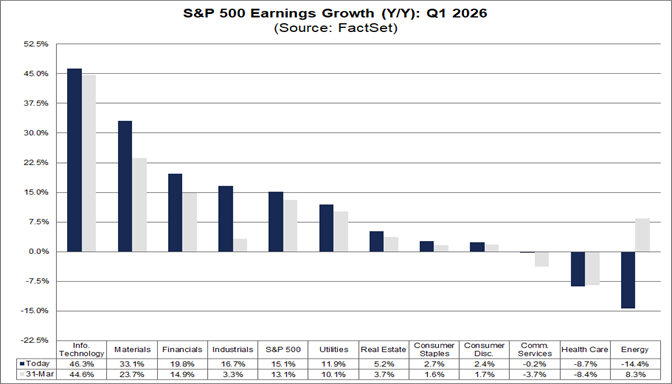
FactSet’s chart “S&P 500 Earnings Growth (Y/Y): Q1 2026” (published April 24, 2026) shows sector-level year-over-year EPS growth — Information Technology is by far the leader (~46%+) and the S&P 500 blended earnings growth rose to ~15.1% from ~13.1%. This visual directly supports the tweet’s point that April earnings (driven by Big Tech) far exceeded expectations and that earnings strength undermines a fundamental bear case.
Source: FactSet (Insight)
Research Brief
What our analysis found
Q1 2026 earnings season has delivered a powerful narrative for Big Tech bulls. The S&P 500's initial earnings growth forecast for the quarter stood at +13.2% year-over-year as of March 31, but by late April — with 28% of companies reporting — the blended growth rate had already climbed to 15.1%. The Information Technology sector is projected to lead all sectors with an estimated 45.0% earnings growth rate, driven by explosive demand for cloud computing and AI infrastructure.
The major hyperscalers posted standout results. Amazon Web Services grew revenue 28% year-over-year to $37.6 billion, its fastest growth in 15 quarters. Google Cloud surged 63% to $20.0 billion, while Microsoft's Azure grew 40% and its Intelligent Cloud segment posted $30.9 billion in revenue, up 28%. Meta Platforms reported total revenue of $56.3 billion, up 33%, and Alphabet's total revenue hit $109.9 billion, up 22% — both exceeding Wall Street estimates.
However, the headline numbers mask important nuances. Alphabet's reported 81% net income surge was significantly inflated by a $36.9 billion unrealized gain on equity securities, while Meta's bottom line benefited from an $8.03 billion tax benefit. Perhaps most critically, the massive capital expenditure commitments required to sustain AI growth — with combined 2026 AI spending across five hyperscalers projected at $650–$700 billion — have spooked some investors, contributing to after-hours stock declines for both Alphabet and Meta despite their earnings beats.
Fact Check
Evidence from both sides
Supporting Evidence
S&P 500 initial forecast aligns with +13% claim
The estimated year-over-year earnings growth rate for the S&P 500 in Q1 2026 was 13.2% as of March 31, 2026, closely matching the tweet's stated expectation of +13%.
AWS revenue growth matches the +28% figure
Amazon Web Services reported 28% year-over-year revenue growth to $37.6 billion in Q1 2026, its fastest growth rate in 15 quarters, directly matching the figure cited in the tweet.
Big Tech broadly exceeded expectations
Amazon, Alphabet, Microsoft, and Meta all reported revenue that surpassed analyst consensus estimates, with Google Cloud growing 63%, Azure growing 40%, and Meta's total revenue rising 33% year-over-year.
IT sector projected to lead S&P 500 earnings
The Information Technology sector is forecast to deliver 45.0% earnings growth for Q1 2026, far outpacing other sectors and reinforcing the claim that Big Tech "crushed" expectations.
Accelerating AI infrastructure cycle supports bullish thesis
Analyst sentiment broadly confirmed an accelerating AI investment cycle, with combined 2026 AI spending across five hyperscalers projected to reach $650–$700 billion, underpinning strong forward revenue expectations.
Contradicting Evidence
The +28% figure is AWS-specific, not a broad market metric
The tweet implies +28% represents overall market earnings growth, but this figure specifically refers to AWS revenue growth. The actual blended S&P 500 earnings growth rate for Q1 2026 was 15.1% — impressive but far below 28%.
Alphabet's net income was inflated by unrealized gains
Alphabet's headline 81% net income increase was dramatically boosted by a $36.9 billion unrealized gain on equity securities, meaning underlying operational profit growth was considerably more modest than the reported figure suggests.
Meta's earnings benefited from a major tax windfall
Meta's reported net income of $26.8 billion included an $8.03 billion tax benefit. Without it, net income would have been approximately $18.7 billion and EPS roughly $7.31 instead of the reported $10.44.
Massive capex commitments rattled investors despite strong earnings
Meta raised its 2026 capital expenditure guidance to $125–$145 billion and Alphabet to $180–$190 billion, triggering stock declines after hours as investors weighed future free cash flow implications against current revenue growth.
Compute constraints are capping potential growth
Both Alphabet and Microsoft disclosed they are currently compute constrained, meaning cloud revenue could have been even higher with more capacity — a bottleneck that introduces uncertainty about whether current growth rates are sustainable or artificially limited.
Report an Issue
Found something wrong with this article? Let us know and we'll look into it.