BREAKING: The S&P 500 erases losses and turns green as US oil prices fall below $93/barrel. https://t.co/RBLEGmUJFX
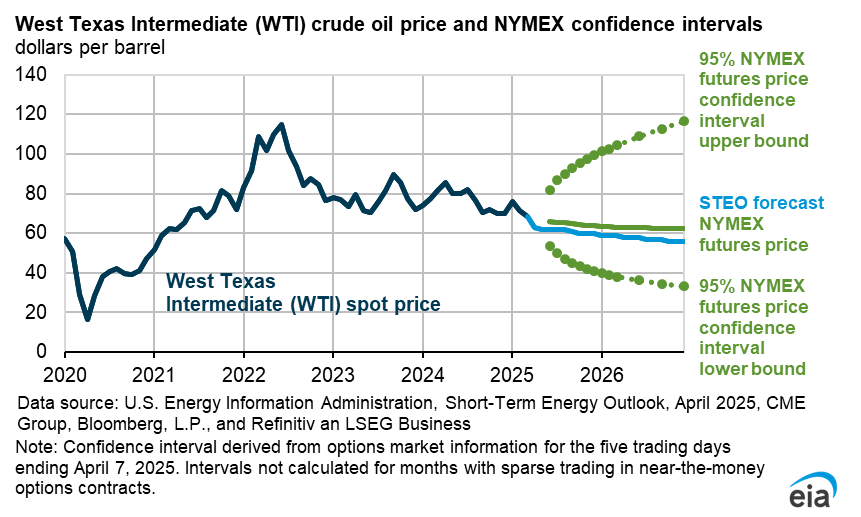
This EIA chart visualizes West Texas Intermediate (WTI) crude’s recent spot price history alongside NYMEX futures and STEO forecasts, with prices in 2025–2026 well below the $90s. It directly illustrates the decline in U.S. oil prices referenced in the tweet, a move that can ease inflation pressures and often coincides with the S&P 500 turning positive.
Source: U.S. Energy Information Administration (EIA)
Research Brief
What our analysis found
In a volatile week for both energy and equity markets, the S&P 500 staged a dramatic intraday reversal on Monday, March 9, 2026, flipping from a loss of as much as 1.5% to a gain of roughly 0.8% near the close as U.S. benchmark crude (WTI) plunged from an intraday spike near $119.48 per barrel back below $90. The whiplash move underscored how tightly equity sentiment had become linked to oil prices amid escalating geopolitical tensions and supply fears.
The following day, Tuesday, March 10, saw WTI trade near $92.20 per barrel — down 6.8% on the session — prompting live market blogs to report that "Wall Street turns green," with the S&P 500 up about 0.3% and the Dow up roughly 0.4% at mid-morning. However, the rally faded: the S&P 500 ultimately closed the day down 0.21% at 6,781.48, illustrating the fragility of oil-driven equity bounces.
By Wednesday, March 11, the International Energy Agency moved toward what was described as the largest coordinated emergency oil reserve release on record, pushing WTI into the mid-$80s to low $90s. Yet U.S. stocks closed mostly lower that day, and on March 12 the S&P 500 fell roughly 0.75% to 1.5% as oil prices rebounded — a reminder that cheaper crude alone was not enough to sustain a durable equity rally in a headline-driven market.
Fact Check
Evidence from both sides
Supporting Evidence
March 9 intraday reversal directly mirrors the tweet's claim
The Associated Press reported that the S&P 500 erased a 1.5% loss and closed up roughly 0.8% on Monday, March 9, as WTI crude collapsed from nearly $119.48 per barrel back below $90 — a textbook example of stocks turning green on falling oil prices (AP via Boston.com).
March 10 mid-session data aligns with the specific price threshold cited
TheStreet's live blog recorded WTI at approximately $92.20 per barrel (down 6.8%) during the Tuesday morning session, while Yahoo Finance UK's live updates noted "Wall Street turns green" with the S&P 500 up about 0.3%, the Dow up 0.4%, and the Nasdaq up 0.6% — matching the tweet's description of the S&P 500 turning positive as oil fell below $93 (TheStreet; Yahoo Finance UK).
Contradicting Evidence
The March 10 equity bounce did not hold into the close
Despite WTI trading near or below $93 per barrel during the session, the S&P 500 finished Tuesday, March 10 down 0.21% at 6,781.48, meaning the "turn green" moment captured in the tweet was a transient intraday snapshot rather than a lasting move (The Motley Fool).
Cheaper oil did not guarantee sustained stock gains later in the week
On March 11, even as WTI dropped to the mid-$80s following IEA reserve-release headlines, U.S. equities closed mostly lower, and on March 12 the S&P 500 fell roughly 0.75% to 1.5% as oil rebounded — demonstrating that the inverse oil-equity relationship was inconsistent and that other factors weighed on stocks (Times of India; Reuters via Investing.com; TheStreet).
Extreme intraday volatility makes point-in-time claims misleading
Oil swung in ranges of more than $30 per barrel within individual sessions during this week, meaning any snapshot of oil below $93 and stocks turning positive could be cherry-picked from a chaotic trading day where both markets reversed direction multiple times.
Report an Issue
Found something wrong with this article? Let us know and we'll look into it.