"The unemployment rate is low. The stock market is high. Consumer spending is healthy. But ask Americans how they’re doing, and you’d think we were in a recession," per WSJ
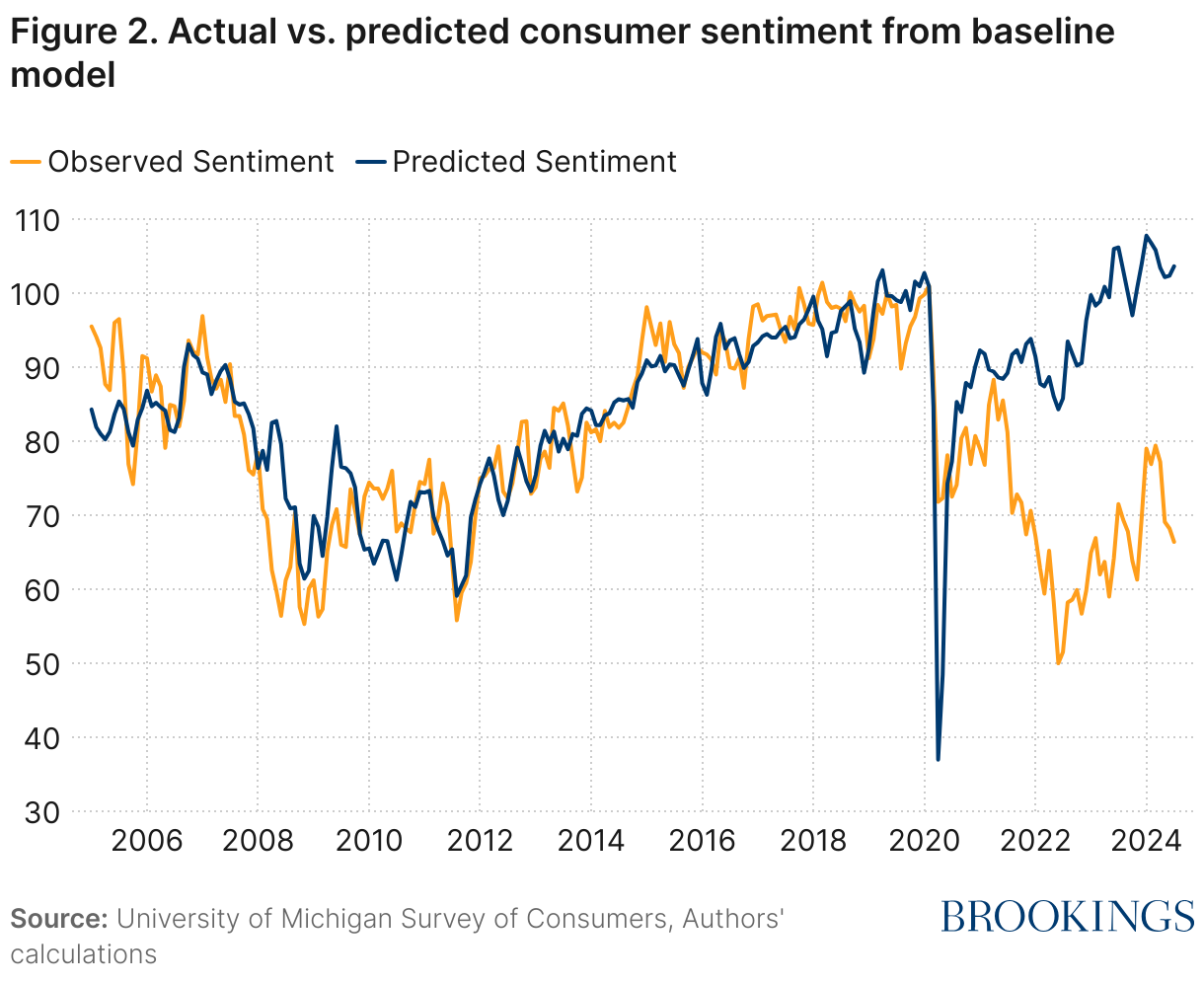
Figure 2 plots observed consumer sentiment (orange) against sentiment predicted from macro variables including unemployment, inflation, consumption and stock-market performance (blue). The chart clearly shows sentiment running well below what the macro indicators would predict—illustrating the disconnect described in the WSJ quote.
Source: Brookings Institution
Research Brief
What our analysis found
The Wall Street Journal captured a paradox that has puzzled economists since at least early 2024: by nearly every traditional measure, the U.S. economy has been performing well, yet Americans consistently report feeling economically distressed. In March 2024, the unemployment rate stood at 3.8%, marking the 26th consecutive month below 4% — the longest such streak in over 50 years. The S&P 500 surged 25% in 2024, reaching 57 new all-time highs, while consumer spending climbed 3.7% in the third quarter of 2024, the strongest pace since early 2023.
Yet public sentiment has told a starkly different story. A September 2024 Upside survey found that 56% of respondents described the economy as "somewhat worse" or "much worse" than a year prior, with only 22% seeing improvement. The Brookings Institution reported that consumer attitudes remained as bleak as they were following the Great Recession, despite robust GDP growth of 3.0% and wages outpacing inflation by 0.9%. A key driver of this disconnect appears to be the lingering psychological weight of inflation: a March 2024 WSJ poll found 74% of voters felt their income had not kept up with rising prices, and a December 2024 McKinsey survey showed 53% of consumers still cited inflation as a top concern.
The paradox has persisted well beyond 2024. By April 2026, the University of Michigan Consumer Sentiment Index plunged to a record low of 49.8, falling below the troughs seen during the 2008-09 financial crisis and the 2022 inflation shock. Meanwhile, long-run inflation expectations climbed to 3.5%, the highest reading since October 2025. Although the unemployment rate edged up to 4.3% by April 2026, it remained historically low — underscoring that the gap between economic data and economic feeling has proven remarkably durable.
Fact Check
Evidence from both sides
Supporting Evidence
Historically low unemployment confirmed
The Bureau of Labor Statistics reported the unemployment rate at 3.8% in March 2024, the 26th consecutive month below 4% — the longest such stretch in over half a century. Even as it rose to 4.1% by September 2024, it remained well below the 21st-century average of 5.7%.
Stock market posted exceptional gains
The S&P 500 gained 25% in 2024 with 57 new all-time highs, while the Nasdaq Composite rose 29.6%, driven largely by the "Magnificent Seven" tech stocks. Between Q1 2020 and Q2 2024, stock market gains contributed to a $50 trillion expansion in household wealth.
Consumer spending remained robust
Consumer spending increased 3.7% in Q3 2024, the strongest pace since early 2023, and average annual consumer expenditures rose to $78,535 in 2024 from $77,158 in 2023.
Sentiment deeply negative despite strong data
The Brookings Institution found in October 2024 that consumer attitudes were "divorced from the underlying economic conditions," with sentiment comparable to post-Great Recession levels despite strong GDP growth, low unemployment, and rising wages. A September 2024 Upside survey showed 56% of respondents viewed the economy as worse, consistent across demographic groups.
Inflation overhang drives pessimism
A December 2024 McKinsey survey found 53% of consumers still cited rising prices as a concern, and a March 2024 WSJ poll showed 74% of voters felt their income lagged behind inflation — supporting the claim that Americans feel economically distressed despite headline numbers suggesting otherwise.
Contradicting Evidence
Sentiment briefly improved in late 2024
In December 2024, consumer optimism reached its highest level since before the COVID-19 pandemic, likely driven by encouraging economic data and the stock market rally, suggesting the disconnect is not permanent and may respond to policy signals such as the Fed's September 2024 rate cut.
Income gains are real for some groups
Median household income reached $83,730 in 2024, and wages outpaced inflation by 0.9% according to Brookings, meaning the pessimism may partly reflect perception rather than current economic reality for many workers.
Spending behavior contradicts stated gloom
Despite reporting low confidence, Americans continued spending at healthy rates — consumer expenditures rose in 2024 and food-away-from-home spending reached $2.58 trillion, suggesting that actual economic behavior diverges from the pessimism consumers express in surveys.
The paradox may reflect real inequality, not just perception
The stock market's $50 trillion wealth expansion disproportionately benefited the wealthiest 10% of households, while Black households saw a 3.3% decline in median income between 2023 and 2024 and 48% of consumers said incomes were not keeping pace with inflation. This suggests that headline economic indicators may genuinely fail to capture the economic experience of a large share of Americans, complicating the framing as purely a sentiment disconnect.
By 2026, economic conditions had measurably softened
The unemployment rate rose to 4.3% by April 2026, the University of Michigan Consumer Sentiment Index hit a record low of 49.8, and long-run inflation expectations climbed to 3.5%, indicating that the negative sentiment may have become increasingly justified by deteriorating conditions rather than being purely paradoxical.
Report an Issue
Found something wrong with this article? Let us know and we'll look into it.